How to Turn Fan Art into Custom Pins Legally
A complete guide for creators, collectors, and small business owners who want to sell enamel pins inspired by their favourite fandoms — without crossing copyright boundaries.
Fan art enamel pins are everywhere — from anime conventions to Kickstarter launches and independent online shops. They’re a powerful way to celebrate the characters and worlds you love. But for creators hoping to turn that passion into a business, the legal landscape can be confusing and even dangerous to navigate without the right information.
This comprehensive guide explains exactly how to create and sell custom enamel pins inspired by your favourite fandoms without crossing legal boundaries — covering copyright basics, four proven strategies for staying compliant, and practical steps to launch a sustainable pin business.
Turning Passion into Product
Creating custom pins based on beloved characters, movies, or games can be both creatively fulfilling and commercially rewarding. The global enamel pin market has grown rapidly alongside fandom culture, with artists earning significant income from pin drops, convention tables, and online shops.
However, the intersection of fan art and copyright law is complex, and misunderstanding the rules can lead to rejected production orders, platform takedowns, or even direct legal action from IP holders.
⚠️ Critical Understanding: “I drew it myself” does not equal legal ownership. Even if you create entirely original artwork, the underlying character design and intellectual property rights typically belong to the copyright holder — not you.
This guide provides a detailed roadmap for navigating these legal waters, exploring what you can and cannot do, and offering practical strategies for designing pins that celebrate fandoms while fully respecting intellectual property rights.
Why This Matters More Than Ever
Enforcement of fan art merchandise has intensified significantly. Major IP holders — from Nintendo and Disney to anime studios and sports leagues — now employ dedicated IP enforcement teams and automated monitoring systems that scan platforms like Etsy, Shopify, Kickstarter, Instagram, and TikTok around the clock. Even small creators with modest followings have received cease-and-desist letters and faced platform bans.
Getting informed before you launch protects your creative work, your finances, and your reputation as a maker.
What Is Fan Art (From a Legal Perspective)?
Fan art is artwork created by fans based on existing copyrighted characters, worlds, or intellectual property (IP). From a legal standpoint, it doesn’t matter how skilled, original-looking, or lovingly crafted the artwork is — if it depicts a protected character or element, it involves someone else’s IP.
Fan art in the pin world typically includes:
- Anime & manga characters — From popular series like Naruto, Dragon Ball, Demon Slayer, or Studio Ghibli films
- Video game characters — Icons from franchises like Pokémon, Super Mario, The Legend of Zelda, or Final Fantasy
- Movie & TV characters — Figures from Marvel, Star Wars, Disney, or popular streaming series
- Comics, mascots, or brand logos — Recognisable symbols from established intellectual properties
- Sports teams and league logos — Trademarked uniforms, mascots, and branding from the NFL, NBA, EPL, and similar organisations
- Musician imagery — Stylised portraits, iconic symbols, or phrases closely associated with artists
Key Legal Concept: Copyright law protects the expression of ideas, not the ideas themselves. This means that while you cannot copy a specific character’s design, you can create original artwork inspired by similar themes, styles, or concepts — as long as you avoid the protected specific expression.
Copyright vs Trademark: What’s the Difference?
These are two separate legal protections that often overlap in the fan art world:
- Copyright protects original creative works — including character designs, illustrations, and artwork — automatically from the moment of creation. No registration required.
- Trademark protects brand identifiers — names, logos, slogans — that distinguish goods or services in the marketplace. Using “Pokémon” or “Disney” in a product title, even on an original design, can infringe trademark.
Understanding both layers is essential when designing and marketing your pins.
Can You Make Fan Art Pins for Personal Use?
✅ Generally Allowed (Low Risk)
You can usually create fan art pins for personal enjoyment without significant legal risk, provided you meet all of the following conditions:
- ✓ Strictly for personal use — not sold, traded, gifted commercially, or distributed in any form
- ✓ No commercial promotion — not advertised, listed online, or displayed in a commercial context (even for free)
- ✓ Very small quantities — typically 1–5 pins for your own personal collection
- ✓ No wide public display — wearing at conventions is generally fine; selling, tabling, or displaying at a market is not
Example: Creating 2–3 pins of your favourite anime character to attach to your backpack or display on a personal pin board at home is generally low risk.
Important Note: Even personal use is technically a copyright infringement under the strict letter of the law. Copyright holders rarely enforce against purely personal, non-commercial activities — but the risk increases substantially the moment any distribution, sale, or commercial activity enters the picture. Posting photos of your personal pins publicly on social media with purchasing intent also creates risk.
Selling Fan Art Pins: What Changes?
Once you sell, crowdfund, or even publicly promote fan art pins, your activity shifts from personal to commercial — and copyright and trademark rules apply with full force. Most intellectual property owners:
- ✗ Do NOT allow unlicensed merchandise — this applies to small-scale “fan art” sales just as much as mass production
- ✗ Actively monitor online platforms — Etsy, Shopify, Kickstarter, Instagram, TikTok, and Facebook Marketplace are regularly scanned using automated IP detection tools
- ✗ Issue takedowns and legal notices — often starting with platform listing removals, then progressing to account suspension or legal action
- ✗ Protect their trademarks aggressively — character names, logos, and distinctive design elements are legally protected separately from the artwork itself
This is why fan art pin projects frequently run into problems. Here is a summary of common scenarios:
| Common Issue | Typical Consequence | Platform Response |
|---|---|---|
| Unlicensed character pins on Etsy | Product listing removal, shop suspension, withheld funds | DMCA takedown notice, possible permanent account termination |
| Crowdfunding licensed IP without permission | Campaign cancellation, funds withheld pending review | Kickstarter/Indiegogo policy enforcement and removal |
| Using trademarked names in product titles | Search de-optimisation, listing removal, sponsored ad bans | Automated content ID systems, manual review |
| Instagram promotion of unlicensed merch | Post removal, account restrictions, shadowbanning | Copyright holder direct reporting or automated detection |
| Selling at conventions without a licence | Merchandise confiscation, ejection from event | Convention organisers increasingly enforcing IP policies on-site |
| Manufacturing with a licensed design file found online | Factory may refuse order; if produced, liability remains with seller | No platform recourse — seller bears full legal responsibility |
Platform Reality: Online marketplaces enforce IP rules unevenly — but when enforcement happens, it is often swift and without warning. A single takedown can jeopardise your entire shop, payment processor account, and reputation built over years. It’s not worth the risk when legal alternatives exist.
4 Legal Ways to Turn Fan Art into Custom Pins
There are four proven strategies for creating pins inspired by fandoms while staying on the right side of copyright and trademark law. Most successful pin businesses use a combination of these approaches.
1️⃣ Get an Official Licence (Safest Option)
Licensing means receiving written permission from the IP owner to create and sell merchandise featuring their characters or designs.
Common licensors include:
- Major game studios (Nintendo, Blizzard, Bandai Namco)
- Anime production companies and manga publishers
- Comic publishers (Marvel, DC, Image Comics)
- Sports leagues and teams (via official licensing programmes)
- Independent creators open to licensing
Pros: Fully legal, scalable, builds customer trust, can be marketed openly
Cons: Often expensive; may require minimum order guarantees, royalty payments, and advance fees
Best for: Established brands or well-funded projects with proven sales history
2️⃣ Collaborate With Indie IP Owners or Artists
Many independent artists, webcomic creators, indie game developers, and Webtoon authors are far more accessible than large corporations — and are often enthusiastic about collaborations.
Approaches that work:
- Revenue sharing agreements (e.g., 20–30% to the original artist)
- Royalty payments per pin sold
- Direct artwork licensing with a one-time or recurring fee
- Collaborative design partnerships with mutual promotion
💡 Pro Tip: Always use a simple written agreement, even for small projects. Clearly define territory, duration, exclusivity, and sales reporting. This protects both parties and prevents misunderstandings later.
Best for: Beginners and creators wanting to build long-term relationships and a curated catalogue
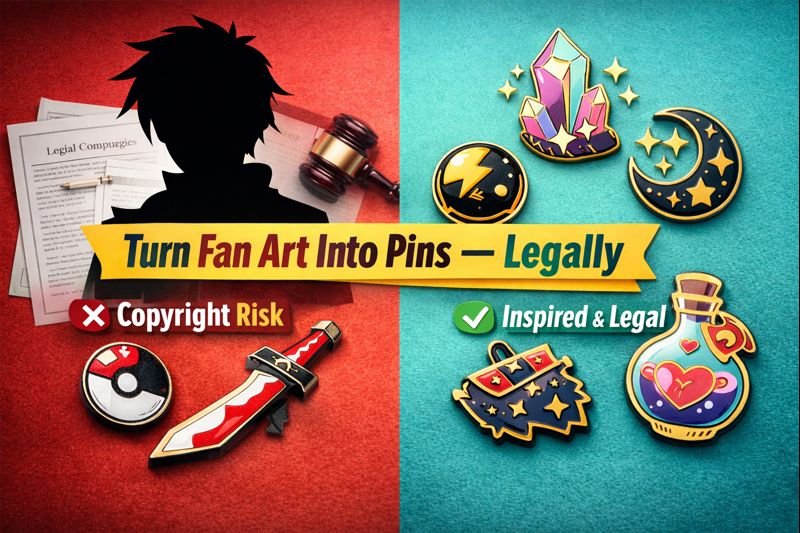
3️⃣ Create “Inspired-By” Designs (Most Popular Legal Approach)
Instead of copying characters directly, design pins that evoke the spirit or aesthetic of a fandom without using any protected elements. This is the most common path for indie pin makers.
Safe elements to use:
- Colour palettes that evoke a character’s vibe (without the character)
- Symbolic items — weapons, accessories, recurring objects
- Original typography inspired by the world’s aesthetic
- Abstract interpretations of themes and moods
- Flora, fauna, or scenery associated with the fictional world
Example Transformation:
- ❌ A pin showing a specific named anime character’s face
- ✅ A pin showing a distinctive sword, flower, or moon symbol strongly associated with that anime’s themes
Best for: All creators — especially those starting out with limited budgets
4️⃣ Create Original Characters for Fandom Audiences
Design completely original characters that appeal to specific fandom interests without referencing any protected IP. This is the highest-ceiling approach for long-term business building.
Effective approaches:
- Original fantasy characters designed for RPG and D&D fans
- Cyberpunk-inspired original designs for sci-fi enthusiasts
- Magical creatures and familiars for fantasy lovers
- Cute chibi-style animals with thematic accessories
- Original “fandom-adjacent” mascots and OC (original character) designs
Key benefits:
- Builds your own brand identity and fanbase
- Complete creative freedom with no external approval needed
- Zero copyright or trademark risk
- Potential to expand into stickers, prints, apparel, and more
- Your designs can themselves become IP others want to license
Best for: Long-term brand builders and illustrators wanting full ownership
Step-by-Step: Launching a Legal Pin Business
Whether you’re starting from scratch or pivoting an existing fan art business, this process will help you build a legally sound pin operation from day one.
- Audit your existing designs Review everything you plan to sell. For each design, ask: does this directly copy or depict a copyrighted character, logo, or protected element? If yes, set it aside for transformation or replacement.
- Choose your legal strategy Decide whether you’ll pursue official licensing, indie collaborations, inspired-by designs, or original characters — or a mixture of all four. Your choice will shape your design process and marketing.
- Transform or create your designs Work with an illustrator (or do it yourself) to either transform existing fan art into inspired-by designs or create wholly original artwork. Focus on making your style distinctive and recognisable as yours.
- Request a design review before production Have your pin manufacturer review the artwork before placing your order. Reputable manufacturers will flag copyright concerns. At CreatePins.com, this design review service is part of our standard production process.
- Choose your sales channels carefully Different platforms have different risk profiles. Your own website (via Shopify, WooCommerce, or Squarespace) gives you more control. Marketplaces like Etsy offer reach but carry more enforcement risk.
- Write safe product descriptions and titles Avoid using trademarked names, character names, franchise titles, or phrases that could trigger automated IP detection. Use descriptive, original language about your design’s aesthetic and themes.
- Keep records of your design process Document sketches, mood boards, and design decisions that demonstrate your work is original or transformed. This paper trail is invaluable if you ever need to defend your designs.
- Consider consulting an IP attorney for larger projects If you’re planning a significant investment — large orders, crowdfunding, or official collaboration — an hour with an intellectual property lawyer is money well spent.
Common Fan Art Pin Mistakes to Avoid
Many creators stumble into serious legal trouble by making these common errors. Understanding them in advance protects your business and your creative work.
- ❌ “Everyone else is doing it” — This is not a legal defence and never has been. The fact that infringement is common on certain platforms doesn’t make it legal or reduce your personal liability.
- ❌ Slightly altering a design — Changing hair colour, adding sunglasses, or other minor modifications does not make a derivative work “original” under copyright law. The underlying protected elements are still present.
- ❌ Using copyrighted names in product titles or tags — Even if your design is entirely original, using “Pokémon-inspired,” “Harry Potter style,” or similar phrases in your product title can trigger trademark issues and automatic listing removal.
- ❌ Assuming conventions are safe havens — Many conventions have become significantly stricter about unlicensed merchandise at artist alley tables. Copyright holders increasingly send representatives to events, and table bans are common.
- ❌ Relying on “fair use” without understanding it — Fair use is a complex legal defence with specific criteria that rarely applies to commercial merchandise. “I changed it enough” is not a fair use argument.
- ❌ Thinking a manufacturer’s acceptance means legal clearance — Some factories will produce any file you send them. Their willingness to manufacture does not mean the design is legal to sell. The legal responsibility lies entirely with you, the seller.
- ❌ Ignoring the trademark layer — A design might avoid copyright issues but still infringe on trademark rights if it uses a protected name, logo, or distinctive branding element as part of the design or product description.
- ❌ Posting “coming soon” content featuring copyrighted characters — Promoting planned but not yet available unlicensed fan art merchandise on social media can trigger takedowns before you’ve even placed your production order.
Note on Enforcement Patterns: IP enforcement is not evenly applied, and small sellers sometimes operate without issue for months or years. However, enforcement actions — when they come — are often simultaneous across all platforms and can be devastating. Building your business on a legally sound foundation from the start is far less risky than rebuilding after a takedown.
How to Transform Fan Art into a Legal Pin Design
Transforming an existing fan art concept into a legally safer “inspired-by” design is both a creative skill and a practical business necessity. Here is a practical framework for making that transformation effectively.
The Four-Filter Method
Before finalising any pin design intended for sale, run it through these four filters:
Filter 1 — Character Recognition Test: Would someone familiar with the original IP immediately identify a specific named character from your design? If yes, the design is too close.
Filter 2 — Logo and Name Test: Does your design incorporate any portion of a registered trademark, character name, franchise title, or brand logo? If yes, remove or replace those elements.
Filter 3 — Side-by-Side Comparison: If you placed your design next to the original character, would a consumer believe they were related products? If yes, the design needs further transformation.
Filter 4 — Marketing Language Check: Does your product description, title, or tag reference any trademarked name or franchise? If yes, rewrite using descriptive, original language only.
Transformation Techniques That Work
- Symbol substitution — Replace the character with an object, symbol, or accessory that is strongly associated with the story but not itself protected (e.g., a specific type of hat, a distinctive weapon shape, a recurring flower)
- Silhouette abstraction — Convert a character silhouette into a highly stylised, abstract form that captures the mood without depicting a specific character
- Theme extraction — Identify the emotional or thematic core of a fandom (adventure, magic, friendship, chaos) and design around that idea rather than any specific protected element
- World-building elements — Use architectural details, flora, fauna, or environmental features from a fictional world that are not in themselves directly protected by copyright
- Colour and style homage — Adopt a colour palette or visual style associated with a world or genre without copying any specific artwork
✅ A Note on Style: Copyright does not protect artistic style. You are legally free to work in a style similar to a popular artist or franchise, as long as you do not reproduce specific protected artwork, characters, or logos. Style is inspiration; copying specific protected expression is infringement.
How CreatePins.com Helps With Legal-Friendly Designs
At CreatePins.com, we don’t just manufacture pins — we help creators build sustainable, legally sound businesses. Our team has worked with hundreds of pin makers at every stage, from first-time makers to full-time professional designers.
Our comprehensive creator support includes:
🔍 Design Review Service
We evaluate your artwork for potential copyright and trademark risks before production begins — identifying elements that may be problematic and suggesting specific adjustments.
🎨 Design Transformation
Our in-house artists can help adjust artwork from direct fan art to inspired-by designs that maintain the spirit and appeal of your concept while avoiding infringement.
📏 Production Optimisation
We ensure designs are manufacturable with clean lines, proper spacing, and precise colour separation — so the pin you receive matches the design you approved.
📝 Branding Guidance
Advice on back stamps, polybag packaging, and presentation that builds your unique brand identity and adds perceived value to your products.
💬 Pre-Production Consultation
Free consultation calls for first-time makers and larger orders, covering design, finish selection, quantity, timelines, and legal considerations specific to your project.
📦 Small Batch & Sample Options
Low minimum order quantities and sample runs so you can test new designs — including new legal approaches — before committing to full production.
Our goal is to help you create pins that are:
- ✓ Beautiful — visually appealing, well-crafted, and true to your artistic vision
- ✓ Manufacturable — optimised for production quality with no technical issues
- ✓ Safe to sell — designed to minimise legal risk and support long-term business growth
Ready to Create Legal Fan Art Pins?
Fan art is a powerful creative gateway — but turning it into a sustainable business requires careful navigation of intellectual property laws. Whether you’re just starting out or looking to expand your pin business legally, our team is here to help every step of the way.
Get a free design consultation and learn how to transform your fan art ideas into legally-safe, beautiful custom pins.
FAQ: Fan Art & Custom Pins
These are the questions we hear most often from creators considering their first pin run. Click any question to expand the answer.
- Is fan art inherently illegal?
Not inherently — fan art exists in a legal grey area. Creating fan art for personal enjoyment is rarely enforced against by IP holders. However, selling, publicly distributing, or commercially promoting unlicensed fan art is typically copyright infringement. The moment money changes hands or promotion occurs, the rules change significantly.
- Can I sell fan art pins if I credit the original creator?
No. Crediting the original creator does not replace obtaining permission. While giving credit is an ethical practice and shows respect for the original work, attribution does not provide legal protection against copyright infringement claims. You must obtain a licence or create original inspired-by designs to sell fan art legally.
- What about “parody” or “satire” protections for fan art?
Parody has a specific legal definition — it must comment on or criticise the original work itself. Simply making a cute or funny version of an existing character does not automatically qualify as protected parody. Courts assess parody cases individually, and the burden of proof falls on the creator. This is not a reliable legal defence for commercial merchandise, and attempting to claim it without proper legal advice is very risky.
- Will manufacturers refuse to produce copyrighted fan art designs?
Reputable manufacturers will often flag obviously copyrighted designs and may refuse to produce them. However, some factories accept any artwork submitted regardless of copyright. Important to note: the manufacturer’s willingness to produce the pins does not transfer legal responsibility to them. The legal liability ultimately falls on you as the seller — not the factory. Always clarify this before ordering.
- How do I know if my pin design is too close to an existing copyright?
Apply this simple test: would someone familiar with the original IP immediately recognise a specific character, logo, or protected element in your design? If yes, it is likely too close. Also check: would a consumer reasonably believe the product is an officially licensed item? When in doubt, consult with a legal professional experienced in intellectual property, or request a design review from your pin manufacturer before placing an order.
- Is it legal to sell fan art pins at conventions?
Selling unlicensed fan art pins at conventions is not legal — even if the convention allows it. Many conventions have historically permitted it informally, but enforcement has increased significantly. Copyright holders send representatives to major events, and sellers have had merchandise confiscated and tables banned. Additionally, some conventions now require proof of licensing for certain IP before approving artist alley applications.
- Can I use a character’s name in my product listing even if my design is original?
Using a trademarked character name, franchise title, or brand name in your product listing — even to describe an original inspired-by design — can trigger trademark infringement and automated listing removal on marketplaces. It is safer to use descriptive language about your design’s theme and aesthetic rather than referencing any protected name. For example, “purple wizard pin” is safer than naming a specific trademarked franchise wizard character.
- What is the minimum order quantity for legal inspired-by pins at CreatePins.com?
CreatePins.com offers low minimum order quantities to help new creators test inspired-by designs before committing to large production runs. Contact our team via the quote form for current minimums by pin type and size — or get a custom quote here to discuss your specific project requirements.
Create Legal Fan Art Pins You Can Sell With Confidence
Building a sustainable pin business requires balancing creative passion with legal awareness. The good news is that the most successful indie pin makers have found that working within legal boundaries actually makes them more creative — forcing them to develop unique styles and characters that stand out rather than blending into a sea of generic fan art.
The safest and most sustainable paths forward are:
- Original designs that build your unique brand identity and are entirely yours to own
- Licensed collaborations with indie creators where everyone benefits
- “Inspired-by” approaches that evoke fandom spirit without infringement
- Official licensing for established brands when you have the budget and sales track record to support it
If you’re unsure whether your design is safe to sell, CreatePins.com offers confidential design reviews and practical, actionable suggestions for legal-friendly alternatives before you commit to production. Let’s create something amazing together — responsibly and sustainably.
Start Your Legal Pin Journey Today
Our team of pin specialists is ready to help you design, review, and manufacture custom pins you can sell with complete confidence — at conventions, in your online shop, or on any marketplace.
📚 Further Reading & Resources
- US Copyright Office — Fair Use Overview — Official explanation of fair use doctrine and its limits
- US Patent & Trademark Office — Trademark Basics — Understand trademark protection and how it applies to character names and logos
- Etsy Intellectual Property Policy — How Etsy handles DMCA takedowns and IP enforcement for sellers
- Kickstarter Community Guidelines — IP Policy — Crowdfunding rules relevant to pin and merchandise campaigns
- Creative Commons Licence Types — Understanding open licences and when fan art is explicitly permitted
- WIPO — Understanding Copyright — International copyright fundamentals from the World Intellectual Property Organization
- CreatePins.com Blog — More guides on pin design, production, and selling strategies
- CreatePins — Best Ways to Display Enamel Pins: Creative Display Ideas & Tips
- CreatePins — Pin Collecting Trends 2026: What’s Hot Right Now
- CreatePins — How to Fix Enamel Pin Damage at Home (Easy DIY Repairs Guide)
- CreatePins — How to Store Enamel Pins & Display Tips
- CreatePins — Back Stamps & Sequential Numbering for Enamel Pins
- CreatePins — Limited Edition Pins & Why They Sell Out So Fast
- CreatePins — How to Choose the Perfect Size & Thickness for Your Enamel Pin Design (Expert Size Guide 2026)
- CreatePins — Complete Enamel Pin Packaging Guide Types, Costs & Best Practices (2026)