Custom Enamel Pin Production Expectations & Tolerances
Everything you need to know about normal handcrafted variation, quality classifications, corrective action standards, and how to set realistic expectations before your order begins
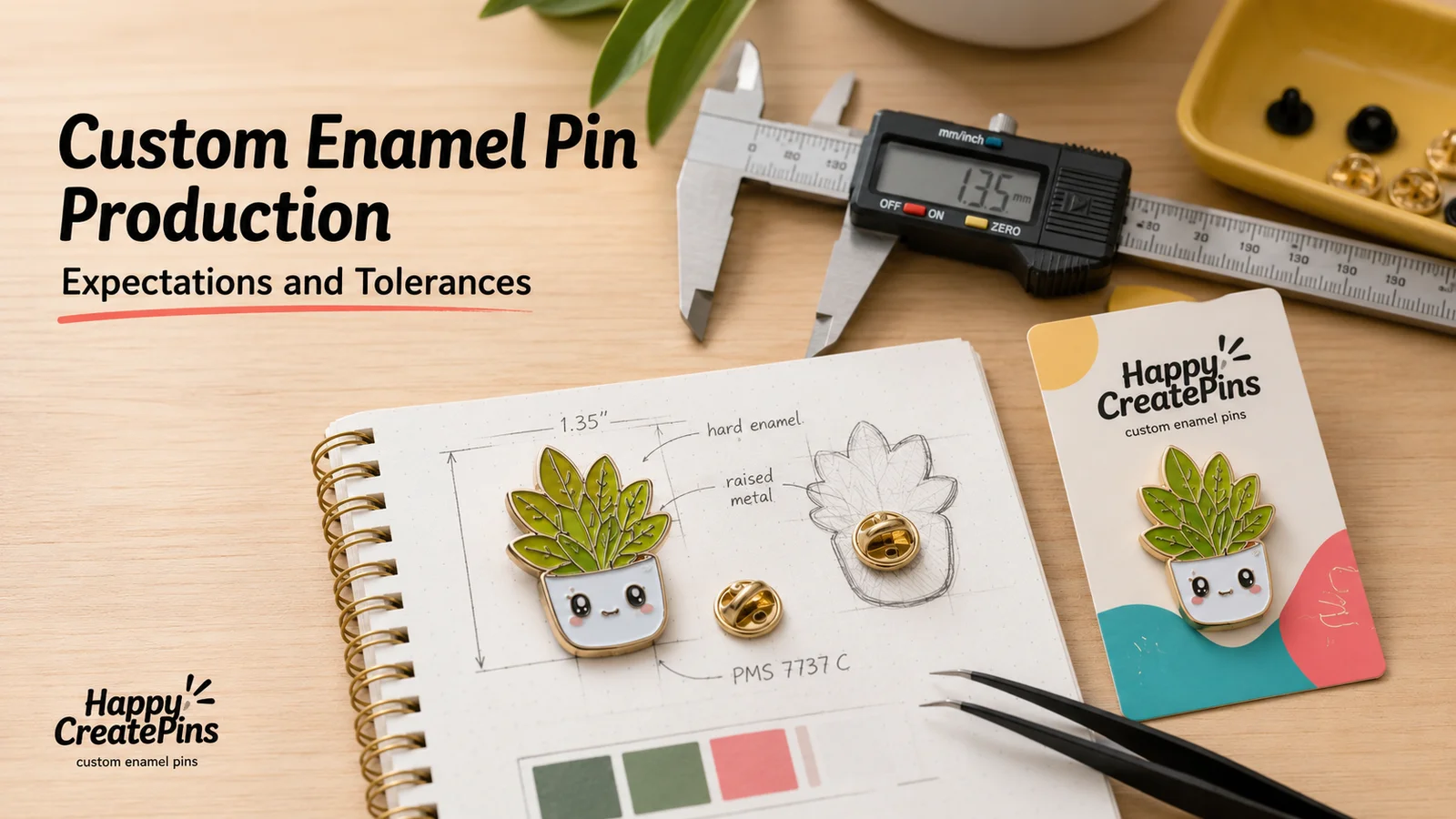
Custom enamel pins are a handcrafted product that combines metal casting, electroplating, hand-filled coloring, and polishing. While we follow strict quality control standards at every stage, it’s important for customers to understand realistic production expectations, common tolerances, and the potential variations that may occur during manufacturing.
This transparency helps ensure a smooth production process and avoids misunderstandings once pins are completed. Understanding what is normal, what requires review, and what constitutes a genuine defect is the foundation of a positive production experience.
📌 Minor variations are normal and industry-accepted in enamel pin manufacturing — even when the same design is produced repeatedly. This is not a quality failure; it’s the inherent character of handcrafted metal art.
1. The Handcrafted Nature of Enamel Pins
Unlike mass-produced plastic or injection-moulded items, custom enamel pins are made through multiple sequential manual processes — each of which introduces a small window of natural variation. Understanding these stages helps explain why production tolerances exist and why they’re accepted industry-wide.
Metal mold casting
Electroplating
Enamel hand-filling
Baking & curing
Polishing & QC inspection
Each step is performed by skilled artisans under controlled conditions — but natural variation in bath chemistry, ambient temperature, enamel viscosity, and curing time means that identical results across every pin in a batch are not physically achievable. This is why industry-standard tolerances exist: they define the acceptable range of natural variation rather than demanding the impossible standard of perfect mechanical uniformity.
2. Size, Shape & Mold Tolerances
Size variance: ±0.2–0.3 mm — this is the normal production tolerance for custom enamel pins across all manufacturers. It is not a defect.
Line thickness: Very thin lines under 0.2 mm may appear slightly thicker or softer than designed — this is a structural manufacturing reality, not a production error.
Edge shape: Minor rounding on sharp corners is normal and occurs during the polishing stage.
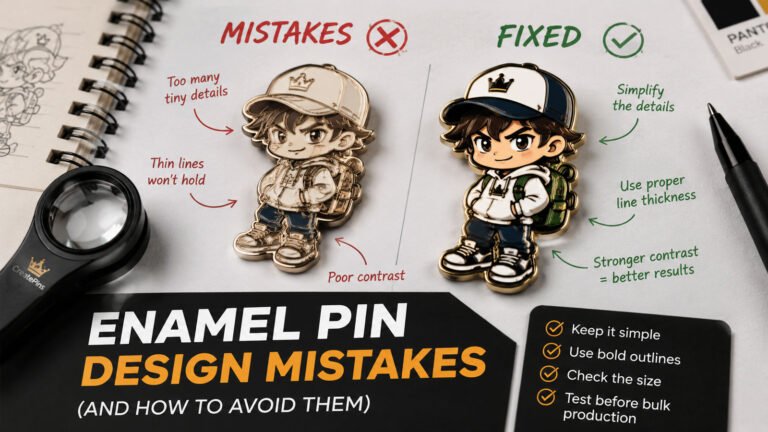
Extremely fine details may be simplified slightly during production to ensure structural strength and mold durability. Design elements thinner than 0.2 mm or isolated areas under 0.3 mm wide are at the greatest risk of simplification. This can be avoided by following minimum specification guidelines during your design stage.
3. Plating Color Expectations & Risks
Metal plating is one of the most chemically sensitive stages of enamel pin production. The electroplating process involves immersing pins in chemical baths — and even small changes in bath temperature, chemical concentration, or immersion time can produce subtle tone variations.
Available Plating Types
What to Expect
- Slight tone differences may occur between production batches due to bath chemistry variation — this is normal and industry-accepted
- Antique finishes vary intentionally — lighter and darker areas are the defining aesthetic of these finishes, not a defect
- Black nickel may show subtle grey or bronze undertones under certain lighting conditions
- Mirror-polished platings (silver, bright nickel) are highly sensitive to fingerprints and handling marks — this is an inherent characteristic of the finish
Potential Risks
- Micro spots or faint clouding visible only under extreme close inspection or direct lighting
- Minor tone shifts between pins in the same batch — within the normal ±5–10% tolerance window
- Rainbow or iridescent platings carry a higher natural variation risk as gradient direction cannot be controlled
These variations fall within normal industry standards and do not affect structural durability or functional quality.
🎨 Not sure which plating works best for your design? Our team provides free design advice before production begins.
Get Free Design Advice4. Enamel Color Expectations & Tolerances
Color Matching Reality
- Pantone colors are matched as closely as possible but are not guaranteed to be 100% identical — physical enamel pigments fired at high temperatures do not perfectly replicate Pantone reference chips
- Screen-based colors (RGB, HEX, CMYK) differ fundamentally from baked enamel pigments — always specify Pantone Solid Coated (PMS) references
- Expect a natural ±5–10% variation from Pantone reference as a normal production tolerance
Common Tolerances
- Slight brightness or saturation differences from the reference color
- Color depth may vary slightly between individual enamel fill applications
- Very small enamel fill areas may appear slightly darker due to greater depth-to-width ratio
Glow-in-the-dark enamel: Natural variation in glow intensity and duration is expected — this is an inherent characteristic of the phosphorescent pigment type.
Translucent & pearl enamels: Color appearance varies with enamel thickness and lighting conditions — this is part of the aesthetic character of these effects.
UV printing: Colors may appear slightly different from adjacent enamel fills due to the different pigment and application process.
5. Metal Line & Enamel Fill Variations
Due to the physical properties of liquid enamel during curing — gravity, surface tension, and viscosity — the following variations are considered acceptable craftsmanship characteristics:
- Slight enamel recession: Enamel may settle marginally lower than the metal lines during firing — this is normal in soft enamel and not a defect
- Micro air bubbles: Small bubbles can form in soft enamel due to gas release during the curing process — tiny bubbles not visible at normal viewing distance are accepted
- Minor overflow polishing: Small amounts of enamel that overflow metal lines are typically polished flat and removed during QC — residual marks from this process are accepted
- Slight fill level variation: Very minor depth differences between adjacent color fills within the same pin are normal and accepted
6. Quality Classification Chart
This chart defines the three quality tiers for all categories of enamel pin production issues — with specific corrective actions for each scenario. Use this as your reference for understanding how CreatePins evaluates and responds to quality concerns.
| Category | ✅ Acceptable | ⚠️ Needs Review | ❌ Unacceptable |
|---|---|---|---|
| Pin Size | ±0.2–0.3 mm variance | ±0.4–0.5 mm variance Partial refund if usable | >0.5 mm variance or incorrect size Full remake required |
| Shape & Edges | Slight corner rounding | Noticeable but not affecting design Discount on future order | Warped, bent, or misshapen Full remake required |
| Metal Lines | Minor thickness variation ±0.1 mm | Noticeable variation, lines intact Case-by-case evaluation | Broken, missing, or merged lines Full remake required |
| Plating Color | Slight tone difference between batches | Noticeable tone shift within same batch Partial refund if usable | Peeling, flaking, or exposed base metal Full remake required |
| Plating Surface | Micro marks not visible at normal viewing distance | Visible but minor surface marks Discount on future order | Deep scratches, corrosion, or surface pitting Full remake required |
| Antique Finish | Natural light / dark area variation | Uneven but still artistic in appearance Case-by-case evaluation | Inconsistent coverage clearly affecting design readability Full remake required |
| Enamel Color | Minor shade difference from Pantone reference | Noticeable but within same color family Partial refund if usable | Wrong color family (e.g., blue instead of green) Full remake required |
| Enamel Fill | Slightly recessed or minor fill variation | Noticeable unevenness with no gaps Discount on future order | Missing enamel or large visible gaps Full remake required |
| Air Bubbles | Tiny bubbles in soft enamel | Medium bubbles, surface intact Partial refund if usable | Large bubbles breaking the enamel surface Full remake required |
| UV Printing | Minor alignment or texture variation | Noticeable misalignment but text readable Case-by-case evaluation | Misaligned, blurred, or missing print Full remake required |
| Pin Attachments | Slight post angle variance | Moderate angle but still functional Partial refund if usable | Loose, detached, or missing posts Full remake required |
| Back Stamp | Light or shallow stamping | Partially readable with effort Discount on future order | Incorrect or entirely unreadable text Full remake required |
7. Quality Control Standards
Every CreatePins order undergoes systematic quality control before shipment. Our QC process includes:
- Visual inspection — every pin examined under standardized lighting conditions for surface, color, and structural issues
- Color consistency checks — enamel colors verified against the approved digital proof and Pantone references
- Attachment testing — pin posts and clutch hardware tested for security and correct alignment
- Random batch sampling — statistical sampling across the full batch to verify consistency
Pins that fall outside acceptable quality standards are removed from the batch before shipping. Orders are not dispatched until the batch passes QC review.
8. What Is NOT Considered a Defect
The following are explicitly not defects under industry-standard quality criteria — they represent the normal range of handcrafted variation for metal enamel products:
9. How to Achieve the Best Results
The quality of your finished pins is a collaboration between your design preparation and our manufacturing process. The single biggest factor in production quality is how well your design file meets manufacturing specifications before it enters production.
Maintain Minimum Line Thickness
All metal die lines should be at least 0.3 mm — 0.4 mm is recommended as a safe working standard. Enamel fill areas should be at least 0.3 mm wide. Lines below 0.2 mm risk simplification or loss during stamping.
Specify Pantone Solid Coated References
Use PMS Solid Coated color numbers for all enamel fills — never RGB, HEX, or CMYK values. Verify your color choices using a physical Pantone swatch book, not a monitor display.
Review Your Digital Proof Carefully
Your digital proof is your last low-cost opportunity to catch issues. Check every color reference, every metal line, and the overall composition before approving production. Changes after the mold is created are significantly more expensive.
Build Tolerance Flexibility into Your Expectations
Accept that ±0.3 mm size variance and ±5–10% color variation are normal characteristics of handcrafted metal enamel products. Building this knowledge into your planning prevents disappointment and ensures a positive experience.
Request a Physical Sample for High-Stakes Orders
For orders where exact color, plating appearance, or translucent effects are critical — request a pre-production physical sample. This adds time and a small cost but is the only reliable way to verify quality before a full production run.
Custom enamel pins are a premium, handcrafted product. While we strive for precision at every stage, understanding production tolerances and material behavior ensures a positive experience and realistic expectations. At CreatePins, transparency, quality, and communication are core to everything we produce. Our specialists are always available to advise during the design stage — before production begins, when changes are still easy and inexpensive.
Custom Pins Made Right, First Time
Get expert design review before production begins — we catch specification issues before they become quality problems, saving you time and revision costs.
Get Your Free Instant QuoteReport a Quality Issue
Free design review · Transparent quality standards · Clear corrective action process
Frequently Asked Questions
Common questions about enamel pin production tolerances and quality standards.
A size variance of ±0.2–0.3 mm is the accepted industry standard and is considered normal handcrafted variation. ±0.4–0.5 mm enters a review zone where partial compensation may be appropriate. Variance greater than 0.5 mm, or pins produced at the wrong size entirely, constitutes a production defect requiring a full remake.
Screen colors use RGB or CMYK color models, which are fundamentally different from physical pigments used in baked enamel. The same Pantone reference can appear noticeably different as a physical enamel color — affected by enamel thickness, firing temperature, and the metal plating color beneath the fill. Always specify Pantone Solid Coated (PMS) references, not RGB or HEX values, and expect a natural ±5–10% variation from the reference as a normal production tolerance.
Tiny air bubbles in soft enamel are accepted as normal craftsmanship variation — they occur due to gas release and surface tension during the curing process. Medium-sized bubbles where the surface remains intact enter a review zone. Large bubbles that break the enamel surface or create visible craters are production defects requiring corrective action.
Defects requiring a full remake include: size variance over 0.5 mm; warped, bent, or misshapen pins; broken, missing, or merged metal lines; plating that is peeling, flaking, or exposing base metal; enamel in the wrong color family; large visible enamel gaps; large surface-breaking air bubbles; misaligned or unreadable UV printing; and loose, detached, or missing pin posts.
Antique plating finishes intentionally vary in their light and dark areas — this natural oxidation-style variation is the defining aesthetic of antique finishes, not a defect. It results from the controlled chemical aging process applied to create the weathered appearance. Pins showing severe inconsistency that significantly affects design readability enter the review zone and may qualify for corrective action.
References & Further Reading
- CreatePins — Complete Enamel Pin Design Guide (2026)
- CreatePins — Common Enamel Pin Defects & How CreatePins Prevent Them
- CreatePins — Custom Enamel Pin Production Expectations & Tolerances
- CreatePins — How to Order Enamel Pins (Step-by-Step Guide)
- CreatePins — How to Choose Enamel Pin Colors: A Complete Color Palette Guide
- CreatePins — The Beginner’s Guide to Enamel Pin Plating Colors
- CreatePins — Common Enamel Pin Types: Differences, Costs & Mistakes (2026)
- CreatePins — Essential Criteria for Grading Enamel Pins
- CreatePins — Best File Formats for Custom Enamel Pins (AI vs PSD vs PNG)
- CreatePins — Want More Than Just Custom Pins?