Refrigerator Magnets vs Car Magnets: What’s the Difference?
They both stick to metal and both carry your design — but refrigerator magnets and car magnets are fundamentally different products. Choosing the wrong one wastes money and can damage your vehicle or brand. Here’s what separates them.
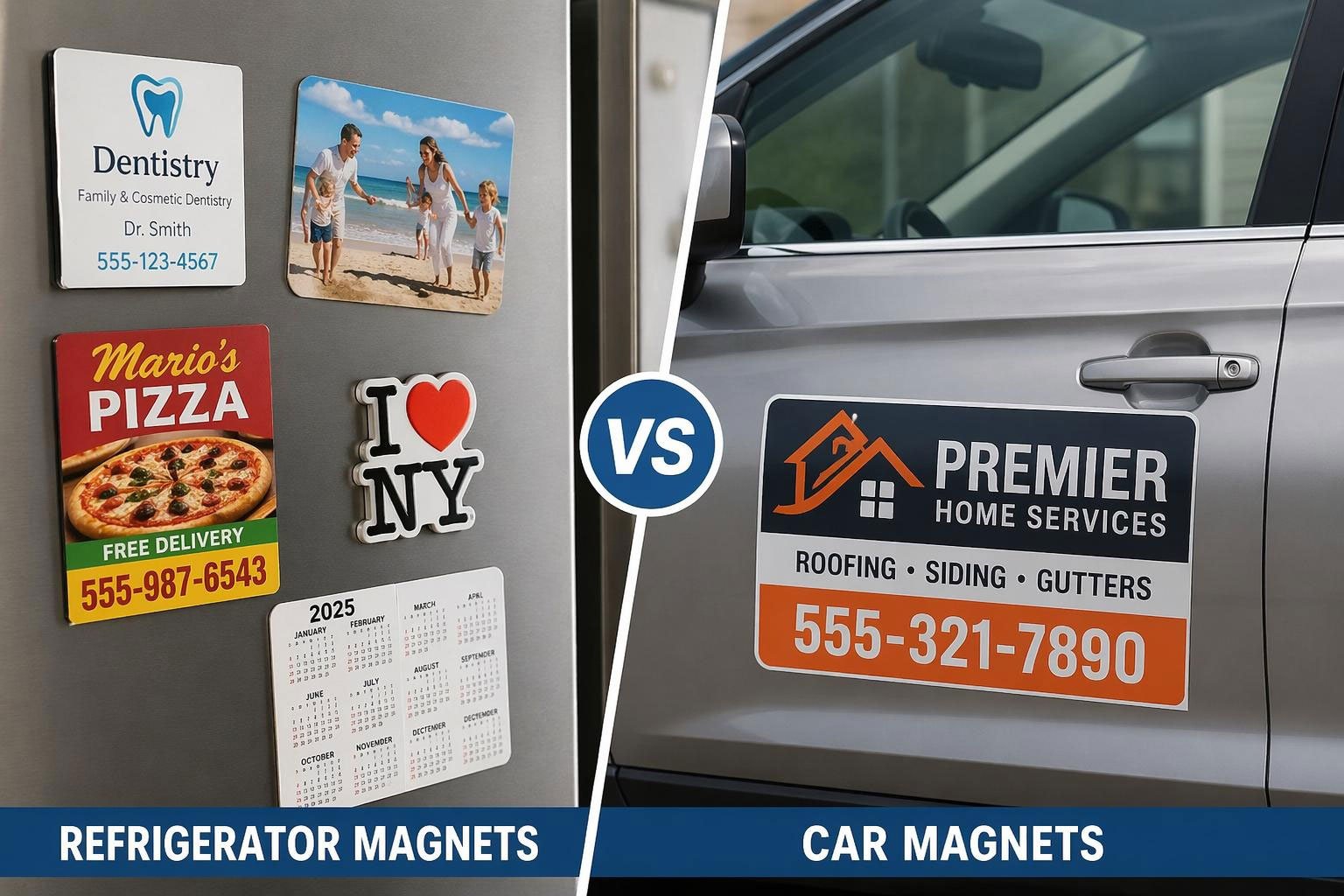
Magnets are everywhere — from the family photos on your fridge to the bold branding on company vehicles. But not all magnets are made the same. Two of the most commonly confused products are refrigerator magnets and car magnets.
At first glance they seem similar — they both stick to metal surfaces and can be customized with logos, designs, or messages. But their materials, durability, thickness, magnetic strength, and intended uses are completely different. Choosing the wrong one leads to wasted money, poor performance, and in the worst case, damaged vehicle paint.
Indoor Promotional Magnets
- Use: Fridges, lockers, filing cabinets
- Thickness: 0.3–0.7mm (thin, lightweight)
- Magnetic strength: Light hold
- Weather resistance: Indoor only
- Surface: Printed paper, PVC, or lamination
- Cost: Lower — ideal for bulk
Heavy-Duty Vehicle Signage
- Use: Vehicle doors, panels, hoods
- Thickness: 0.8–1.2mm+ (thick, strong)
- Magnetic strength: Strong hold at highway speed
- Weather resistance: UV, rain, wind rated
- Surface: Automotive-grade vinyl + UV coating
- Cost: Higher — built for longevity
What Are Refrigerator Magnets?
Refrigerator magnets are lightweight magnets designed for indoor use on smooth magnetic surfaces. They’re made from flexible magnetic sheets with a printed paper, PVC, or laminated surface — affordable, thin, and easy to mass-produce in high volumes.
They’re commonly used for:
What Are Car Magnets?
Car magnets are heavy-duty magnetic signs specifically engineered for outdoor vehicle use. They use thicker magnetic material with weather-resistant vinyl and protective coatings that can withstand sun, rain, wind, and the physical stresses of driving at speed.
They’re commonly used for:
✅ The most important thing to understand: a car magnet is not a larger version of a fridge magnet. It’s a completely different product category — different materials, different manufacturing, different performance requirements, and a completely different price point justified by its specific use case.
1 Material Thickness
Thickness is the most fundamental physical difference between the two product types — and it determines everything downstream: magnetic strength, weatherability, and appropriate use case.
A thin fridge magnet will fly off a car at highway speeds — this is a safety and property hazard, not just a performance issue. A thick car magnet is unnecessarily expensive and heavy for refrigerator use. Always choose based on the intended application.
2 Weather Resistance
This is one of the most critical performance differences — and the most common source of costly mistakes when buyers use fridge magnets outdoors.
- Not designed for rain, snow, or moisture
- No UV resistance — fades in sunlight
- Cannot withstand wind pressure at speed
- Heat causes warping and delamination
- Road dirt penetrates the print surface
- Will fail outdoors within days or weeks
- Fully waterproof vinyl surface coating
- UV-resistant — colors stay vibrant in sun
- Engineered to withstand highway wind pressure
- Temperature stable across hot and cold extremes
- Easy to wipe clean from road grime
- Long-term outdoor exposure rated
If your magnet will ever be exposed to direct sunlight — even indoors near a window — choose materials with at least basic UV lamination. Color fade is permanent and becomes obvious within weeks on lower-grade materials.
3 Surface Finish
- Gloss lamination — bright, reflective finish
- Matte lamination — premium soft appearance
- PVC coating — flexible and durable indoor
- Paper print layer — most affordable option
- Epoxy dome — premium retail appearance
Prioritizes appearance and affordability over outdoor durability.
- Automotive-grade vinyl — purpose-built exterior material
- UV protective coating — prevents color fade
- Outdoor protective laminate — sealed against weather
- Wide-format digital print — high visibility at distance
Prioritizes durability and performance over decorative options.
4 Magnetic Strength
The magnetic force of a product determines what it can hold and where it can be reliably attached. This difference has direct safety implications for vehicle use.
- Sufficient for holding paper, photos, and light memos
- Stays reliably on vertical indoor surfaces
- Not sufficient for any vehicle application
- Static environment — no wind or vibration forces
- Engineered to remain attached at 70+ mph highway speeds
- Resists wind uplift and suction forces during driving
- Maintains hold through temperature expansion and contraction
- Sized for maximum flat surface contact area
The physics of vehicle use are significantly more demanding than static surface use. At 60 mph, wind force on a flat magnetic sign creates substantial lift and drag. Only purpose-engineered car magnets — with appropriate thickness, magnetic strength, and large surface contact area — can reliably resist these forces.
5 Shape & Size Options
- Die-cut to any custom shape — characters, logos, animals
- Small decorative pieces in any silhouette
- Complex outlines and irregular edges
- Large size range from mini to standard card
- Shape is a major branding differentiator
- Primarily rectangular or square format
- Large format — typically 12″×18″ to 18″×24″
- Simple shapes maximize flat surface contact
- Complex die-cuts reduce adhesion reliability
- Shape is secondary to maximum magnetic contact area
The reason car magnets default to rectangular shapes isn’t a lack of creativity — it’s physics. More flat surface area means more magnetic contact, which means better hold at speed. Irregular cut-outs create edge points that catch wind, reducing adhesion. Simple shapes are the right choice for any moving vehicle application.
6 Printing Method
- Offset printing — consistent, cost-efficient at volume
- Digital printing — flexible, photo-quality reproduction
- UV printing — vibrant, scratch-resistant surface
- Best for high-volume promotional production runs
- Fine detail and photography reproduce well
- Wide-format outdoor digital printing
- Vinyl graphic application with UV-stable inks
- Bold, high-contrast output designed for distance visibility
- Ink and coating systems rated for outdoor longevity
- Designed for readability at speed, not close inspection
Quick Comparison Table
| Feature | 🧲 Refrigerator Magnets | 🚗 Car Magnets |
|---|---|---|
| Primary use | Indoor — fridges, lockers, cabinets | Outdoor — vehicle doors, panels |
| Thickness | 0.3–0.7mm (thin) | 0.8–1.2mm+ (thick) |
| Magnetic strength | Light hold | Strong — highway-speed rated |
| Weatherproof | No | Yes |
| UV resistant | Usually No | Yes |
| Shape options | Highly custom — any shape | Mostly rectangular / standard |
| Surface finish | Gloss, matte, PVC, epoxy | Automotive vinyl + UV laminate |
| Cost | Lower | Higher |
| Expected lifespan | Shorter — decorative / promotional | Longer — engineered durability |
| Best volume | High volume — 100s to 1000s | Lower volume — per vehicle |
Not sure which type you need? Our team will help you choose the right magnet for your specific application — free consultation with every quote.
Get a Free Magnet QuoteWhich One Should You Choose?
The right choice is almost always obvious once you answer a single question: where will this magnet be used? Everything else flows from that answer.
- You need affordable giveaways for events, trade shows, or direct mail
- You’re creating promotional handouts — restaurant menus, real estate info, business contact magnets
- You need high-volume production at low cost per unit
- Your distribution channel is indoor — homes, offices, schools
- You want wedding or event reminders people will keep on their fridge
- You need creative die-cut shapes — characters, mascots, custom silhouettes
- You’re selling retail merchandise or souvenir products
- You need vehicle advertising that stays on at highway speeds
- You want temporary company vehicle branding — removable when needed
- You’re running a mobile business and need your vehicle to work as a marketing asset
- You need signage that survives rain, sun, and outdoor exposure
- You want professional appearance that builds brand credibility on the road
- Durability and long-term performance are more important than cost
Common Mistakes to Avoid
Mistake #1: Using Fridge Magnets on Cars
This is the most frequently made — and most dangerous — magnet error. Standard fridge magnets will fly off at speed (creating a road hazard for other drivers), damage your vehicle paint when moisture accumulates underneath, fade rapidly from UV exposure, and warp from heat. The cost saving is immediately eliminated by the damage caused.
Mistake #2: Ignoring Vehicle Surface Compatibility
Car magnets only adhere reliably to flat, steel body panels. Many modern vehicles have aluminum hoods and doors, plastic bumpers, fiberglass body panels, or curved surfaces where flat contact cannot be achieved. A magnet placed on a non-magnetic or curved surface will fail — potentially at speed.
Mistake #3: Leaving Car Magnets On Too Long Without Cleaning
Water and road grime accumulate between the magnet and the vehicle surface — even if it appears dry from the outside. This moisture causes paint discoloration, corrosion under the magnetic backing, and surface scratches as trapped particles move when the vehicle flexes.
Design Tips for Better Results
The design approach for each magnet type is very different — because the contexts in which they’re viewed are completely different. A fridge magnet is read from inches away; a car magnet is read in seconds from a moving vehicle.
- Strong brand colors — the magnet competes with everything else on the fridge
- Clear contact info — phone number in large, readable font
- Make it useful — calendars, tip sheets, and useful reminders get kept; purely promotional messages get discarded
- Simple, memorable messaging — what problem do you solve? State it clearly in 5 words or fewer
- Your best photo or design — this is a keepsake item; make it something people want on their fridge
- QR code for digital connection — links to your website, menu, or booking page
- Large, bold text first — drivers and pedestrians have 2–3 seconds maximum to absorb information
- High contrast colors — dark text on light background or light text on dark background; never low-contrast
- One phone number, large — this is the primary call to action; make it impossible to miss
- Minimal information — your name, what you do, and how to contact you. Nothing else
- Your logo — brand recognition builds with repetition; every time your vehicle is seen is an impression
- Visible from 30+ feet — test your design printed at scale before approving
The most effective car magnet design passes the “highway test”: a driver in an adjacent lane glancing at your vehicle for two seconds should be able to read your business name, what you do, and your phone number — without slowing down or squinting.
Need Custom Magnets for Your Project?
At CreatePins, we help businesses create custom magnets for every purpose — from promotional fridge magnets to durable outdoor magnetic vehicle signage. Tell us your use case and we’ll recommend the right material, thickness, and finish for maximum results.
Frequently Asked Questions
Refrigerator magnets are thin, lightweight, and designed for indoor use on smooth magnetic surfaces — ideal for promotions, giveaways, and decorative use. Car magnets are thicker, weatherproof, and engineered for outdoor vehicle use — with stronger magnetic force, UV-resistant coatings, and heavy-duty vinyl that can withstand highway speeds, rain, and sun exposure. They’re fundamentally different products despite looking similar.
No — and this is the most common and costly mistake. At highway speeds, a fridge magnet will fly off the vehicle, creating a road hazard. The materials are not weather-resistant, so they will fade, warp, and peel from UV and rain exposure. They may also trap moisture between the magnet and the paint, causing discoloration or surface damage. Always use purpose-made car magnets for any vehicle application.
Car magnets should be at least 0.8mm thick — with 1.0mm being the most common and reliable standard for vehicle use. This thickness provides the magnetic holding force needed to remain securely attached at highway speeds and in wind. Thinner materials under 0.7mm lack sufficient magnetic strength to stay attached to a moving vehicle reliably.
No. Car magnets only adhere to steel body panels that are magnetic. They will not work on aluminum panels, plastic bumpers, fiberglass body panels, or curved surfaces where full flat contact cannot be achieved. Many modern vehicles have aluminum hoods and doors that will not hold a car magnet. Always test the surface with a standard magnet before ordering custom car magnets.
Remove and clean your car magnets at least once a week. Moisture and road grime accumulate between the magnet and the vehicle surface, causing paint discoloration, surface scratches, or adhesion failure over time. Clean both the back of the magnet and the vehicle surface before reattaching. Never leave car magnets in place during vehicle washing — the heat and pressure can cause delamination.
It depends on your strategy. Refrigerator magnets are better for high-volume, low-cost distribution — giveaways, direct mail, restaurant marketing, and any situation where you need hundreds or thousands of branded items affordably. Car magnets are better for ongoing mobile advertising — turning your vehicle into a moving billboard that is seen daily by people in your service area. Many businesses use both for different marketing objectives.