AI vs Human: Who Is Better Enamel Pin Designer?
A complete, honest comparison of AI design tools versus working with a human designer — covering speed, creativity, manufacturing precision, brand storytelling, and cost — to help you make the best choice for your custom pin project.
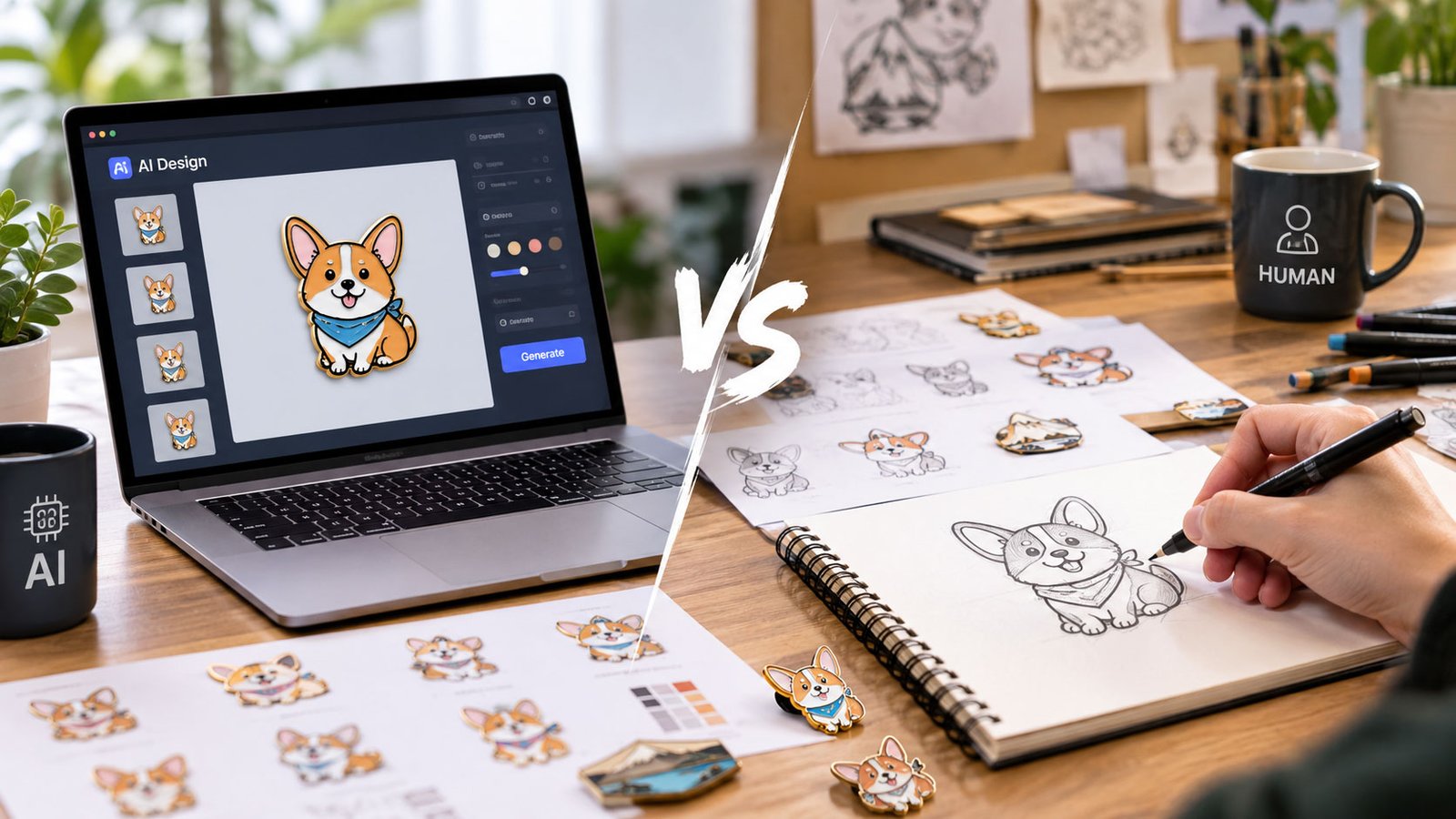
Artificial intelligence is reshaping the creative industry at a remarkable pace. In just a few years, AI image generators have gone from research curiosities to tools used daily by artists, brands, and product designers around the world. For enamel pin creators, this shift raises a direct and practical question: should you use AI design tools, work with a human designer, or do you need both?
The answer isn’t as simple as picking a winner. Both AI tools and human designers bring genuine strengths to the pin design process — and both have real limitations when it comes to producing artwork that can actually be manufactured. Understanding where each excels will help you make a smarter decision for your next pin project.
At a Glance — AI vs Human Enamel Pin Designers
Both approaches are capable of producing beautiful design concepts. The key differences emerge when you look at what happens after the initial image is created — specifically, when that design needs to be prepared for physical enamel pin manufacturing.
The Rise of AI Design Tools
AI art generators have become remarkably powerful in a very short time. Platforms like Midjourney, DALL·E, and Stable Diffusion allow anyone — regardless of drawing skill — to generate visually compelling artwork simply by describing what they want in text.
For enamel pin creators, this represents a genuinely significant shift. What once required either drawing skill, a hired illustrator, or weeks of ideation can now be explored visually in minutes. The barrier between “I have a pin idea” and “I can see what that pin might look like” has essentially collapsed.
But the barrier between “I have a visual concept” and “I have a pin ready for manufacturing” remains — and it’s here that the comparison between AI tools and human designers becomes most important.
What AI Does Well for Pin Design
Used at the right stage and for the right purpose, AI tools offer genuine advantages that even experienced designers appreciate. Here are the areas where AI genuinely excels in the pin design process:
Speed
Generate dozens of distinct visual concepts in the time it takes to sketch one. Ideal when exploring multiple design directions before committing.
Creative Exploration
Test wildly different styles, characters, color palettes, and compositions without any upfront cost or designer time.
Overcoming Creative Block
When you know you want a pin but can’t visualize it, AI can jumpstart the process by generating ideas you wouldn’t have thought of.
Style Reference Generation
Produce visual references in a specific style — kawaii, retro, gothic, pixel art — to guide a human designer more precisely.
Rapid Iterations
Produce color variants, alternate expressions, or thematic variations of a concept almost instantly to compare options.
Low Upfront Cost
AI subscription tools are far less expensive than commissioning an illustrator for exploratory concept work — especially useful on tight budgets.
Limitations of AI Enamel Pin Designers
Despite their impressive visual outputs, AI tools have significant limitations when it comes to producing artwork that can actually be manufactured as an enamel pin. These aren’t minor technical details — they represent fundamental incompatibilities between how AI generates images and how enamel pins are physically made.
Gradients & Complex Shading
AI almost always produces gradients, soft shadows, and blended tones. Enamel cannot reproduce these — every color must be a flat, solid fill.
Undefined Metal Lines
AI has no concept of metal dividing lines. It creates areas of color that blend and overlap — the opposite of what enamel pin manufacturing requires.
Overly Fine Details
AI-generated art often includes textures and micro-details that disappear entirely at physical pin scale (25–50mm).
Raster File Output
AI produces PNG or JPG raster files. Manufacturers need vector files (.AI or .EPS). Every AI image must be redrawn in vector software.
Inconsistent Edges
AI-generated outlines are often blurry or inconsistent — unsuitable for CNC mold engraving which requires precisely defined, clean paths.
Uncontrolled Color Count
AI freely uses hundreds of colors in a single image. Pin designs need a controlled palette of 4–8 enamel colors for cost-effective production.
No Manufacturing Knowledge
AI has no understanding of minimum line thickness, enamel fill requirements, or structural constraints. It will produce designs that look great but can’t be made.
Copyright & Originality Concerns
AI is trained on existing art, raising unresolved questions about commercial use rights. Selling AI-generated merchandise carries legal risk that human-designed art does not.
What Human Designers Do Better
Experienced human designers — particularly those who specialize in enamel pin illustration — bring capabilities that AI tools simply cannot replicate. Here’s where working with a skilled designer makes the biggest difference:
Manufacturing Knowledge & Technical Precision
A designer experienced in enamel pin production understands the technical constraints from the very first stroke. They know the minimum metal line thickness (0.3mm), how to create properly enclosed color areas, how to design for specific pin sizes, and how to prepare a file that a manufacturer can use directly without modification. This knowledge prevents the expensive back-and-forth of sending artwork that needs to be reworked.
- Gradients throughout
- No metal line structure
- Raster PNG file
- Uncontrolled color count
- Details too fine for pin scale
- Needs complete redraw before manufacturing
- Flat solid color fills
- Defined metal dividing lines
- Production-ready .AI vector file
- Controlled Pantone color palette
- Designed for actual pin dimensions
- Ready for manufacturer submission
Brand Identity & Storytelling
A human designer can interpret brand values, community culture, and merchandise strategy in ways that AI cannot replicate. For gaming studios, music artists, sports teams, or lifestyle brands, the pin design isn’t just an image — it’s a statement about who the brand is and what it means to its audience. That kind of contextual, strategic creative thinking requires a human who understands the brief.
Iterative Collaboration
Working with a human designer is a dialogue. You can explain what you want, respond to what you see, provide feedback, and arrive at a result that genuinely reflects your vision. AI tools can generate many variations, but they can’t truly understand nuance like “make it feel more nostalgic” or “the character should look friendlier but still edgy.”
Accountability & Revision
A professional designer takes ownership of the work. If something isn’t right, you can request specific revisions with confidence. AI outputs are probabilistic — prompting the same text twice produces different results, and targeted adjustments to specific elements are often difficult to control.
Manufacturing Ready
Delivers production-ready .AI vector files with correct line weights, closed paths, and Pantone color references.
Brand Alignment
Interprets brand voice, aesthetic, and community culture to create designs that feel authentic and strategic.
Collaborative Process
Understands nuanced creative direction and can translate abstract feedback into specific visual changes.
Clear Ownership
Commissioned human artwork provides clear copyright ownership for commercial merchandise with no legal ambiguity.
Scale-Aware Design
Designs with awareness of how the pin will look at 25–50mm — making intentional choices that AI has no concept of.
Collectible Quality
Skilled illustrators create designs with a level of character and craft that resonates with pin collectors and fans.
Full Category Scorecard
Here’s a direct comparison across the criteria that matter most for producing professional custom enamel pins:
| Category | 🤖 AI Tools | ✏️ Human Designer | Winner |
|---|---|---|---|
| Concept speed | Dozens of ideas in seconds | Hours to days per concept | AI ✓ |
| Creative exploration | Unlimited variations, any style | Directed by brief & experience | AI ✓ |
| Vector file output | Raster only — must be redrawn | Delivers .AI/.EPS ready files | Human ✓ |
| Metal line structure | No concept of metal lines | Designs with manufacturing in mind | Human ✓ |
| Color control | Uncontrolled, gradient-heavy | Precise Pantone palette management | Human ✓ |
| Brand storytelling | Limited — no brand context | Deep contextual understanding | Human ✓ |
| Manufacturing knowledge | None | Experienced pin designers understand all constraints | Human ✓ |
| Upfront cost | Low subscription ($10–$30/mo) | $50–$300+ per design | AI ✓ |
| Copyright clarity | Legally complex, unresolved | Clear ownership via commission | Human ✓ |
| Revision control | Probabilistic — hard to target | Precise, collaborative revisions | Human ✓ |
| Scale awareness | No pin-scale consideration | Designs for actual physical dimensions | Human ✓ |
| Combined workflow | AI for ideation → Human for production prep | Both ✓ | |
The Best Approach: AI + Human Together
For many creators, the most effective and efficient path to a finished enamel pin isn’t a choice between AI or human designers — it’s using both in a structured workflow where each handles what it does best.
AI excels at rapid, low-cost ideation. Human designers excel at refinement, technical precision, and manufacturing preparation. Combining the two means you get the speed and creative freedom of AI at the concept stage, and the accuracy and quality of human craftsmanship at the production stage.
The AI + Human Hybrid Workflow
- Generate concepts with AI AI Use Midjourney, DALL·E, or Stable Diffusion to generate 10–20 visual concepts across different styles, characters, and compositions. The goal is quantity and variety — don’t filter too early.
- Select your strongest concept AI Review the AI output and identify the one or two concepts that best capture your vision. Look for strong silhouettes, clear subject matter, and a limited color feel — these translate best to pins.
- Brief a human designer Human Share the selected AI image as a reference alongside a written brief explaining the style, target audience, pin size, and any brand requirements. The AI image is inspiration — not final artwork.
- Designer creates vector artwork Human The designer redraws the concept as clean vector artwork in Adobe Illustrator, adding proper metal line structure, simplifying the color palette to 4–8 enamel colors, and ensuring all design elements work at pin scale.
- Review and refine Human Collaborate with the designer on any adjustments — line weight, color choices, proportions, detail level. This iterative stage ensures the final artwork matches your vision before it goes to manufacturing.
- Submit to manufacturer Human The finished .AI or .EPS vector file is submitted to your pin manufacturer. At CreatePins, the team reviews the artwork and creates an accurate digital proof showing exactly how the finished pin will look.
- Approve proof and proceed to production Human Once the proof is reviewed and approved, production begins. The combination of AI-speed ideation and human-precision manufacturing prep ensures the best possible outcome.
When to Choose Each Approach
The right balance between AI and human design depends on your project type, budget, timeline, and how important brand precision is to you. Here’s a practical guide:
Choose AI-First When…
- You’re brainstorming a new pin concept and don’t have a clear visual direction yet
- You want to quickly explore a wide range of styles before committing
- You have a tight budget for the ideation phase
- You’re creating your first pin and want to see possibilities before investing in designer fees
- You need visual references to communicate your concept to a designer or manufacturer
Choose Human Designer-First When…
- You’re producing official brand merchandise that must match existing brand guidelines
- You need high-quality, original collectible pin art with clear copyright ownership
- Your design requires complex character illustration or detailed artistic craftsmanship
- You’re launching a Kickstarter campaign where the art quality directly impacts backer trust
- You’re ordering a large production run where production errors would be costly
- You need the artwork to be used across multiple merchandise formats, not just pins
Use Both When…
- You want to move fast on ideation without sacrificing production quality
- You have a visual concept but lack drawing skills to communicate it clearly
- You’re developing a large pin collection and need to generate many concepts efficiently
- You want to test multiple design directions before committing designer hours to just one
Why Manufacturing Experience Matters
Regardless of whether your design starts with AI or a human designer, working with an experienced manufacturer from the beginning of the process is one of the most valuable investments you can make. Many design problems — whether from AI artwork or professionally produced vector files — are caught and resolved during the manufacturer’s review stage.
An experienced pin manufacturer like CreatePins can help bridge the gap between design and production by:
- Reviewing AI or designer-produced artwork for manufacturing compatibility before production begins
- Advising on line thickness adjustments to prevent mold failures
- Simplifying overly complex color areas without changing the overall design intent
- Converting AI-generated concepts into production-ready vector artwork
- Preparing accurate digital proofs so you see exactly how the pin will look before manufacturing
- Recommending pin type, size, plating, and backing options to best suit your design
- Offering physical sampling for large orders to verify quality before bulk production
AI Will Assist Designers — Not Replace Them
The conversation around AI and human designers is often framed as a competition — but for enamel pin production, that framing misses the point. These tools are most powerful when they work together, each doing what the other can’t.
Looking at where the technology is heading, AI’s role in pin design will likely grow in specific ways:
- Faster concept iteration — AI will continue to improve at generating cleaner, more stylized outputs that are closer to flat illustration
- AI-assisted vectorization — new tools are beginning to automate parts of the raster-to-vector conversion process, reducing designer workload
- Style-consistent collections — AI can help maintain visual consistency across a large pin collection by generating variations within a defined style
- Manufacturing constraint awareness — future AI tools may learn to apply pin manufacturing rules automatically, flagging problems before a designer even sees the output
But the core creative judgment — deciding what a pin should say, who it’s for, what emotion it should evoke, and how it fits into a brand’s story — will remain human territory for the foreseeable future. And the technical precision of preparing a clean, production-ready vector file will continue to require skilled human hands and eyes.
The future of enamel pin design isn’t AI or human designers. It’s AI and human designers — each making the other more effective.
Frequently Asked Questions
AI Concept or Designer Artwork — We Can Work With Both
Whether your pin design comes from an AI generator, a professional illustrator, or just a rough sketch, the CreatePins team can help turn it into a high-quality custom enamel pin — with expert guidance from artwork review through to production.
References & Further Reading
- Midjourney — AI Art Generation Platform
- DALL·E 3 by OpenAI — Text-to-Image Generation
- Stability AI — Stable Diffusion Open-Source Platform
- Adobe Illustrator — Vector Design Software
- Pantone — Color Standards for Design & Manufacturing
- CreatePins Guide: Turning AI Art into Manufacturable Enamel Pins
- CreatePins Custom Quote Form — Start Your Order