Why Your Custom Magnets Don’t Stick
Custom magnets that slide down the fridge or barely hold a sheet of paper are a frustrating — and entirely preventable — problem. Here are the 7 most common causes, and exactly how to fix each one.
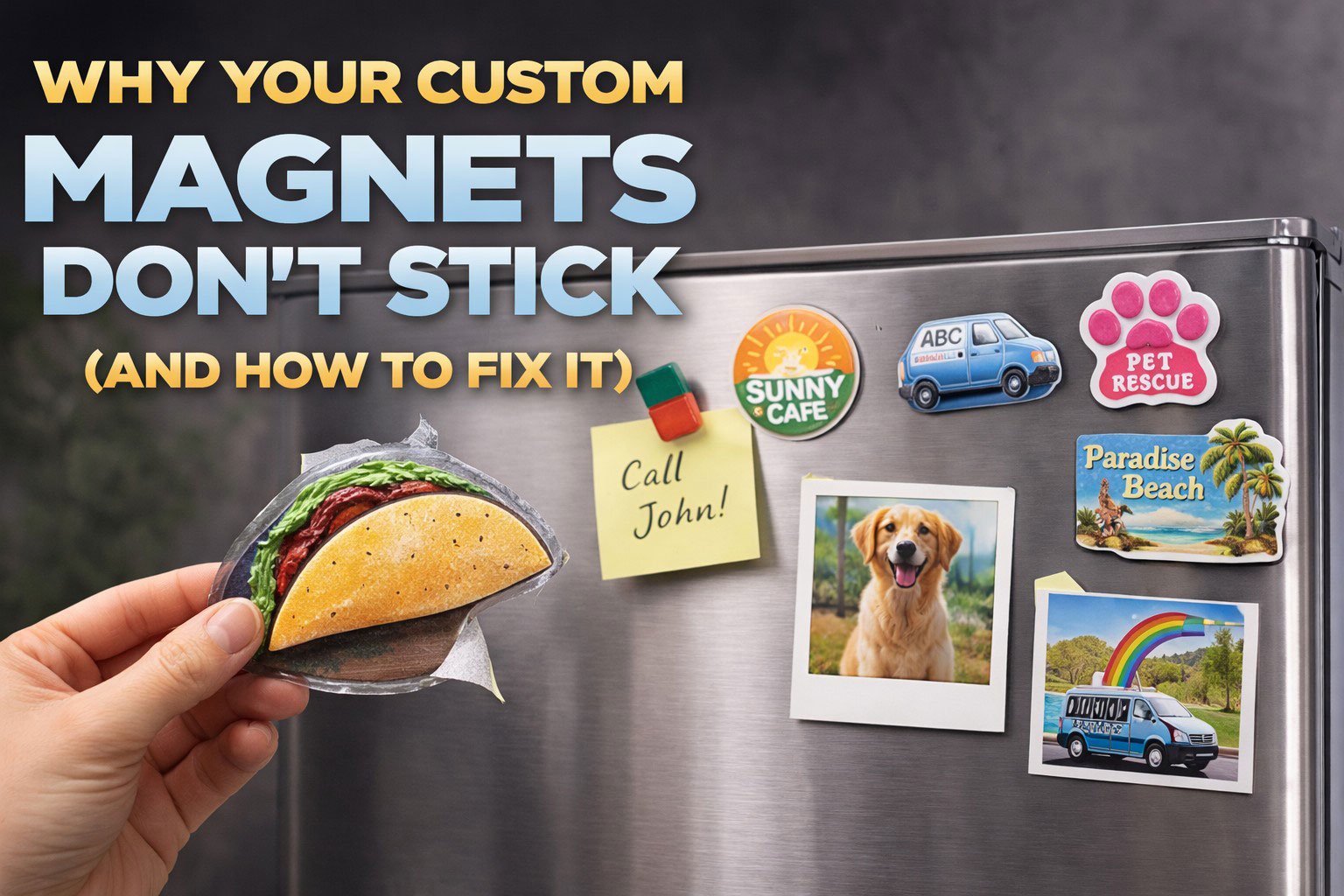
Custom magnets are a popular product for brands, artists, schools, and businesses — affordable, practical, and highly visible. But few things are more frustrating than receiving a batch of custom magnets that slide down the fridge, fall off lockers, or barely hold a single sheet of paper.
The good news: this problem is almost always preventable. Every cause of poor magnet performance is predictable and correctable — if you know what to look for before you place your order. Here are the seven most common reasons custom magnets fail to stick, with the specific fix for each.
Common Reasons of Magnets Don’t Stick
1 The Magnet Material Is Too Weak
Not all magnetic materials are created equal. Many budget suppliers use ultra-thin magnetic backing to reduce production costs — and while this saves money at the factory, it often results in magnets with very weak holding power that frustrate customers and damage your brand’s reputation.
- Low-grade flexible magnetic sheets
- Thin rubber magnets under 0.5mm
- Poor-quality ferrite compounds
- Recycled low-density magnetic backing
- Any backing not specified by thickness
- 0.7–1.0mm flexible ferrite magnetic sheets
- Premium high-density magnetic vinyl
- Neodymium (rare-earth) magnets for heavy applications
- Materials specified by holding strength, not just thickness
Magnetic Backing Thickness Guide
For fridge magnets, promotional magnets, and business branding magnets intended for everyday practical use, specify a minimum of 0.7mm flexible ferrite backing. For any magnet heavier than a standard printed card, go to 1.0mm or ask about rare-earth inserts.
2 The Surface Isn’t Actually Magnetic
This is one of the most common — and most surprising — causes of magnet disappointment. Many buyers assume all metal surfaces are magnetic, but that’s not accurate. A wide range of metal surfaces that look and feel “metallic” will not attract a magnet at all.
- Standard steel refrigerators (older models)
- Standard steel lockers and cabinets
- Cast iron surfaces
- Plain steel whiteboards
- Most automotive body panels (steel)
- Many modern stainless steel refrigerators
- Aluminum surfaces and panels
- Copper and brass
- Coated or laminated decorative panels
- Glass, plastic, or composite surfaces
Modern “stainless steel” refrigerators are increasingly made with aluminum or non-ferrous steel alloys that are not magnetic. If a customer plans to use your magnets on modern kitchen appliances, test the target model first — or include a note with the product that the surface must be magnetic.
The test is simple and free: hold a standard small magnet against the intended surface. If it sticks, your custom magnets will too. If it slides or doesn’t attract at all, even the strongest custom magnet won’t help — the surface itself is the problem.
3 The Magnet Is Too Heavy for Its Backing
A magnet’s holding power depends on the balance between the magnetic force it generates and the total weight it needs to support. When a decorative front face — acrylic, epoxy dome, thick PVC, layered printed construction — is significantly heavier than the magnetic force available, the magnet simply cannot hold itself up.
- Epoxy-coated or domed acrylic magnets
- Multi-layer promotional magnets
- Wooden magnets
- Thick PVC magnets
- Large custom die-cut shapes with heavy resin
- Increase the total magnetic contact area (larger backing sheet)
- Use thicker, higher-density magnetic material
- Add multiple magnet attachment points distributed across the back
- Use neodymium rare-earth inserts for heavy applications
- Reduce front-face weight where possible without affecting design
When placing your order, provide the weight of your product to your supplier and ask them to calculate whether the specified magnetic backing will generate enough holding force. A good supplier will calculate this before production — not discover the problem afterward.
Need help specifying the right magnetic material for your product? Our team advises on material, thickness, and adhesive — free consultation with every quote.
Get a Free Consultation →4 Poor Adhesive Bond Between Magnet and Product
Sometimes the magnetic material itself is perfectly adequate — but the glue holding the backing to the printed surface, acrylic front, or metal face is insufficient. This manifests as corners lifting, entire magnetic backing sheets peeling away from the product, or reduced surface contact that makes an otherwise acceptable magnet perform poorly.
- Corners or edges lifting from the backing
- Magnetic sheet falling off entirely over time
- Reduced flat contact — magnet bows or curves
- Adhesive failure in heat or humidity
- Bubbles or separation visible between layers
- 3M adhesive backing — industry-trusted, very reliable
- Strong two-part epoxy bonding for heavy products
- Heat-pressed magnetic lamination (bonds under heat + pressure)
- Pressure-sensitive permanent adhesives rated for the application
- Ask suppliers to specify the adhesive used by name
Cheap glue creates expensive problems. A batch of magnets that arrive peeling costs you the batch cost plus reshipping plus reputational damage. Always ask your supplier what adhesive method they use before confirming production.
5 The Magnet Shape Is Too Small
Magnetic holding force is directly proportional to the contact area between the magnet’s surface and the metal surface it’s attached to. Very small custom die-cut magnets — mini logo shapes, tiny character silhouettes, small souvenir shapes — may have insufficient contact area to hold themselves vertically against a fridge, even with good-quality magnetic material.
- Small logo shapes under 1.5 inches
- Character magnet silhouettes with thin protrusions
- Mini souvenir magnets
- Custom die-cut shapes with very small total area
- Increase the back surface area beyond the visible die-cut shape
- Thicken the magnetic sheet to maximize force per unit area
- Add hidden magnetic backing behind the decorative face
- Consider a slightly larger overall format to improve holding
For very small magnet designs, consider extending the magnetic backing slightly larger than the die-cut shape. The extra magnetic contact area is hidden behind the product and invisible to the customer — but it meaningfully increases holding power without changing the visible design at all.
6 Protective Coatings Reduce Contact & Add Weight
Gloss coatings, epoxy doming, UV printing layers, and thick resin finishes are popular for making magnets look premium — and they do. But they add weight to the front face without adding any magnetic strength. This shifts the balance between the magnet’s holding force and the product’s total weight — and can cause an otherwise adequate magnet to slide or fall.
- Added front-face weight reduces effective holding force per gram
- Thick coatings can create uneven weight distribution
- Heavy resin finishes on small magnets are particularly problematic
- Curved or warped surfaces from coating reduce flat contact area
- Keep back surfaces perfectly flat — warping reduces contact
- If adding heavy coatings, upgrade magnetic backing proportionally
- Test prototypes after coating before committing to full production
- Ask your supplier to calculate weight vs. holding force before production
Looks matter — but function matters more. A beautiful custom magnet that slides down the fridge will always leave a negative impression, regardless of how premium the epoxy finish looks. Test prototypes for holding performance before approving coating specifications for mass production.
7 Supplier Prioritizes Price Over Performance
Some manufacturers compete purely on price — and they achieve low prices by using the thinnest possible magnetic material, the cheapest adhesive available, minimal quality testing, and no performance verification before shipping. You save a small amount per unit upfront and spend a much larger amount dealing with the consequences.
- Ultra-thin magnetic backing to reduce material cost
- Weak, low-grade adhesive between layers
- No actual performance testing before shipping
- No discussion of your intended use or surface type
- High defect rates with no replacement policy
- Discusses magnet strength requirements before production
- Asks about your surface type and intended use
- Calculates weight-to-holding-force balance for your product
- Recommends materials based on performance, not just cost
- Tests prototypes before committing to a full run
✅ A supplier who asks questions before producing is more valuable than a supplier who simply produces the cheapest thing and ships it. The right question at the right time — “What surface will this be used on?” — prevents every category of magnet failure at zero cost.
Pro Tips Before Ordering Custom Magnets
To prevent all seven problems before they happen, provide this information to your supplier when placing your order. A quality manufacturer will use each piece of information to specify the right material, thickness, and adhesive for your exact application.
Specify Your Intended Use Surface
Tell your supplier exactly where the magnet will be used — standard steel refrigerator, car body panel, steel locker, whiteboard, retail display, or promotional mailer. The target surface determines the correct magnetic material, required holding strength, and any surface-compatibility considerations.
Describe Your Product’s Weight and Structure
Share the size, total thickness, front-face material (printed paper, acrylic, PVC, epoxy-coated), coating method, and layer structure with your supplier. This is the information they need to calculate whether the magnetic backing will have sufficient holding force — and what to specify if it doesn’t.
Define Your Performance Expectations
Be specific about what “strong enough” means for your product. Should it hold several sheets of paper to a fridge? Support a heavy acrylic charm hanging vertically? Provide light decorative hold only? Handle outdoor temperature variation? Different expectations require different materials — and “standard” is not a specification.
The Three Core Causes — Summarized
Material
Too thin, too weak, or wrong grade for the application and surface type
Surface
Target surface is non-magnetic — aluminum, modern stainless, or coated panels
Balance
Product weight exceeds the magnetic force available from the backing
✅ The solution is almost never complicated — but it must be handled before production starts. Specifying the right material, testing the target surface, and balancing product weight against magnetic force are all decisions that cost nothing to get right upfront — and can cost a full batch to fix after the fact.
Need Reliable Custom Magnets That Actually Stick?
From promotional fridge magnets to premium acrylic magnetic products, CreatePins helps you choose the right materials, proper thickness, and production methods that ensure your magnets perform as well as they look.
Frequently Asked Questions
The most common cause is magnetic backing that is too thin or low-grade. Many budget suppliers use sheets under 0.5mm to reduce costs, producing very weak holding power. For reliable everyday fridge magnet use, specify 0.7–1.0mm flexible ferrite magnetic backing. For heavy acrylic or epoxy-coated products, stronger rare-earth magnet inserts or larger magnetic contact area may be needed to balance the product’s weight.
No — this is one of the most common magnet misconceptions. Many modern stainless steel refrigerators are not magnetic. Aluminum, copper, and brass surfaces are also completely non-magnetic. Always test your target surface with a known strong magnet before ordering. If a standard magnet doesn’t stick to the surface, your custom magnets won’t either, regardless of how good the quality is.
Peeling indicates weak adhesive between the magnetic sheet and the front face — a common cost-cutting measure by budget manufacturers. The fix is to specify industrial-grade bonding at the order stage: 3M adhesive backing, epoxy bonding, heat-pressed magnetic lamination, or pressure-sensitive permanent adhesive. Ask your supplier to name the specific adhesive they use and confirm it’s rated for your product’s application.
For standard fridge magnets and promotional magnets, 0.7mm to 1.0mm flexible ferrite magnetic backing is the recommended range for reliable everyday holding power. Anything under 0.5mm is generally too weak for practical use. For products with heavy epoxy coatings, acrylic fronts, or multi-layer construction, 1.0mm or above — or neodymium rare-earth inserts — may be needed to balance the product’s weight.
Yes. Thick coatings like epoxy doming, heavy UV printing, or resin finishes add weight to the front face without adding any magnetic strength — reducing the holding power-to-weight ratio. They can also create uneven weight distribution that causes the magnet to tilt and reduce flat contact area. Always test prototypes with the intended coating applied before committing to full production.
Provide your intended use surface (fridge, car, locker, whiteboard), the product size and weight, the material of the front face (printed paper, acrylic, PVC, epoxy-coated), and your performance expectations (hold paper, support heavy acrylic, light decorative hold, outdoor use). A good supplier uses this information to specify the correct magnetic material, thickness, and adhesive — rather than defaulting to the cheapest available option.
References & Further Reading
- Complete Enamel Pin Design Guide (2026)
- Custom Enamel Pin Production Expectations & Tolerances
- How to Order Enamel Pins (Step-by-Step Guide)
- Enamel Pin Production Specifications: Line Thickness, Text, Colors & File Requirements
- How to Choose Durable Metal Keychain Finishes
- What Thickness Should Your Keychain Be
- The Biggest Enamel Pin Design Mistakes That Ruin Everything
- What Enamel Pin Manufacturers Don’t Tell You Before Ordering
- How We Ensure Quality in Custom Enamel Pins
- Get a Free Custom Quote – CreatePins
- Want More Than Just Custom Pins?