Are Custom Enamel Pins Worth It for Small Business?
Custom enamel pins can be branding tools, revenue drivers, and community builders — or an expensive experiment that doesn’t pay off. Here’s how to know which outcome you’ll get.
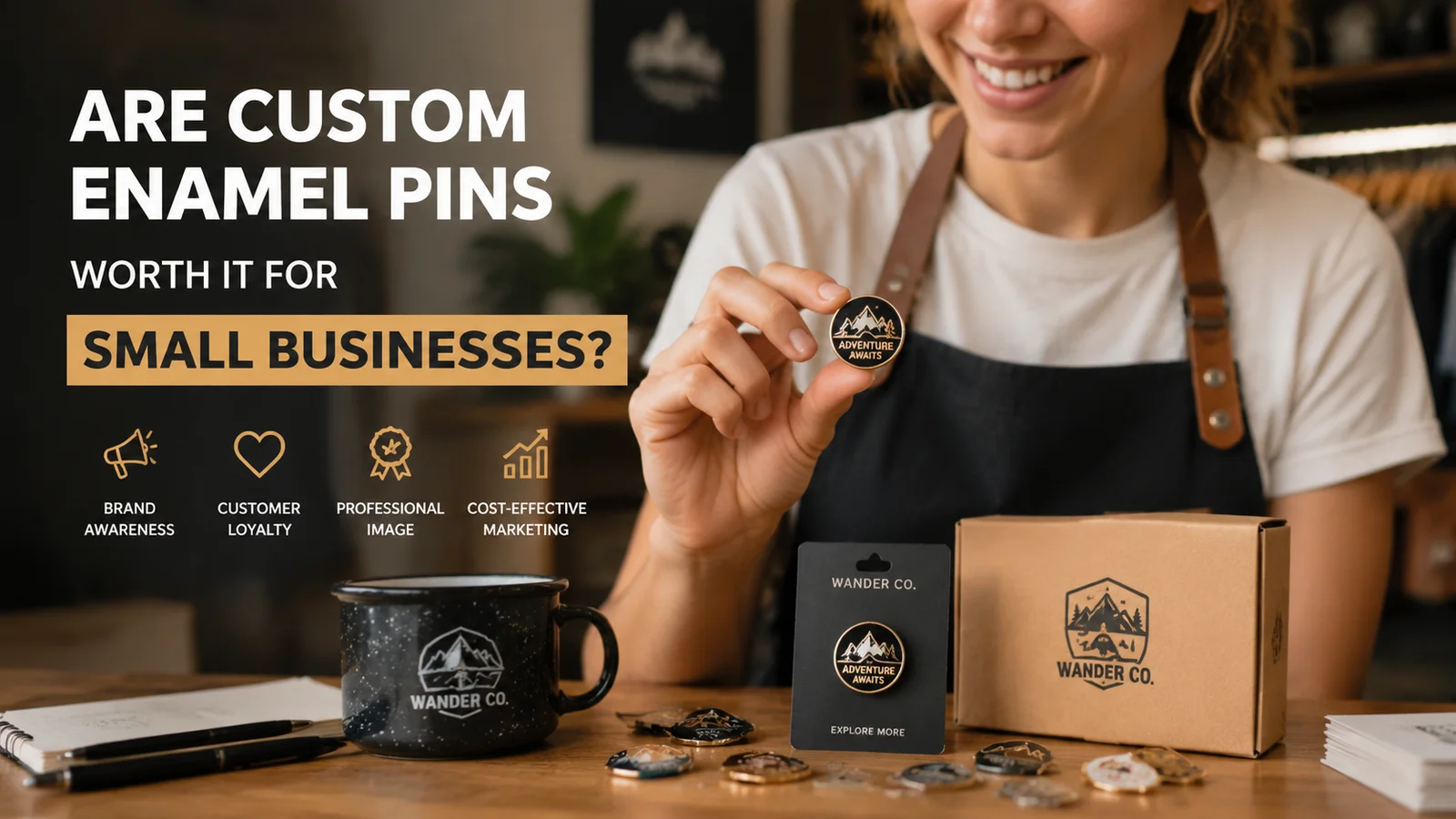
Custom enamel pins have exploded in popularity over the past few years — but are they actually worth the investment for small businesses?
Whether you run an online shop, a local brand, or a creative business, enamel pins can be more than accessories. They can become powerful tools for branding, marketing, and revenue — or a waste of budget if deployed without strategy. This guide breaks down the real value, real costs, and real strategic advantages so you can make an informed decision.
What Are Custom Enamel Pins?
Custom enamel pins are small metal accessories filled with colored enamel to create unique, brand-specific designs. They can be tailored to match your logo, brand identity, character, mascot, or creative concept — and produced in quantities ranging from 50 to tens of thousands.
Textured, affordable, vibrant
- Raised metal lines above enamel fill
- Lower production cost
- Vibrant, punchy colors
- Best for: merch, events, large orders
Smooth, polished, jewel-like
- Flat polished surface, no texture
- Higher production cost
- Premium, jewelry-grade feel
- Best for: luxury branding, gifts
For most small businesses starting out, soft enamel is the recommended choice — it delivers excellent visual quality at a significantly lower price point, and its tactile quality is actually a popular feature among buyers and collectors.
Why Small Businesses Are Using Enamel Pins
The appeal of custom enamel pins for small businesses comes down to a rare combination: low production cost, high perceived value, strong branding utility, and genuine customer enthusiasm. Here’s what makes them different from most other branded merchandise options.
Affordable Entry Product
Enamel pins are relatively low-cost to produce compared to apparel or larger merchandise — allowing small businesses to offer branded products without heavy upfront investment or inventory risk.
High Perceived Value
Even at moderate production costs, pins feel like premium collectibles. Customers are consistently willing to pay 3–5× the production cost — one of the best ratios of any physical product category.
Wearable Brand Billboards
When customers wear your pins on jackets, bags, and hats, they naturally promote your business to everyone they encounter. It’s passive, continuous, peer-trusted advertising at no recurring cost.
Drives Repeat Purchases
Pins are highly collectible. Limited editions, themed series, and exclusive drops encourage customers to return and buy again — building the kind of recurring revenue that most physical products can’t replicate.
Easy to Ship Globally
Enamel pins are lightweight, durable, and inexpensive to ship — ideal for eCommerce brands and international orders. A padded envelope is often sufficient, keeping fulfilment costs low.
Community Building Tool
Pins create shared identity within a community. Customers who wear the same pin connect with each other — a network effect that deepens brand loyalty beyond what a typical product achieves.
Considering your first pin order? Get a free, fully itemized quote with no hidden fees from CreatePins.
Get a Free Custom Quote →The Real Costs: What to Expect
Before jumping in, understanding the complete cost picture prevents unpleasant surprises and helps you price for profit from day one.
| Cost Item | Typical Range | Notes |
|---|---|---|
| Mold / setup fee | $40 – $80 per design | One-time Reused free on reorders |
| Production (100 pins) | $1.80 – $3.00 / pin | Per unit Higher at low qty |
| Production (500 pins) | $0.90 – $1.50 / pin | Per unit Volume pricing kicks in |
| Shipping (air freight) | $20 – $60 typical | Varies by destination & weight |
| Backing cards (optional) | $0.05 – $0.40 / card | Quantity-dependent; highly recommended |
| Special effects (glitter, glow, epoxy) | $0.20 – $0.80 / pin | Per effect; use selectively |
| Design preparation | Free – $50 | Free with CreatePins; external designer varies |
Always request a fully landed cost quote that includes production, shipping, and any applicable customs duties. What looks like a low per-unit price can become more expensive once all costs are factored in.
The mold fee is a one-time investment per design. On reorders of the same design, you pay production costs only — which is one of the most powerful long-term cost advantages of building a pin product line.
Are They Profitable? The Numbers
The short answer is yes — when done right, enamel pins offer some of the strongest margins in branded merchandise. Here’s a realistic worked example.
📌 Example Profit Scenario — 200 Soft Enamel Pins, 1.25″, 4 Colors
After platform fees (typically 5–15% on Etsy or Shopify), payment processing, and any marketing spend, net margins of 50–65% are realistic for a well-priced, well-marketed pin. That’s significantly better than most physical product categories available to small businesses.
✅ As your reorder volume grows, your per-unit cost drops — but your retail price stays the same. At 500+ pins, production costs can fall to under $1.50 per pin while you continue selling at $10–$12. This is where enamel pin businesses become genuinely strong margin businesses.
When Enamel Pins Are Worth It
Enamel pins work exceptionally well for certain types of businesses and situations. If several of these apply to you, pins are almost certainly a strong fit.
- You have a strong visual brand that translates well into a small format
- You sell to a niche community with shared identity (gaming, anime, art, fandoms, subcultures)
- You have an existing audience on social media, email, or a platform like Etsy
- You want a high-margin product that’s lightweight and easy to ship
- You plan to build collectible series that encourage repeat purchasing
- You’re attending events or conventions where impulse purchases are common
- You want a low-risk merch launch with minimal upfront investment
- Your audience has no interest in accessories or wearable merchandise
- Your branding doesn’t translate visually to a small 1–1.5 inch format
- You have no existing audience or marketing channel to promote the product
- You can’t economically meet minimum order quantities (50–100 pins minimum)
- Your business model is purely service-based with no physical product dimension
- You’re not prepared to market the pins actively after receiving them
The most common reason enamel pins don’t work for small businesses isn’t design quality or production costs — it’s lack of an existing audience to sell to. If you don’t yet have customers or followers who are invested in your brand, build that foundation first. Pins are a reward for an engaged community, not a tool to create one from scratch.
Have an audience and a brand idea? Our team helps you go from concept to production-ready pins — with free design assistance.
Start My First Pin Order →Smart Strategies for Small Businesses
The difference between a successful pin launch and a slow-moving inventory problem often comes down to how you approach the product strategically — not just how good the design is.
Start Small — Test Before Scaling
Launch with 1–2 designs at 100–200 pins rather than ordering 500+ immediately. A small test batch lets you validate demand, gather customer feedback, and refine your approach before committing significant budget. Your reorder at higher volume will have better per-unit costs anyway.
Use Pre-Orders to Fund Production
Running a pre-order campaign before production begins is one of the smartest risk-reduction strategies available. You validate real demand, collect payment upfront, and fund the production run before spending a dollar on inventory. Platforms like your own site, Kickstarter, or Backerkit all support this model.
Create Limited Editions for Urgency
Artificial scarcity is one of the most effective sales mechanisms for physical merchandise. A numbered edition of 100 or 200 pins creates genuine urgency — and a clear, believable reason to buy now rather than later. Limited editions also command premium pricing that further improves your margin.
Bundle Pins with Complementary Products
Pins are natural companions to stickers, art prints, tote bags, and apparel. Product bundles increase average order value without requiring the customer to make multiple separate decisions. A “starter pack” bundle at a slight discount can significantly improve your revenue per order and reduce per-shipment fulfilment cost.
Lead with Storytelling, Not Just Design
Pins that carry a narrative — a character’s backstory, the inspiration behind a design, a cause being supported — consistently outsell purely visual designs of equivalent quality. Tell the story behind each pin in your product listing, social posts, and packaging. Story creates connection; connection drives purchase.
Build a Series, Not Just Singles
A single well-designed pin can sell well. A series of 4–8 thematically connected pins turns one-time buyers into collectors who return for every release. Design your first pin with the series in mind — establish a visual language and theme that can expand naturally into subsequent drops.
The most successful small-business pin sellers think of pins as a community engagement tool first, and a revenue product second. Engaged community members share your products, create user-generated content, and recruit new buyers — organic marketing that compounds over time.
Real Use Cases for Small Businesses
Custom enamel pins serve multiple business functions beyond simple retail sales. Here’s how small businesses across different industries are putting them to work.
Final Verdict: Are Custom Enamel Pins Worth It?
Yes — for most small businesses with a visual brand and an engaged audience.
Custom enamel pins offer low production costs, strong profit margins of 60–80%, powerful branding impact, and genuine community-building potential. For many small brands, they’re not just products — they’re growth tools that pay for themselves many times over.
The key conditions for success are a visual brand identity that translates well to a small format, an existing audience to market to, and a strategic approach to launches — starting small, validating demand, and scaling on proven designs.
✅ Summary of what enamel pins deliver for small businesses: Low production costs ($1–$3/pin at volume) · High retail margins (60–80% gross) · Wearable brand exposure · Collectible repeat-purchase mechanics · Lightweight, affordable global shipping · Genuine customer enthusiasm that most merchandise can’t generate.
If you’re still on the fence, start with a single design at 100 pins. Your total investment including mold fee and shipping will likely be $250–$400. Sell 40 pins at $10 each and you’ve broken even. Everything after that is profit — and you’ve validated whether pins work for your specific audience with minimal risk.
Ready to Launch Your First Pin?
Get a transparent, all-in quote from CreatePins — free design assistance, no hidden fees, and expert guidance from concept to delivery.
Frequently Asked Questions
Yes — for small businesses with a visual brand identity and an engaged audience, custom enamel pins offer an excellent combination of low production costs, high perceived value, strong profit margins (60–80% gross), and genuine community-building potential. They’re lightweight to ship, easy to store, and create collectible repeat-purchase dynamics that most physical products cannot replicate.
At standard small-business quantities, enamel pins typically cost $1.50–$3.00 per pin depending on size, color count, enamel type, and any special effects. There is also a one-time mold fee of $40–$80 per design that is reused free on future reorders. Shipping adds $20–$60 depending on destination. Total landed cost for 200 standard soft enamel pins typically falls in the $300–$650 range including mold and shipping.
Enamel pins typically retail for $8–$15 each with production costs of $1.50–$3.00 per pin. This gives a gross profit margin of 60–80% before platform fees, packaging costs, and marketing spend. After all costs, net margins of 50–65% are realistic for a well-priced, well-marketed pin — significantly better than most other physical merchandise categories available to small brands.
Businesses with strong visual brand identities and engaged niche communities see the strongest results. This includes independent artists and illustrators, gaming and anime brands, lifestyle and streetwear labels, event organizers, non-profits and cause-driven organizations, convention and festival brands, and any creator or business with an active social media following and a community identity. The common thread is visual brand strength and an audience already invested in the brand.
Start with 1–2 designs at a small test batch of 100–200 pins to validate market response before committing to larger quantities. Consider using pre-orders to fund production before spending on inventory. Sell on Etsy or your own Shopify store, and promote through Instagram and TikTok with behind-the-scenes content and unboxing videos. Once a design validates strong demand, scale up on reorders at higher quantities for significantly better per-unit costs — and your mold is already paid for.
Enamel pins may not be the right fit if your audience isn’t interested in accessories or wearable merchandise, your branding doesn’t translate visually into a small 1–1.5 inch format, you don’t have an existing audience or marketing channel to promote the product, or you can’t economically meet minimum order quantities. The most common failure mode is ordering pins without an existing community to sell to — build your audience first, then reward them with merchandise.
References & Further Reading
- Get a Free Custom Pin Quote
- How Much Do Enamel Pins Cost to Make in 2026?
- Pricing Custom Enamel Pins for Profit (Cost Breakdown & Calculator)
- Custom Enamel Pin Hidden Costs You Should Know
- No Minimum Order Custom Pins: What You Need to Know
- How to Order Enamel Pins (Step-by-Step Guide)
- Pins vs Keychains for Giveaways: What Gets Kept?
- Shopify — How to Build and Scale a Custom Merchandise Line