Custom Enamel Pin Sample Approval Process Explained
Before your custom enamel pins go into full production, there is one critical step that protects your design, quality, and investment: the sample approval process. Understanding how does enamel pin sample approval work is essential for anyone ordering custom pins for the first time — it’s your final quality checkpoint before hundreds or thousands of pins are made.
At CreatePins.com, this step ensures that what you imagined in your design becomes exactly what you receive in the final product. Whether you’re an independent artist, a growing brand, a Kickstarter creator, or ordering custom pins for the very first time, getting familiar with the approval flow will help you avoid costly mistakes and end up with pins you’re proud of.
In this guide, we’ll walk through the entire sample review cycle, explain how does enamel pin sample approval work step by step, what to check before approving, and answer the common question: do I need a sample before ordering custom pins? We’ll also cover typical enamel pin sample cost and the enamel pin sample policy so you know exactly what to expect.
What Is an Enamel Pin Sample?
The sample approval stage is where a prototype of your custom pin is created and reviewed before mass production starts. Think of it as a final “dress rehearsal” — a real, physical (or photographed) pin made with the exact same tools and materials that will be used for your full order. This enamel pin sample allows you to confirm important details like:
Once you approve the prototype, the manufacturer proceeds with full production using the same mold and specifications. Skipping this verification step can be risky for complex designs, large orders, or anyone working with a new manufacturer for the first time — since it’s your last checkpoint before hundreds or thousands of pins are made. So, do I need a sample before ordering custom pins? For complex or large orders, the answer is almost always yes.
Digital Proof vs. Physical Sample: Quick Comparison
Every custom pin order includes a free digital proof. A physical prototype is a separate, optional step for larger or more complex orders. Here’s how they compare side by side:
| Factor | Digital Proof | Physical Sample |
|---|---|---|
| What it is | A rendered image showing layout, colors, and specs | A real, manufactured pin using your actual mold |
| Typical cost | Free, included with every order | Usually free or low-cost for orders 500+; enamel pin sample cost is deducted from bulk total |
| Added time | 1–2 days per revision | Adds roughly 5–7 days to the timeline |
| Confirms | Layout, size, color zones, plating plan, back stamp | Everything a proof confirms, plus real color, weight, texture, and finish |
| Best for | Most small-to-medium orders | Large orders, crowdfunding, complex or first-time projects |
Why a Prototype Is Important
Producing enamel pins requires custom molds, metal stamping, electroplating, and enamel filling — all specialized manufacturing processes. Once bulk production begins, changes become difficult, slow, and expensive. A physical prototype acts as your quality-control checkpoint before large-scale manufacturing starts. Here’s why you should care about how does enamel pin sample approval work:
Preventing Production Errors
Small design issues can appear during manufacturing that aren’t visible on a flat digital file — thin lines that don’t stamp cleanly, subtle color shifts, or plating inconsistencies. A sample lets you catch and correct these early, before they multiply across an entire batch.Confirming Color Accuracy
Enamel colors are matched to Pantone references, but colors on metal can look noticeably different than the same color on a digital screen. A physical or photographed sample lets you confirm the true, real-world appearance before committing.Checking Physical Details
A physical pin reveals details artwork alone can’t show — the weight in your hand, the texture of the enamel, the shine of the metal plating, and how deep the recessed color areas actually sit.Protecting Larger Orders
If you’re ordering 100–1,000+ pins, approving a sample first prevents a small mistake from turning into an expensive, hard-to-fix problem across your entire batch.The Sample Approval Process at CreatePins
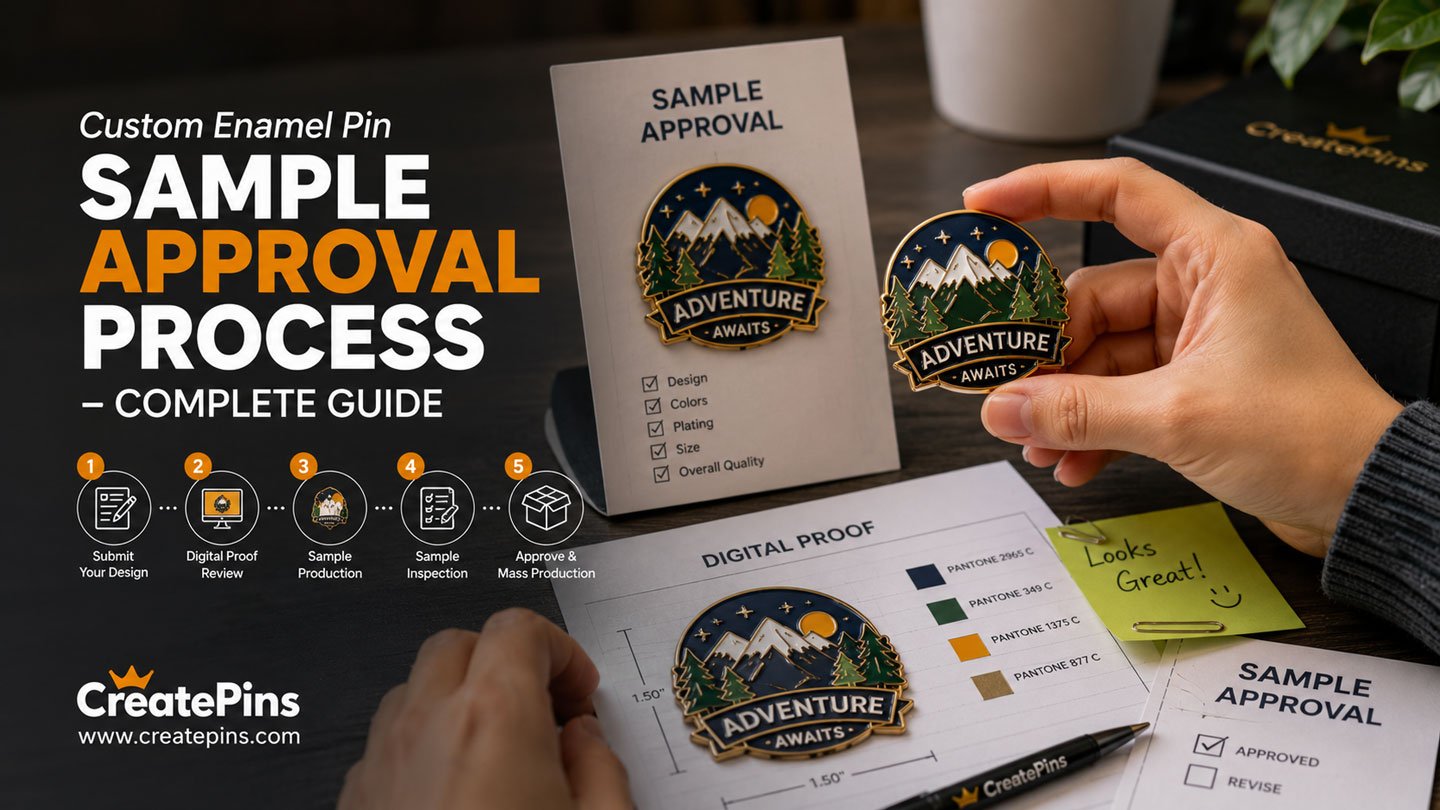
Understanding how does enamel pin sample approval work in practice is straightforward. Here’s the step-by-step workflow we follow at CreatePins to ensure your prototype meets your expectations before we start mass production.
You send your pin design or idea — a vector file, PNG, sketch, or even a logo. Our design team reviews it and converts it into a manufacturing-ready pin layout, including outlines, color zones, and plating breakdown.
Before any physical sample is made, you receive a digital proof showing size, color areas, metal lines, plating, back stamp, and attachment type. You get unlimited revisions until the proof matches your vision exactly. Only after you approve this digital proof does mold production begin.
The factory engraves your approved design into a steel mold. This mold is what stamps the pin’s shape and raised metal lines into the metal sheet — it determines the final shape and detail of every pin produced from it.
Using the finished mold, the factory produces a small number of sample pins. These prototypes go through the exact same steps as your final order: metal stamping, polishing, electroplating, enamel filling, baking, and finishing. The enamel pin sample shows you precisely how your final pins will look and feel.
You’ll receive either high-resolution photos and video of the sample, or a physical prototype shipped directly to you. Carefully check color accuracy, metal line clarity, plating finish, enamel fill quality, and pin backing placement. If everything looks good, you approve it. If changes are needed, adjustments can be made before mass production begins.
Once you confirm the sample, production begins using the same mold and specifications, and your full order is manufactured. Production timelines usually depend on order size and complexity, but typically take 2–4 weeks after approval.
CreatePins Sample Policy
Understanding our enamel pin sample policy helps you plan your project timeline and budget with confidence. Here’s what you need to know about enamel pin sample cost and how sampling works at CreatePins.
- Sampling is available for larger orders — We usually offer physical sample production for orders of 500 pins or more per design. For smaller orders, production normally proceeds after digital proof approval, which already confirms all design specifications. This is a key part of our enamel pin sample policy to keep smaller orders efficient.
- Sample quantity — To keep the process efficient, we typically produce up to 3 sample pins per design for review. These prototypes represent the final production quality and materials, not a lower-quality mockup.
- Enamel pin sample cost — Sampling may involve additional costs, particularly for physical samples shipped to you. The mold fee is never charged again when your bulk order enters production, and sampling costs are deducted from your total bulk order amount (shipping for the samples themselves is not included in that deduction). In practice, this makes enamel pin sample cost mainly a quality-assurance investment rather than an extra production cost.
- Why this policy exists — Producing samples requires the same manufacturing steps used in full production: mold engraving, metal stamping, plating, enamel filling, polishing, and finishing. By offering sampling primarily for larger orders under our enamel pin sample policy, we make sure customers placing significant orders get the highest level of quality verification before production begins.
What If You Want Changes After Seeing the Sample?
If something isn’t quite perfect in your prototype, you can request adjustments before approving it. Common changes include color adjustments, a plating change (for example, gold to black nickel), small design refinements, or back-stamp corrections. However, changes that affect the metal structure itself — like altering the outline or adding new engraved lines — may require a new mold, which can add both enamel pin sample cost and time to your project.
Digital Swatches vs. Realistic Pantone — Why They Can Differ
Understanding Color Accuracy in Your Sample
- Screen vs. Physical Material: Digital swatches are displayed on screens using RGB light, while realistic Pantone swatches represent ink or enamel on physical material. Light from a screen and enamel on metal reflect color very differently — something your enamel pin sample will reveal.
- Monitor Settings: Different monitors have different brightness, contrast, and color calibration, which can slightly change how a color looks on screen versus in real life.
- Lighting Conditions: Physical samples are viewed under ambient lighting — sunlight, office light, or indoor lamps — which can affect how a color appears compared to a backlit digital display.
- Material & Finish: For enamel pins specifically, the metal plating, enamel finish, or epoxy coating also influences how the final color reads compared to a flat digital swatch.
Because of these factors, digital swatches are used as a visual reference, while Pantone Solid Coated colors are used as the production standard to keep the final color as accurate as possible. At CreatePins.com, if color mismatch, detail loss, or unexpected finish differences occur in your final batch compared to the approved proof and Pantone swatches, we guarantee to remake the entire batch at no extra cost — even after you’ve approved your sample.
Sample Review Tips for First-Time Pin Creators
If you’re wondering do I need a sample before ordering custom pins for the first time, here are practical tips to make the most of your review:
Zoom in on your photos or physical prototype to check for uneven enamel fill or thin metal lines, hold the pin at different angles to see how plating reflects light, and don’t hesitate to ask your manufacturer questions — a good one will walk you through any concerns before you approve.
Sample Approval Checklist
Before you sign off on your prototype, run through this quick checklist. Save it or screenshot it for your next order:
- Size and shape match your approved digital proof (measure if you have the physical enamel pin sample in hand).
- Metal plating color looks correct under at least two different lighting conditions.
- Enamel colors are solid, even, and match the Pantone references you agreed on.
- Metal lines are clean, crisp, and not blurred, bent, or filled over with enamel.
- Back stamp and numbering (if applicable) are correctly placed and legible.
- Pin backing/attachment (butterfly clutch, rubber clutch, safety pin, magnet) is installed correctly and holds securely.
- Overall finish — no scratches, exposed metal, bubbling, or rough edges.
- Any requested revisions from earlier proofs have actually been applied.
Common Mistakes to Avoid During Sample Review
- Reviewing only on one screen or in one lighting condition. Colors can look different on a phone vs. a monitor, and under daylight vs. indoor lighting. Check your sample in multiple conditions before approving.
- Rushing the approval to save time. A sample review takes minutes; a full batch of incorrect pins can take weeks to remake. Slow down at this step specifically — how does enamel pin sample approval work is designed to protect you, so use it.
- Not asking about tolerances. Enamel pins have natural manufacturing tolerances (small variations in size, color, and finish). Ask your manufacturer what’s considered normal before assuming something is a defect in your sample.
- Forgetting to check the back of the pin. Back stamps, numbering, and attachment quality are easy to overlook when you’re focused on the front design of your prototype.
- Approving verbally without written confirmation. Always approve in writing (email or your manufacturer’s official proof-approval system) so there’s a clear record of what was agreed.
Do I Need a Sample Before Ordering Custom Pins?
This is one of the most common questions we hear: do I need a sample before ordering custom pins? The short answer: it depends on your order size, design complexity, and risk tolerance. Technically you can skip the physical sample stage — and for many small orders, it’s not necessary. Production can proceed directly after digital proof approval, which already confirms the design layout, colors, plating, and specifications.
At CreatePins.com, we stand behind our production quality: if color mismatch, detail loss, or unexpected finish differences occur in the final batch compared to the approved proof and Pantone swatches, we guarantee to remake the entire batch. Because of this guarantee, many customers — especially those ordering smaller quantities — choose to move straight into production after approving the digital proof without a physical sample.
When Sampling May Not Be Ideal
A physical prototype usually adds an additional 5–7 days to your production timeline. For projects with tight deadlines, this extra step may not be practical. It’s also generally not necessary for very small orders (under 500 pins per design), since the digital proof process already provides sufficient confirmation for most designs.
When Sampling Is Recommended
Physical sample approval is still valuable for projects where absolute precision matters — Kickstarter or crowdfunding campaigns, large retail merchandise orders, highly detailed or complex designs, or your first collaboration with a new manufacturer. In these cases, reviewing a physical prototype provides extra peace of mind before full production begins. If you’re asking yourself do I need a sample before ordering custom pins for any of these scenarios, the answer is a strong yes.
Glossary of Key Terms
New to custom enamel pins? Here are a few terms you’ll see throughout the sampling and production process:
- Digital Proof
- A rendered image of your pin design showing colors, plating, size, and layout before any physical manufacturing begins.
- Enamel Pin Sample
- A physical prototype of your custom pin produced using the actual mold and production process — the best way to verify quality before mass production.
- Mold
- A steel die engraved with your design, used to stamp the pin’s shape and raised metal lines into a metal sheet.
- Electroplating
- The process of coating a pin’s metal surface with a thin layer of gold, silver, nickel, or another finish for color and durability.
- Pantone Solid Coated
- A standardized color-matching system used to specify exact colors for manufacturing, independent of how a color displays on screen.
- Back Stamp
- Text, a logo, or a number engraved on the back of a pin, often used for branding or limited-edition tracking.
Final Thoughts on Sample Approval
The sample approval process is one of the most important steps in custom enamel pin production. Understanding how does enamel pin sample approval work ensures your final pins match your design, protects your investment, and prevents costly production errors. Whether you’re ordering 100 pins or 10,000, knowing do I need a sample before ordering custom pins and what the enamel pin sample cost and enamel pin sample policy are will help you make informed decisions.
At CreatePins.com, our goal is to make the process smooth and transparent — from digital proof, to sample, to final production. By carefully reviewing your prototype, you can move forward with confidence, knowing your pins will look exactly as you envisioned.
Start Your Custom Pin Project Today