How to Protect Your Designs With a Signed NDA for Custom Enamel Pins
A beginner-friendly walkthrough of copyright, trademarks, and enamel pin NDA basics — everything to check before your artwork leaves your hands.
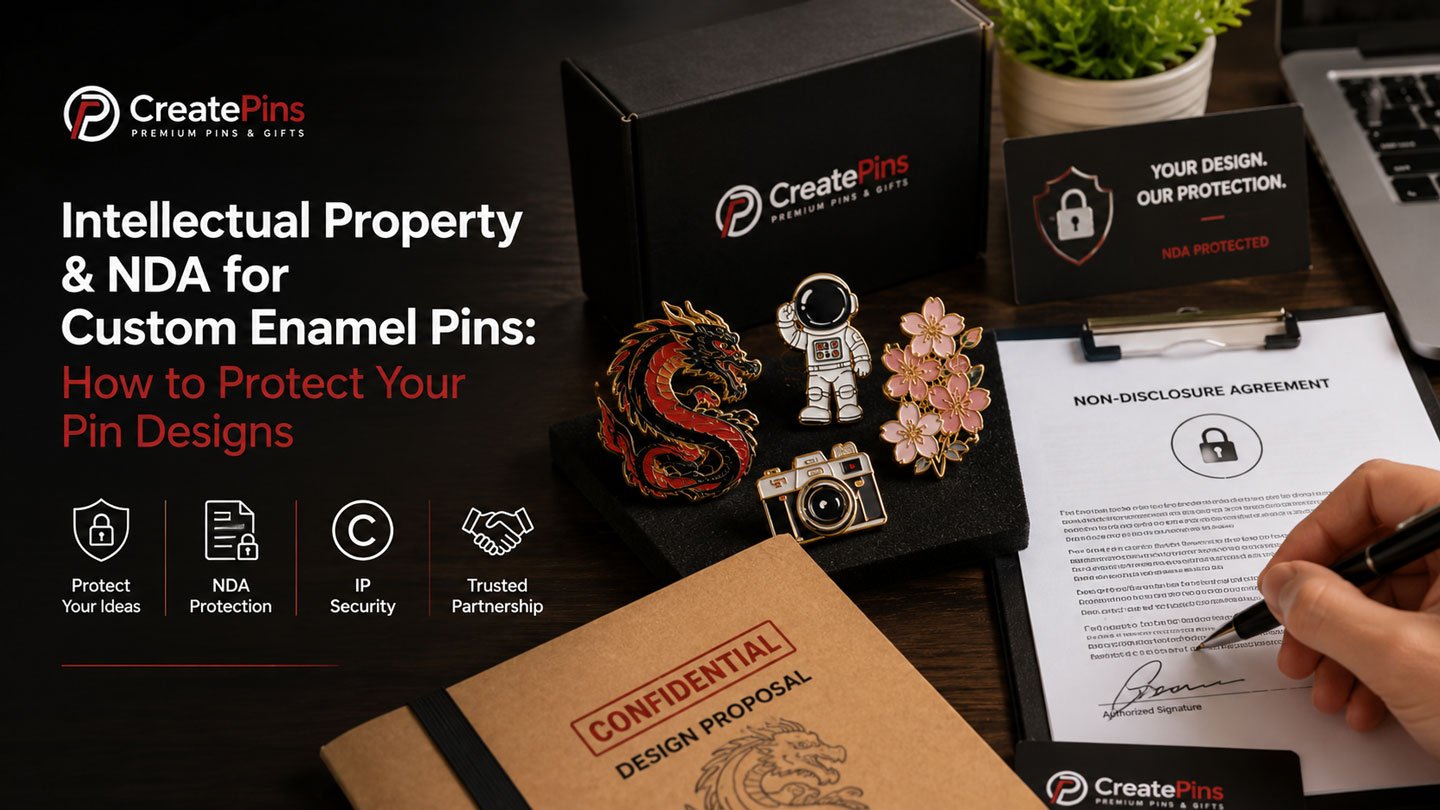
Creating a custom enamel pin usually starts with an original idea — a character, illustration, logo, mascot, or slogan that represents you or your brand. For artists and small businesses, that artwork can be genuinely valuable. So before you send your files off for production, it’s fair to ask: how do you protect enamel pin designs once someone else has your artwork?
The good news is that there are practical, beginner-friendly steps you can take. This guide covers the basics of intellectual property, copyright, trademarks, and how a confidentiality agreement fits into the picture, so you can move through manufacturing with more confidence.
Why Intellectual Property Matters for Enamel Pins
A pin looks like a small physical object, but the artwork behind it — an original character, a hand-drawn illustration, a brand mascot, a Kickstarter-exclusive design — can represent real creative and commercial value. The physical pin is only one part of the product; the underlying artwork is the part worth protecting, and that’s best handled before manufacturing, not after a problem shows up.
1. What Counts as Intellectual Property Here?
Intellectual property (IP) generally refers to creations of the mind that can receive legal protection. For pin creators, three categories usually matter most:
- Copyright — protects original creative works like illustrations, drawings, and digital artwork. This is the foundation of enamel pin copyright for most independent artists.
- Trademarks — protect brand names, logos, product names, and certain slogans tied to your business.
- Design rights & trade secrets — cover a product’s appearance in some countries, and confidential business information that has value because it isn’t public.
2. Copyright and Your Pin Artwork
Copyright generally protects original creative expression once it’s fixed in a tangible medium — save your illustration as a digital file, and it may already be protected. But not every idea qualifies. “A cat wearing a space helmet” is just an idea; the specific illustration you draw of that cat, in your pose, style, and color treatment, is the protected expression. That distinction matters a lot when you’re thinking through what’s actually protected in your artwork.
3. Your Artwork Isn’t the Same as the Physical Pin
Several distinct things exist across a single order: your original artwork, production artwork, a manufacturing mold, the physical pin, packaging artwork, and marketing photos. You may own the copyright in your illustration while a manufacturer creates separate manufacturing files or tooling based on your approved design — which is one more reason it helps to understand your agreement clearly.
4. Who Owns the Finished Pin Design?
If you supply your own artwork, make sure your agreement with the manufacturer addresses:
- You retain ownership of your original artwork
- Your artwork is used only for the agreed manufacturing purpose
- It isn’t reused for another customer’s project
- Confidential designs are handled appropriately
- Production files aren’t distributed without authorization
Don’t assume — ask, and get it clarified before production starts.
5. What Is an NDA, Exactly?
NDA stands for Non-Disclosure Agreement — a legal agreement that sets confidentiality obligations around specific information. For a pin project, that might include unreleased artwork, new character designs, an unannounced collaboration, or a Kickstarter design that hasn’t launched yet. In short, a custom pin NDA gives both sides a shared understanding of what needs to stay private.
6. When Should You Ask About One?
An NDA for custom enamel pins tends to matter most when a design hasn’t been publicly released yet — think a product launch, a convention exclusive, a surprise collaboration, or a Kickstarter campaign you don’t want appearing online before your announcement.
7. An NDA Is Not the Same as Copyright
This distinction is easy to miss but important: copyright asks “who has rights in this creative work?” An NDA asks “how should confidential information shared between us be handled?” An NDA doesn’t replace copyright protection, and owning copyright doesn’t automatically mean every recipient has a confidentiality obligation. The two work best together.
8. What Can an NDA Cover?
Wording should be worked out by the parties (and legal counsel, when it matters), but a typical confidentiality agreement addresses:
- Confidential information — what’s actually covered
- Permitted use — e.g. “to evaluate and manufacture the customer’s custom enamel pin order”
- Disclosure restrictions — who the recipient can share it with
- Protection requirements — reasonable steps to keep it secure
- Exceptions — information that’s already public or independently developed
- Duration — how long obligations last
9. What an NDA Does Not Guarantee
An NDA isn’t a magic shield. Its effectiveness depends on the wording, the parties, applicable law, and how enforceable it turns out to be. It also doesn’t prove you own the underlying artwork — which is exactly why good recordkeeping still matters, alongside broader IP protection.
10. Keep Records of Your Original Artwork
Keep your original sketches, layered working files, creation dates, revision history, emails, and approvals. A layered Photoshop, Illustrator, or Procreate file is much stronger evidence of your creative process than a single exported PNG. If you’re troubleshooting production-ready files, our guide to common artwork mistakes that delay production is a useful companion piece.
11. Be Careful With AI-Generated Artwork
AI-generated artwork raises extra questions. Don’t assume an AI-generated image has exactly the same legal status as something you drew entirely by hand — treatment varies by jurisdiction and by how much human creative input went into it. If your design matters commercially, document your prompts, your edits, and your human modifications. We go deeper on this in Turning AI Art into Manufacturable Enamel Pins and Common AI Enamel Pin Mistakes (and How to Fix Them).
12. Be Careful With Fan Art and Existing Characters
Being able to manufacture a design doesn’t mean you’re allowed to sell it. If you’re working with a licensed character, a sports logo, or another artist’s illustration, copyright, trademark, and publicity rights can all apply. A simple rule: if you didn’t create it and don’t own the rights, don’t assume you can commercially manufacture and sell it. Our guide on How to Turn Fan Art into Custom Pins (Legally) walks through this in more detail.
13. What to Share (and Not Share) With a Manufacturer
A manufacturer generally needs your artwork, dimensions, quantity, enamel type, plating, backing, and packaging notes — not your entire marketing strategy or unreleased business plan. Share what’s necessary for production, and keep the rest to yourself.
14. Use Clear File Names and Version Control
Small detail, big payoff. Instead of final.png, try something like Character_Pin_1.5in_Final_Approved_2026-08-24.png, with a simple folder structure for original artwork, manufacturing files, proofs, approved files, and your NDA. It also helps to understand which file type is actually best for production — see our Best File Formats for Custom Enamel Pins (AI vs PSD vs PNG) guide.
15. Ask About Portfolio and Marketing Use
Manufacturers work with many artists and brands, and some like to showcase finished products in their own portfolio or social media. Neither preference should be assumed — if your project is confidential, ask directly: “Can you confirm whether my artwork and finished product may be used in your portfolio or marketing?” Put the answer in writing.
16. Questions to Ask Your Manufacturer
Before sending important artwork, it’s worth asking:
- Do you offer an NDA, and how is confidential artwork handled?
- Who can access my files, and can subcontractors see them?
- Who owns my submitted artwork, and can it be reused?
- How will my artwork become production files, and will I see a proof?
- How long are files retained, and can I request deletion after production?
Not every manufacturer has identical policies — the important thing is to ask before assuming.
17. A Simple Workflow for Protecting Your Pin Design
- Create your original artwork and keep your source files
- Identify any third-party content in your design
- Confirm you have commercial-use rights
- Flag what should stay confidential
- Discuss an NDA if confidentiality matters
- Submit only what’s needed for manufacturing
- Review your proof carefully — see our Sample Approval Process guide
- Approve production and keep the final files
- Control when your unreleased design goes public
- Store your contracts, proofs, and invoices together
For a broader look at what happens after you approve artwork, see Custom Enamel Pin Order Process Explained.
18. Common Mistakes to Avoid
- Sending confidential artwork without asking about confidentiality first
- Assuming an NDA automatically means you own everything
- Using copyrighted characters without permission
- Losing your original layered source files
- Not documenting revisions or proof approvals
- Assuming your manufacturer can use your artwork for marketing
- Waiting until a dispute happens to think about ownership
Final Checklist Before You Send Your Pin Design
- I created the artwork, or I have permission to use it
- I’ve kept my original layered source files
- I know whether my design includes any third-party IP
- I have the commercial-use rights I need
- I’ve identified what should stay confidential
- I’ve asked about NDA options if confidentiality matters
- I understand how my artwork will be used and stored
- I’ve asked whether my product may appear in marketing or a portfolio
- I’ll review my production proof carefully and keep a final copy
Protecting the Design Behind the Pin
A custom enamel pin is a small physical object, but the artwork behind it can represent real creative investment. Whether you’re making your first pin or preparing a Kickstarter-exclusive collection, it’s worth knowing what you own, what you’re allowed to use, and when a custom pin NDA is worth asking about. You don’t need to become an IP lawyer — just understand the basics, keep good records, and clarify ownership before your artwork leaves your hands.
Have an unreleased pin design?
Ask our team about NDA options and get a friendly, no-pressure quote for your custom enamel pins.
Related Reading
Frequently Asked Questions
What is an NDA for custom enamel pins?
It’s a confidentiality agreement between you and your manufacturer that limits how your unreleased artwork and project details can be shared or used, separate from any copyright you already hold in the design.
Do I need an enamel pin NDA before sharing my artwork?
Not every project needs one, but it’s worth requesting whenever your design hasn’t launched yet — for example, a Kickstarter campaign, a convention exclusive, or an unannounced collaboration.
Does copyright automatically protect my pin design?
Original creative expression is generally protected once it’s fixed in a file, but plain ideas or concepts are not. The exact rules and how they’re enforced depend on your jurisdiction.
Can a manufacturer reuse or resell my artwork?
Not without your permission. A clear confidentiality agreement and manufacturing contract should state that your artwork is used only for your order and isn’t reused for another customer’s project.
What’s the simplest way to protect enamel pin designs?
Keep your original layered source files, document your creation process, ask about an NDA for confidential projects, and clarify ownership and marketing-use terms with your manufacturer before production starts.