2D vs. 3D Challenge Coins: What’s the Difference?
Compare how 2D challenge coins and 3D challenge coins are made, what each style costs, and which is right for your custom challenge coins, from military insignias to sculpted collectibles.
Challenge coins are popular for military units, law enforcement agencies, corporate recognition programs, first responders, clubs, and special events. While their size, shape, and plating all influence their appearance, one of the most important design decisions for custom challenge coins is whether to choose 2D challenge coins or 3D challenge coins.
Both styles can create professional, memorable coins, but they differ in surface depth, visual effects, design flexibility, and manufacturing considerations. Understanding 2D vs 3D challenge coins early helps you choose the right artwork, budget, and production approach.
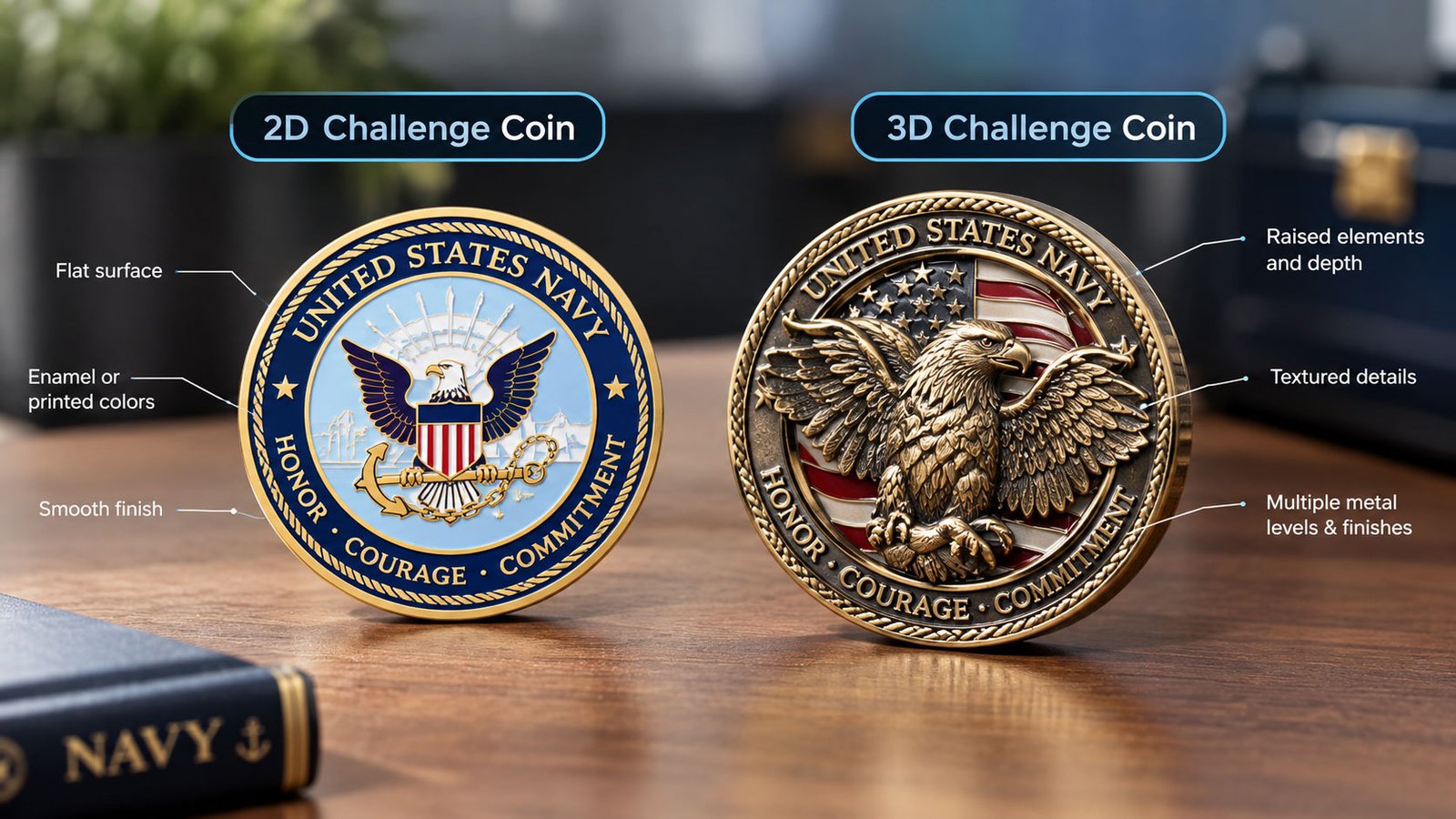
The main difference is that 2D challenge coins use flat, raised, and recessed levels to define artwork, while 3D challenge coins feature sculpted surfaces with varying heights, depths, and contours. A 2D coin is often ideal for clear logos, lettering, and detailed graphics. A 3D coin is better suited to sculpted figures, realistic portraits, animals, buildings, and designs that benefit from a more dimensional appearance.
In this guide, we explain how 2D and 3D challenge coins are made, compare their costs and applications, and help you choose the right style for your next custom challenge coins project. New to coins? Start with our complete beginner’s guide to designing custom challenge coins.
What Is a 2D Challenge Coin?
A 2D challenge coin is a custom metal coin featuring a primarily flat design with distinct raised and recessed areas. The artwork is defined by the differences in surface height, metal outlines, and colored sections rather than by sculpted, rounded forms.
Although called “2D,” these coins are not completely flat. The raised metal areas and recessed backgrounds create a small amount of physical depth and help separate different parts of the design.
Key Features of 2D Challenge Coins
Flat, defined surfaces
Artwork is arranged across relatively level planes.
Clear outlines
Raised metal borders separate colors, lettering, and design elements.
Crisp details
Text, logos, numbers, and geometric patterns are generally well suited to this style.
Flexible finishes
Options may include antique gold, antique silver, polished gold, nickel, black nickel, and other available finishes.
Color options: Depending on the design and manufacturing process, recessed areas can be filled with soft enamel or other suitable color finishes. See our guide to hard enamel vs. soft enamel and plating colors to compare finishes.
How Are 2D Challenge Coins Made?
Custom 2D challenge coins are commonly produced by striking or stamping metal with a custom die. The die creates raised and recessed areas that reproduce the approved artwork.
After striking, the coins undergo processes such as trimming, polishing, plating, coloring, and quality inspection, depending on the selected specification. Because the design relies on clearly defined surface levels, 2D challenge coins work particularly well when the artwork contains readable text, strong outlines, and organized graphic elements.
Best Uses for 2D Challenge Coins
2D challenge coins are particularly suitable for:
- Military unit insignias and official emblems
- Police, fire department, and emergency service badges
- Corporate logos and employee recognition
- Conference, convention, and promotional giveaways
- Commemorative coins with dates, names, and mottos
- Membership coins for clubs and organizations
If your coin needs to communicate an official identity or include substantial lettering, a 2D design is often a practical and cost-effective starting point. For military projects, see how to design a military challenge coin that looks professional.
What Is a 3D Challenge Coin?
A 3D challenge coin features sculpted surfaces that rise and fall across the design. Instead of relying mainly on flat levels, the artwork uses contours, rounded forms, varying depths, and dimensional relief to create a more realistic or dramatic appearance. These 3D relief challenge coins can resemble a miniature sculpture cast or struck into a metal coin.
For example, a military eagle can have individually shaped feathers, a portrait can include sculpted facial features, and a building can show dimensional columns, rooflines, and architectural details.
Key Features of 3D Challenge Coins
Sculpted relief
Different areas have varying heights and depths.
More realistic forms
Faces, animals, machinery, and objects can appear more lifelike.
Stronger visual depth
Lighting and shadows emphasize the shape of the artwork.
Premium presentation
The dimensional surface can create a distinctive collectible appearance.
Greater sculpting complexity: 3D relief challenge coins may require more detailed modeling, die preparation, and production evaluation.
How Are 3D Challenge Coins Made?
The process typically begins with artwork review and the creation of a three-dimensional model or sculpted die design. The manufacturer develops the relief according to the desired appearance, coin dimensions, and technical limitations of the selected production method.
The coin is then struck or formed using suitable tooling, followed by finishing, plating, polishing, coloring when applicable, and quality inspection. The key challenge is translating a two-dimensional reference image into a three-dimensional metal surface. Some details may need to be simplified or exaggerated so that they remain recognizable after manufacturing. If you start from AI concept art, read what AI-generated coin artwork can actually be manufactured in metal.
Best Uses for 3D Challenge Coins
3D challenge coins are especially effective for:
- Military mascots, eagles, shields, and sculpted insignias
- Detailed portraits of service members or notable figures
- Vehicles, aircraft, ships, and military equipment
- Buildings, monuments, and architectural landmarks
- Animal designs and elaborate commemorative artwork
- Premium corporate awards and collectible coins
- Coins intended to highlight craftsmanship and visual impact
If your goal is to make a coin feel like a miniature work of art, 3D relief is worth considering.
2D vs. 3D Challenge Coins: Key Differences
The following table summarizes the most important differences between the two styles.
| Feature | 2D Challenge Coins | 3D Challenge Coins |
|---|---|---|
| Surface design | Primarily flat raised and recessed levels | Sculpted surfaces with varying heights and depths |
| Overall appearance | Clean, graphic, and structured | Dimensional, sculptural, and realistic |
| Best artwork | Logos, text, emblems, geometric graphics | Portraits, animals, vehicles, buildings, complex symbols |
| Fine lettering | Often easier to accommodate | May require simplification on curved or uneven surfaces |
| Visual depth | Created mainly by stepped relief and metal outlines | Created by sculpted contours and deeper relief |
| Color application | Often straightforward in defined recessed areas | Possible, but complex relief may limit suitable color placement |
| Design preparation | Generally simpler | Usually requires more detailed 3D modeling |
| Tooling complexity | Often lower | Can be higher, depending on the sculpting requirements |
| Relative cost | Often more economical | Often more expensive for comparable specifications |
| Ideal applications | Official insignias, corporate branding, promotional coins | Premium collectibles, sculpted figures, artistic commemorative coins |
Important: These are general tendencies, not absolute rules. Actual costs and results depend on coin size, quantity, relief depth, artwork complexity, metal finish, color requirements, and the manufacturer’s production capabilities.
Which Challenge Coin Style Costs More?
In many cases, a 3D challenge coin costs more than a comparable 2D coin because it requires additional design development and more complex tooling. However, the difference is not fixed, and some elaborate 2D designs can also be expensive. Several factors influence the final price of custom challenge coins. For real numbers, see our custom challenge coin pricing guide.
1. Design Complexity
A simple 3D emblem may be easier to produce than a highly detailed 2D design containing numerous small text elements, intricate borders, and multiple colors. The number of sculpted elements, the depth of the relief, and the level of detail all influence the production requirements.
2. Coin Size and Thickness
Larger coins generally require more material and may need more substantial tooling. Deeper sculpted relief can also require sufficient thickness to preserve the intended contours. For thickness basics, read our thickness guide.
3. Order Quantity
The cost per coin is affected by the quantity ordered because tooling and setup costs are distributed across the production run. Larger orders may reduce the per-unit cost, although the exact pricing depends on the project.
4. Plating and Surface Finish
Polished gold, antique gold, antique silver, black nickel, and other finishes can change the final appearance and price. Antique finishes may help emphasize recessed details, while polished finishes can highlight raised surfaces.
5. Color and Additional Features
Soft enamel colors, printed details, cutout sections, dual-sided artwork, special edges, and other custom features can affect both production complexity and cost. Compare options in UV printing vs. screen printing for pins, coins, and badges.
Cost-saving tip: If your design mainly consists of a logo, text, and simple graphic elements, start with a 2D concept. If sculpted depth is essential to the design, request a 3D concept and compare quotations based on the same size, quantity, plating, and other specifications.
Can You Combine 2D and 3D Relief on One Challenge Coin?
Yes. A combination of 2D and 3D relief can be an effective way to balance readability, visual depth, and production cost. For example, a coin could feature a sculpted 3D eagle in the center, surrounded by a flat 2D border containing a unit name, motto, and establishment date.
Other possible combinations include:
- A 3D vehicle with flat lettering around the outer ring
- A sculpted portrait with a 2D background and border
- A 3D mascot with flat-colored sections and a clearly defined logo
- A dimensional monument surrounded by a flat text panel
This approach allows the most important visual element to stand out without making every part of the coin equally complex. When planning a hybrid design, consider the available surface area, relief transitions, minimum detail requirements, and whether the selected color-filling method is compatible with the sculpted sections.
How to Choose Between 2D and 3D Challenge Coins
The best choice depends on your artwork, budget, intended audience, and the impression you want the finished coin to create.
Choose 2D challenge coins if…
Your design includes a detailed logo or official insignia. Readable lettering, names, dates, or unit numbers are essential. You want a clean, professional appearance. You need a practical option for a large recognition or promotional order. Your artwork relies on clear outlines and distinct color areas.
Choose 3D challenge coins if…
Your design features a portrait, animal, vehicle, or sculpted object. You want visible depth and a more realistic appearance. The central artwork is more important than extensive small lettering. You are creating a premium collectible or commemorative gift. You want the physical surface to be a major part of the design.
Still Unsure? Start With Your Artwork
A useful way to decide is to ask what makes your design recognizable. If its identity depends on a logo, text, and clearly separated graphic elements, 2D relief may be sufficient. If its identity depends on shape, volume, facial features, or sculpted contours, 3D relief may be the better option.
You do not need to determine every technical detail before contacting a manufacturer. Sharing your artwork, approximate coin size, order quantity, and budget will help the manufacturer recommend a suitable production method. Learn what a good quote includes in what is included in a custom quote.
Design Tips for Professional 2D and 3D Challenge Coins
Regardless of the style you choose, good design preparation helps reduce revisions and improves the likelihood of a successful production result.
Tip 1: Prioritize the Main Visual Element
A challenge coin has limited space. Identify the most important feature first, such as a unit emblem, company logo, mascot, or commemorative symbol. Avoid giving every design element equal visual importance.
Tip 2: Keep Small Text Readable
Small lettering can become difficult to read on a coin, particularly when text follows a circular border or sits beside sculpted details. Use an appropriate font size, sufficient spacing, and a clear contrast between the lettering and its background. Ask your manufacturer to review small text before approving the final design. Our typography guide explains font size, line thickness, and spacing.
Tip 3: Match Relief Depth to the Artwork
For 2D coins, establish clear raised and recessed levels. For 3D coins, use depth selectively to emphasize the main subject. Excessively deep or tightly packed details can create manufacturing challenges, especially on smaller coins. The appropriate relief depends on the design, dimensions, thickness, and production process.
Tip 4: Select a Finish That Supports the Design
Antique finishes can emphasize recessed areas and give a coin a traditional appearance. Polished finishes can create brighter highlights on raised surfaces. The best option depends on whether you want an official, understated, vintage, or premium look.
Tip 5: Request a Digital Proof Before Production
Review the artwork carefully before approving manufacturing. Check the spelling, dates, insignia, proportions, color placement, relief levels, and the alignment of front and back designs. For a complex 3D coin, ask for a clear preview of the proposed sculpted surfaces. A digital proof is useful for evaluating the design, although it cannot reproduce every effect of the finished metal and lighting. See our sample approval process explained.
Frequently Asked Questions
Are 3D challenge coins better than 2D challenge coins?
Not necessarily. Three-dimensional relief is better for artwork that benefits from sculpted depth, while 2D relief is often better for clear logos, text, and graphic designs. The right choice depends on your priorities.
Are 3D challenge coins more expensive?
They often cost more than comparable 2D coins because of additional modeling and tooling complexity. However, the actual price depends on the design, dimensions, quantity, finish, and production method.
Can 2D challenge coins have raised metal?
Yes. The term “2D” does not mean the coin is completely flat. Traditional 2D coins have raised and recessed areas, but those areas generally form distinct levels rather than continuously sculpted shapes.
Can a 3D challenge coin have enamel colors?
Yes, depending on the design and manufacturing method. However, deeply sculpted or curved areas may not be suitable for conventional enamel filling. The manufacturer can advise which areas should remain metal and which can accommodate color.
Can the front be 3D and the back be 2D?
Yes. Combining different relief styles on opposite sides is a common design possibility. For example, the front could feature a sculpted mascot while the reverse carries flat lettering, a date, or an organizational emblem.
What is the best thickness for a 3D challenge coin?
There is no single ideal thickness for every 3D coin. The appropriate thickness depends on the coin’s diameter, the depth of the relief, the desired weight, and the complexity of the design. Discuss these requirements with your manufacturer before finalizing the specifications.
Do 3D challenge coins last longer than 2D challenge coins?
Neither style is automatically more durable. Longevity depends on the base metal, thickness, plating, protective finish, manufacturing quality, and how the coin is handled. Both styles can be made into durable commemorative pieces.
Can I turn a 2D logo into a 3D challenge coin?
Often, yes. However, a flat logo may need to be adapted for sculpted relief. The manufacturer may need to adjust proportions, simplify small details, or create additional contours to achieve a clear and manufacturable result.
Create Your Custom Challenge Coin
Choosing between 2D and 3D challenge coins does not have to be complicated. A 2D coin offers a clean, professional way to present logos, lettering, and official insignias. A 3D coin adds sculpted depth and is ideal when you want the artwork itself to become a striking physical feature. For some projects, combining both styles provides the best balance of clarity, appearance, and cost.
At CreatePins, we help customers turn artwork and ideas into custom metal products for recognition programs, organizations, businesses, and special events. Share your design, target quantity, preferred size, and finishing requirements to receive guidance on the most suitable production approach.
Ready to create your custom challenge coins? Send us your concept, and let us help you develop a challenge coin that looks professional and fits your project requirements.