Custom Emblems vs Enamel Pins: What’s the Difference?
They share similar materials, but serve very different purposes. Here’s a complete breakdown of custom emblems vs enamel pins — so you choose the right one for your brand.
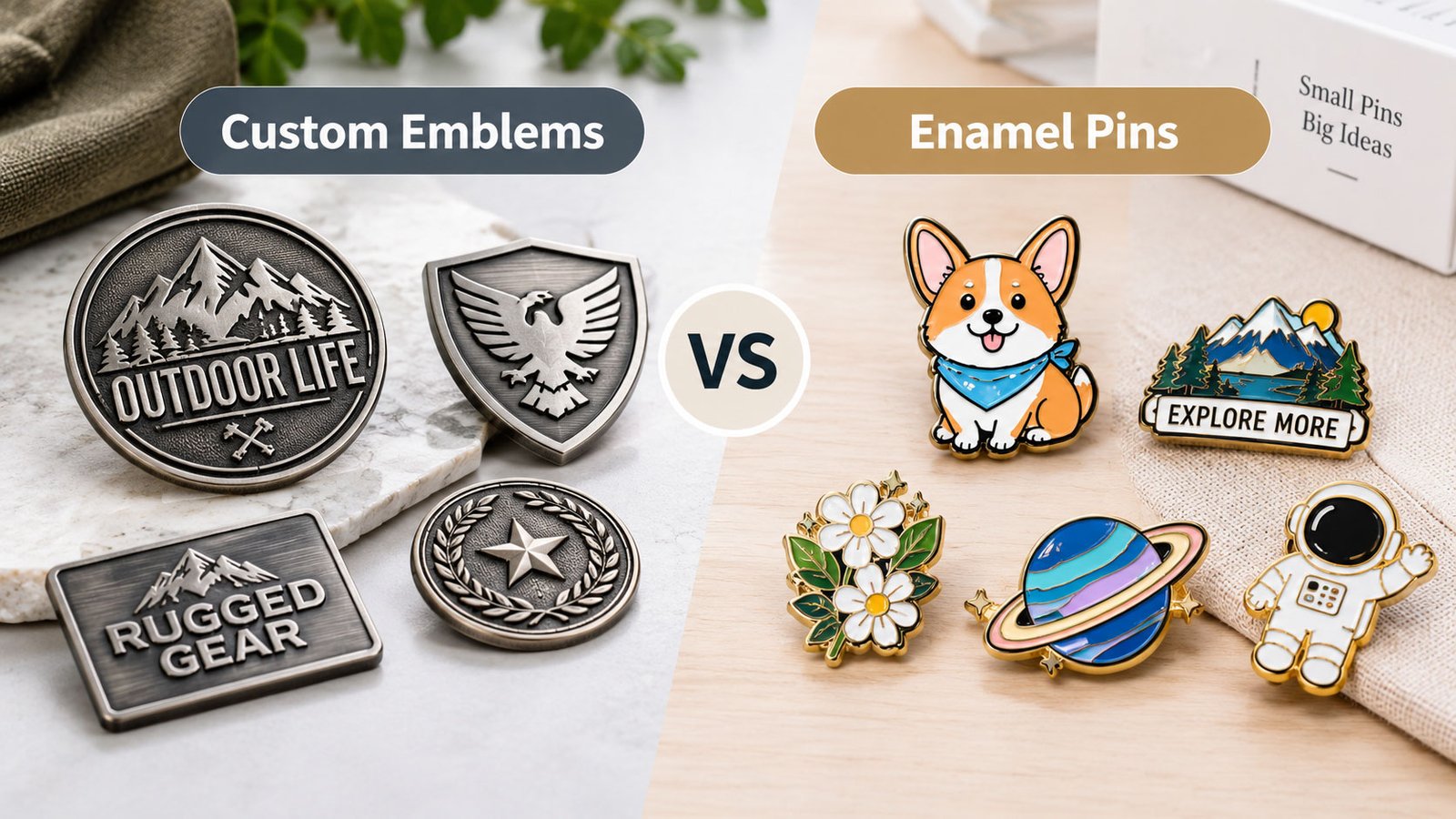
When designing branded merchandise, two popular options often come up: custom emblems and enamel pins. While they may look similar at first glance — both are small, metal, and carry a brand identity — they serve fundamentally different purposes, use different materials, and appeal to completely different audiences.
If you’re deciding between the two for your brand, this guide breaks down every key difference so you can make the right call with confidence.
⚙️ Permanent Brand Badges
- Purpose: Product branding, automotive, industrial
- Form: 3D raised or embossed surface
- Material: Metal, zinc alloy, ABS plastic
- Finish: Chrome, brushed, matte, painted
- Attachment: Adhesive, screws, clips
- Durability: Long-term outdoor rated
📌 Wearable Collectibles
- Purpose: Merchandise, promotion, collectibles
- Form: Flat or slightly raised with enamel fill
- Material: Metal base with colored enamel
- Finish: Vibrant enamel colors, polished metal
- Attachment: Pin post with clutch or rubber back
- Durability: Wearable with proper care
1 What Are Custom Emblems?
Custom emblems are raised or embossed metal or plastic badges primarily used to brand physical products, vehicles, equipment, and corporate identity applications. Think of the chrome badge on the trunk of a car, the manufacturer’s nameplate on industrial machinery, or the insignia on a luxury product’s packaging. Emblems are designed to be permanent, three-dimensional, and built to withstand environmental exposure over the life of the product they’re attached to.
- 3D relief or embossed surface — visual depth and weight
- Made from zinc alloy, brass, iron, or ABS plastic
- Chrome, matte, brushed metal, or painted coatings
- Adhesive backing, screws, clips, or rivet attachment
- Engineered for outdoor durability and UV resistance
- Typically larger and thicker than enamel pins
- Automotive branding — car logos and model badges
- Industrial equipment labels and nameplates
- Corporate or uniform insignia
- Luxury product branding and premium packaging
- Permanent outdoor-facing brand marks
- B2B and institutional brand applications
The defining characteristic of a custom emblem is permanence. Unlike enamel pins, which are worn and removed, emblems are typically fixed to a surface for the lifetime of the product they identify. This shapes every design and material decision in their production.
2 What Are Enamel Pins?
Enamel pins are decorative metal pins filled with colored enamel — the same technique used in cloisonné artwork for centuries, now applied to fashion accessories, brand merchandise, and collectibles. They’re worn on clothing, bags, and hats, and are defined by their vibrant color, compact size, and strong appeal to communities and collectors. The two primary types — soft enamel and hard enamel — differ in texture, finish, and price point, but both share the same foundational production method.
- Flat or slightly raised metal base with enamel color fill
- Soft enamel: textured surface with recessed color areas
- Hard enamel: smooth, polished, flush surface
- Pin post with butterfly clutch or rubber back attachment
- Highly customizable — virtually unlimited colors and shapes
- Designed to be worn, traded, gifted, and collected
- Retail merchandise with strong profit margins
- Community building and fandom products
- Events, campaigns, and promotional giveaways
- Brand character and illustration merchandise
- Crowdfunding rewards and limited editions
- Social media-driven product launches and drops
Enamel pins are fundamentally a consumer product — they’re made to be owned, worn, and shared by individuals who identify with what the pin represents. This audience relationship is entirely different from the B2B or product-mounted function of custom emblems.
Know which product is right for your brand? Get a free quote for custom emblems or enamel pins — our team will help you decide if you’re unsure.
Get a Free Quote →3 Emblems vs Enamel Pins: Key Differences at a Glance
Here’s a complete feature-by-feature comparison. Every row reflects a genuine distinction in how these two product types are designed, produced, and used.
| Feature | Custom Emblems | Enamel Pins |
|---|---|---|
| Primary use | Product branding, automotive, industrial | Fashion accessories, merch, collectibles |
| Form factor | 3D raised or embossed surface | Flat or slightly raised with enamel fill |
| Materials | Metal, zinc alloy, ABS plastic (thicker) | Metal base with colored enamel fill |
| Surface finish | Chrome, brushed, matte, painted | Vibrant enamel colors, polished metal borders |
| Attachment method | Adhesive, screws, clips (permanent) | Pin post with clutch (removable/wearable) |
| Durability | High — weatherproof, outdoor-rated | Moderate — wearable, can scratch |
| Design style | 3D metallic, texture, bold logo shapes | Colorful, illustrative, detailed artwork |
| Color flexibility | Limited — metallic tones, spot paint | High — vibrant enamel palette, printing add-ons |
| Cost range | Higher — larger size, complex manufacturing | Lower to mid-range — more accessible |
| Primary audience | B2B, automotive, institutional brands | Consumers, fans, artists, brands |
| Typical size | 1.5″ – 6″ (often larger) | 0.75″ – 2″ (compact wearable) |
4 Design Flexibility
Design capability is one of the most meaningful differences between these two product types — and it directly determines which is right for a given creative brief.
- Excel at texture, depth, and 3D relief that photography and printing can’t replicate
- Metallic finishes — chrome, brushed gold, antique silver — are their strongest visual asset
- Limited color vocabulary: typically metallic tones, one or two spot paint colors
- Best for clean, bold logos and iconic shapes that translate into relief form
- Fine illustrative detail doesn’t survive the casting process well at smaller sizes
- Visual impact comes from form, finish, and dimension — not color variety
- Near-unlimited color palette with vibrant, saturated enamel fills
- Can reproduce complex illustrations, characters, and fine artwork
- Printing add-ons (screen or UV) enable gradients and photographic detail
- Excellent for storytelling designs, brand characters, and visual humor
- Each color area must be fully enclosed by metal — requires structural design awareness
- Visual impact comes from color, artwork quality, and creative concept
If your brand identity centers on a bold, clean logo mark with strong silhouette recognition — think automotive manufacturers or heritage corporate brands — emblems will give that mark a physical presence and authority that no flat product can match. If your brand identity includes illustrations, characters, or color-rich artwork, enamel pins are almost always the better canvas.
5 Durability & Environment
These two products are engineered for fundamentally different operational environments — and that difference is reflected in every material and finishing choice made in their production.
✅ If your product lives outdoors — on a vehicle, piece of equipment, or outdoor signage — custom emblems are the unambiguous choice. Enamel pins are not engineered for permanent outdoor mounting. If your product lives on people — on clothing, bags, and accessories — enamel pins are the right call. Neither is universally superior; they’re engineered for different environments.
6 Cost Considerations
Cost differences between emblems and enamel pins are real and meaningful — and they reflect the genuine differences in materials, manufacturing complexity, and product scale between the two.
- Larger size requires significantly more raw material per unit
- Thicker metal stock or die-cast material adds material cost
- More complex manufacturing: high-pressure casting, grinding, multi-stage plating
- Outdoor durability requires more expensive finishing processes
- Adhesive, hardware, and attachment systems add cost
- Typically lower order volumes — less economies-of-scale benefit
- Compact size uses minimal raw material per unit
- Highly optimized production process — pins are one of the most manufactured small metal items in the world
- Simple attachment hardware (post and clutch) adds minimal cost
- Strong economies of scale — per-unit price drops significantly with volume
- Wide range of price tiers from budget soft enamel to premium hard enamel
- Lower entry point makes testing and iteration affordable
Despite emblems costing more per unit, they deliver long-term branding value for permanent applications that a disposable per-campaign promotional item can’t match. The comparison isn’t one-to-one — they’re different investments for different purposes.
Want pricing for both options? We’ll quote custom emblems and enamel pins side by side — so you can make an informed decision for your specific needs.
Get Pricing for Both →When to Choose Each
These two frameworks will resolve the decision for almost every use case. Use whichever applies to your current project.
- You need a permanent, outdoor-rated brand badge on a product
- Your application is automotive, industrial, or equipment-facing
- You want a 3D metallic look with physical depth and weight
- Your brand is B2B or institutional in nature
- You need the emblem to last for years in exposed conditions
- Your design is a bold, clean logo that translates into relief form
- You’re branding corporate uniforms, premium packaging, or luxury products
- You want sellable merchandise your customers will wear and collect
- Your design is colorful, illustrative, or character-based
- You need lower-cost promotional items for events or campaigns
- You want to build community — pins are inherently shareable
- You’re an artist, creator, or community-driven brand
- You want a product that encourages trading, gifting, and social media sharing
- You’re testing demand with low minimum order quantities
7 Can You Use Both?
Absolutely — and many of the most strategically sophisticated brands use exactly this combination. Custom emblems and enamel pins aren’t competitors for the same use case; they serve complementary roles that, used together, cover both functional product branding and customer-facing community engagement.
✅ The Combined Strategy — How It Works
- Custom emblems on your product: Permanent, durable brand badges on your packaging, equipment, vehicle fleet, or luxury goods — building brand recognition at every product interaction point
- Enamel pins as merchandise: Collectible, wearable product line sold or given away to customers — turning your brand into something people want to display and share
- Two different audiences: Emblems speak to buyers and stakeholders who evaluate product quality; pins speak to fans and customers who want to identify with your brand
- Compounding effect: Your emblem on a vehicle or product communicates permanence and authority; your enamel pin in someone’s hand or on their jacket turns them into a brand advocate
Streetwear brands do this brilliantly — enamel pins on backing cards are sold as merchandise, while metal emblem-style badges are riveted or screwed to premium garments and accessories. The customer interacts with both, and both reinforce the same brand identity through completely different physical and emotional experiences.
Final Verdict
Custom emblems and enamel pins share similar material origins but serve entirely different roles in a brand strategy. The right choice depends entirely on your goal: long-term functional product identity, or creative wearable promotion.
Durable, premium branding for products, vehicles, and equipment. Built to last years outdoors. The choice when permanence, 3D form, and institutional authority are what your brand needs to project.
Creative, wearable items for marketing, merchandise, and community building. The choice when color, collectability, and customer engagement are what your brand needs to grow.
✅ When in doubt: if your brand needs to mark something permanent, go with emblems. If your brand needs to give customers something to wear and share, go with enamel pins. And if your brand is strong enough to do both — do both. They’ll work together far better than either works alone.
Get a Free Quote — Emblems, Pins, or Both
Tell us what you’re building and we’ll recommend the best product for your goals — with transparent pricing, free design support, and worldwide shipping.
Frequently Asked Questions
Custom emblems are raised or embossed badges primarily used for permanent product branding — automotive badges, corporate insignia, industrial labels — built for long-term outdoor durability. Enamel pins are decorative flat metal pins filled with colored enamel, primarily used for wearable merchandise, promotions, collectibles, and community building. They share similar base materials but serve fundamentally different purposes and audiences.
Generally yes. Enamel pins are more affordable, especially in bulk, because they’re smaller, thinner, and involve less complex manufacturing. Custom emblems cost more due to larger size, thicker materials, more complex molding and finishing processes, and the precision required for outdoor-durability standards. However, emblems provide long-term permanent branding value that pins aren’t designed to deliver — the comparison isn’t one-to-one.
Absolutely — and many brands use this combination very effectively. Use custom emblems on your physical products for permanent functional branding, while producing enamel pins as promotional merchandise that builds community and brand engagement among customers. Emblems speak to buyers evaluating product quality; pins speak to fans who want to identify with your brand. These are complementary, not competing roles.
Custom emblems are significantly more durable for long-term outdoor or product-mounted applications. They’re engineered to withstand sunlight, rain, heat fluctuation, and years of outdoor exposure. Enamel pins are durable for daily wearable use but can scratch or chip over time. For anything mounted permanently outdoors, emblems are the clear choice. For daily wearable use, enamel pins — especially with epoxy coating — are highly appropriate.
Enamel pins offer significantly more flexibility for color and illustration. They can reproduce vibrant colors, complex artwork, characters, and fine details. Custom emblems focus on texture, depth, and metallic finish rather than color variety — they excel at clean logos, bold shapes, and 3D structural design. If your design is illustrative and colorful, pins win. If your design is a bold logo mark that needs physical dimension and metallic authority, emblems win.
Choose enamel pins when you want sellable merchandise your customers will wear and collect, colorful designs showcasing illustrations or brand characters, lower-cost promotional items for events and campaigns, or products that encourage sharing on social media. Choose custom emblems when you need permanent product branding, outdoor durability, a 3D metallic premium look, or automotive and industrial labeling.
References & Further Reading
- CreatePins — Get a Free Quote for Emblems or Enamel Pins
- CreatePins — Custom Emblem Pricing Guide: Materials, Size & Quantity
- CreatePins — Custom Emblems for Clothing Brands: Design, Types & Manufacturing Guide
- CreatePins — Hard Enamel vs Soft Enamel Pins: The Ultimate Guide (2026)
- CreatePins — Complete Enamel Pin Design Guide (2026)
- CreatePins — Are Custom Enamel Pins Worth It for Small Business?
- CreatePins — How We Help First-Time Pin Creators Succeed
- CreatePins — Why Custom Pin Prices Vary by Manufacturer?