What Enamel Pin Manufacturers Don’t Tell You Before Ordering
Custom enamel pins look simple on the surface — but behind every polished design is a manufacturing process full of details most suppliers don’t openly discuss. Here’s what you need to know before you order.
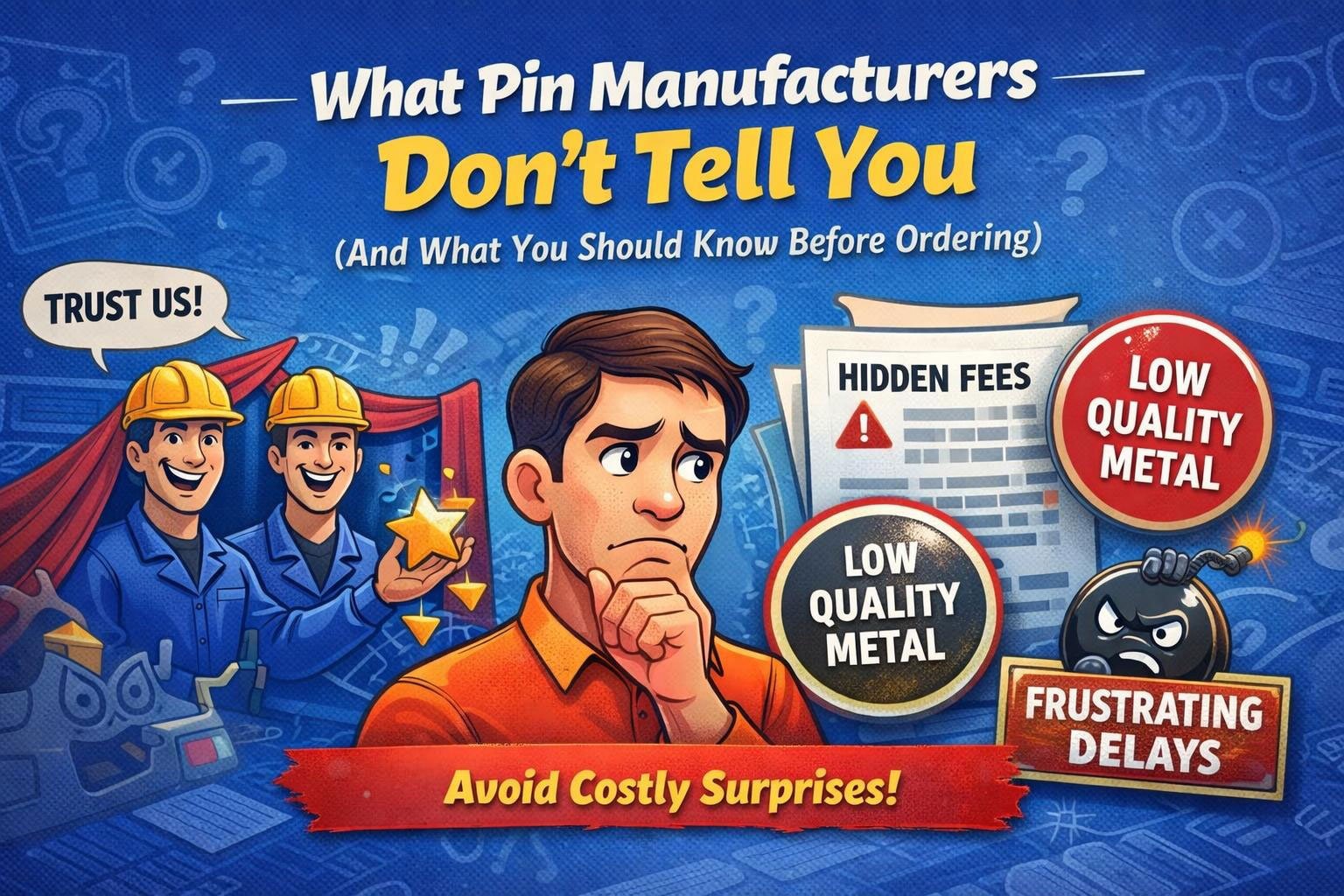
If you’re a brand, artist, or business planning to create custom enamel pins, what you don’t know can cost you — in money, time, and results that don’t match your expectations.
Most enamel pin manufacturers make the ordering process sound straightforward. And it can be — but only if you understand what’s happening behind the scenes. Here are 15 truths about enamel pin manufacturing that most suppliers won’t volunteer, along with exactly what to do about each one.
1 “No Minimum Order” Isn’t Always Truly No Minimum
Many manufacturers use “no minimum order quantity” as a marketing hook — and while technically true, the economics at very low quantities often tell a different story. The per-unit price at 10 or 20 pins can be so high that the order barely makes financial sense, and some features simply aren’t available below a certain production threshold.
- Unit price increases dramatically at very low quantities
- Setup and mold fees still apply regardless of order size
- Special effects (glitter, glow, holographic) often require a minimum quantity
- Physical sampling may not be offered for small runs
- Low-MOQ orders are often deprioritized in production scheduling
- Always request pricing at multiple quantities: 50, 100, 300, 500
- Calculate your fully landed cost per pin at each quantity level
- Start with 100 pins for your first order — enough to test demand without excessive risk
- Factor in the mold fee when comparing “no MOQ” suppliers
2 Mold Fees Are Just the Beginning
The mold (or die) is required before any pin can be produced — but “the mold fee” is rarely a single line item. Many pin manufacturers have additional setup charges that only appear once production begins or when specific features are requested. Understanding these upfront prevents frustration when the final invoice arrives.
| Additional Cost Item | Typical Range | Notes |
|---|---|---|
| Base mold fee | $40 – $80 | Per design Reused free on reorders |
| Back stamp mold | $15 – $30 | Separate fee For custom text/logo on back |
| 3D relief effect | $20 – $30 | Extra fee For raised sculptural elements |
| Cutout mold | $15 – $30 | Per cutout Negative space die cuts |
| Pin over 2 inches | +50% mold cost | Size surcharge Larger molds cost more |
| Complex design surcharge | Varies | Case by case Intricate designs cost more |
| Revision beyond limit | Varies by supplier | CreatePins: unlimited after deposit |
Always ask: “Is the mold fee one-time? Are there separate fees for back stamps, cutouts, or 3D effects? Will this mold be stored for future reorders at no charge?”
3 Colors May Not Look Exactly Like Your Design
This is consistently the most common source of disappointment for first-time pin buyers — and even experienced ones. Color discrepancies aren’t a quality failure; they’re a production reality that stems from the fundamental differences between light-based digital color (RGB) and pigment-based physical enamel.
- Screen RGB colors ≠ enamel pigment colors — even with Pantone matching
- Lighting conditions affect how colors appear in photos vs. in person
- Metal plating changes the apparent tone of adjacent enamel colors
- The same PMS code looks subtly different on soft vs. hard enamel
- Glitter enamel can shift underlying colors (e.g., black may appear greenish)
- Screen printing suits limited simple color points; UV printing handles complex gradients
- Always provide Pantone PMS codes for every color
- Request a digital proof with color annotations before approving
- For color-critical orders, request a physical sample before full production
- For gradients and complex colors, ask about UV printing rather than standard enamel
- Keep records of approved PMS codes for consistent reorders
4 Small Details Can Get Lost in Production
Enamel pins are small — typically 1–1.5 inches — and the production process has real physical limits on the level of detail that can be accurately reproduced. Fine linework, intricate textures, small text, and complex compositions that look perfect in your design software can become blurry, illegible, or structurally compromised in the finished pin.
- Thin lines (below 0.2–0.3mm) may not fill properly or collapse in the mold
- Tiny text becomes unreadable — especially in serif or script fonts
- Overly complex designs lose clarity and may require expensive production upgrades to reproduce
- Gradients and soft shadows cannot be reproduced in standard enamel at all
Simplify your design before submitting. Bold shapes, clean lines, and limited colors consistently produce the best results — and cost less to produce. Print your design at actual pin size and check every element is legible before you send it.
Our team reviews every design submission and flags production issues before your mold is created — completely free.
Get a Free Design Review →5 “Fast Production” Doesn’t Include Everything
When a manufacturer quotes a 7–10 day production time, that almost always refers exclusively to the time the pins spend in the factory being physically produced. It does not include everything that happens before or after — and those additional stages are often where most of the elapsed time actually goes.
- Design revision rounds (can take days or weeks)
- Mold creation (several days)
- Physical sample production and international shipping
- Sample review and approval rounds
- Quality control inspection before shipping
- Freight transit time (air: 7–15 days; sea: 4–6 weeks)
- Customs clearance at the destination country
- Plan for a total timeline of 3–5 weeks from order to delivery for most orders
- Add 1–2 weeks if you’re ordering a physical sample before full production
- Order pins at least 6–8 weeks before any event or launch deadline
- Ask for a full production schedule with milestone dates at order placement
If a timeline sounds too good to be true, ask exactly what stages it covers. “7-day production” with overseas shipping means your pins arrive in 3–4 weeks at the absolute minimum — not 7 days.
6 Shipping Costs Can Be a Shock
The most common post-quote surprise in pin ordering is shipping. Many custom pin manufacturers provide a production-only quote that doesn’t include freight — and when you add shipping, the actual landed cost per pin can be meaningfully higher than you expected. For international orders, customs duties and import taxes add another layer of cost that’s frequently overlooked.
- Order weight and overall package dimensions
- Destination country and distance from the factory
- Shipping speed: air freight vs. sea freight
- Customs duties and import taxes at destination
- Insurance and tracking for larger orders
- Always request a fully landed cost — production + shipping + duties
- Ask if shipping is included or quoted separately
- Ask about DDP (Delivered Duty Paid) — all-in pricing that removes customs surprises
- For large orders, compare air vs. sea freight costs and lead times
CreatePins includes standard shipping in all quotes — so the price you see is the price you pay, with no freight surprises at invoice time.
7 Quality Can Vary Significantly Between Suppliers
Two pin manufacturers can quote almost identical prices for the same design and quantity — and deliver products that are worlds apart in quality. The differences aren’t always visible in a quote or in stock photos; they emerge when you hold the physical pin. Plating that tarnishes after a few weeks, enamel that chips, colors that don’t match the proof, or pins that arrive bent — these are quality failures that no price comparison protects you from.
- Metal base thickness and rigidity
- Plating quality and tarnish resistance
- Enamel fill consistency and bleed control
- Color accuracy across the batch
- Packaging quality and pin protection in transit
- Replacement or refund policy when defects occur
- Ask for real product photos — not stock images or renders
- Check for verified customer reviews with photos of actual pins received
- Request a sample order of an existing design they’ve produced
- Ask explicitly: “What is your defect replacement policy?”
- Look for custom enamel pin manufacturers with a published quality control process
8 Special Effects Cost More Than You Think
Special effects can elevate your pin dramatically — but they add meaningful cost to each unit, and stacking multiple effects on a single design can push your per-unit price into territory that’s difficult to price for retail profit.
| Special Effect | Cost Impact | Best Use Case |
|---|---|---|
| Glitter enamel | Moderate | Accent areas, not full fill — can shift underlying color |
| Glow-in-the-dark | Moderate | Night/space/horror themes with meaningful reveal effect |
| Holographic finishes | Moderate–High | Eye-catching limited editions and premium drops |
| Moving parts (spinner) | High | When movement enhances the storytelling of the design |
| Epoxy dome coating | Low | Best value — adds gloss and protection at minimal cost |
| Screen printing | Moderate | Simple fine details beyond standard enamel limits |
| UV printing | Moderate–High | Complex colors, gradients, photographic detail |
Use special effects strategically — one standout feature per design is almost always more effective than stacking multiple effects. Epoxy coating is the most cost-efficient add-on available: it adds a premium glossy feel and protects the enamel at a very low per-unit cost.
9 Revisions May Be More Limited Than Advertised
Many custom pin manufacturers advertise “free revisions” — but the definition of what counts as a revision, and how many are truly free, varies widely. Minor color adjustments may be unlimited; structural design changes may trigger additional charges. And once the mold is created, any structural change can require a new mold at full cost.
- Only minor changes (color swaps) included in “free” revisions
- Major redesigns or layout changes charged separately
- Structural changes after mold creation can require a new mold
- Excessive revision rounds delay production timelines
- Some suppliers cap free revisions at 2–3 rounds total
- Finalize your design as completely as possible before submitting
- Ask specifically: “How many revision rounds are included, and what counts as a revision?”
- Always request a vector proof before mold creation — this is your last no-cost change window
- At CreatePins: unlimited revisions are included after the deposit — no caps
CreatePins offers unlimited design revisions after deposit — no caps, no hidden revision fees, ever.
Start Your Order with Full Transparency →10 Not All Enamel Pin Manufacturers Offer True Transparency
Transparency in manufacturing means you can see who’s making your product, track where your order is, and get honest answers about timelines, quality issues, and pricing. Not all manufacturers operate this way — and the lack of visibility can lead to costly surprises that only emerge after your deposit is paid.
- No real factory photos — only renders or stock images
- Outsource production without disclosing it
- No order tracking or production status updates
- Vague or evasive answers to direct pricing questions
- No published quality control or defect replacement policy
- Slow or inconsistent communication once deposit is paid
- Real factory photos and production team information
- Order tracking with production milestone updates
- Transparent itemized pricing — nothing hidden
- Published quality control process and defect policy
- Fast, clear communication throughout the order
- Willingness to answer any question directly and honestly
Ask for a factory tour (even a virtual one), production update photos, and a written defect replacement policy before placing a large order. A confident, quality manufacturer will have all of these readily available.
11 Packaging Isn’t Always Included
The clean, retail-ready presentation that makes a pin feel premium? Almost always an add-on. Most base quotes cover the pin and a standard backing clutch — everything else is extra. For brands selling through retail channels, conventions, or e-commerce, the packaging investment is usually worth it. For giveaways or internal use, it can often be skipped.
- Custom backing cards with your logo and branding
- Individual protective poly bags
- Retail-ready packaging with barcoding
- Premium boxes or velvet pouches for luxury pins
- Thank-you cards or additional inserts
- Retail / Etsy sales: Backing cards are essential — they define the product
- Event giveaways: Skip packaging, focus on the pin quality
- Premium / limited edition: Full packaging including box significantly increases perceived value
- All orders: Individual poly bags are low cost and prevent scratches in transit
12 Overproduction & Defect Rates Exist
In any physical manufacturing process, a percentage of units won’t meet quality standards. Enamel pin production is no different. Reputable lapel pin manufacturers account for this by producing more units than ordered — but what happens to those extras, and how defects are handled, varies significantly between suppliers.
- Industry-standard defect tolerance is typically 3–5% of a production batch
- Reputable pin manufacturers overproduce to automatically compensate for defects
- You may not automatically receive overproduced extras — ask about this policy
- Slight imperfections in enamel fill, color variation, or plating are considered within normal tolerance
- More significant defects (structural issues, wrong colors, missing elements) should be replaced
Before ordering, ask: “What is your defect tolerance rate? What quality control checks are performed? What is your replacement policy if defects exceed the stated tolerance?”
13 Communication Can Affect Everything
Most custom enamel pins are produced overseas — typically in China or Southeast Asia. This means your manufacturer operates in a different time zone, and potentially a different primary language. These differences are entirely manageable with the right supplier — but with the wrong one, they become the source of costly miscommunications, missed approvals, and production delays.
- Slow responses (more than 24–48 hours regularly)
- Vague or incomplete answers to specific questions
- No dedicated account manager for your order
- Language barriers that cause repeated misunderstandings
- No proactive updates — you always have to ask
- Replies within 24 hours (or same business day)
- Clear, specific answers with technical details where needed
- Proactive milestone updates without being asked
- A dedicated representative who knows your order history
- Written documentation of all approvals and specifications
Poor communication doesn’t just cause delays — it causes production errors. A specification that’s misunderstood because of a language barrier can result in an entire batch that doesn’t match your expectations. Always confirm critical details in writing, with photos or annotated proofs where possible.
14 The Cheapest Option Isn’t Always the Best
The temptation to choose the lowest-priced supplier is understandable — especially when starting out. But in enamel pin manufacturing, a price that seems significantly below market rate almost always signals a compromise somewhere: thinner metal, lower plating quality, less consistent color matching, slower communication, or a defect replacement policy that’s effectively “no replacements.”
- Thinner base metal that bends or feels cheap
- Plating that tarnishes quickly
- Inconsistent color accuracy across a batch
- Minimal quality control with no defect replacement
- Slow, poor communication that delays resolution
- No refunds or replacements when defects occur
- Balance cost with reputation — read verified reviews with product photos
- Calculate your full cost including reorders from defects or quality failures
- A slightly higher per-pin cost from a reliable supplier almost always costs less in total
- Request a sample before placing a large first order with any new supplier
15 A Good Manufacturer Becomes a Long-Term Partner
The best custom enamel pin manufacturers aren’t transactional vendors — they’re invested in the success of your product. They proactively flag design issues before they become production problems, suggest cost-saving optimizations based on your specific goals, help you scale production as demand grows, and store your molds safely for future reorders at no extra charge.
✅ What the right manufacturing partner does for you: Improves your designs with production-focused feedback · Suggests cost reductions without being asked · Stores your molds for reorders at no charge · Scales production with you as your business grows · Maintains honest, consistent communication throughout every order · Treats your intellectual property with confidentiality.
When you find a supplier who delivers quality, communicates clearly, and handles problems professionally — stay with them. The accumulated knowledge of your molds, approved PMS colors, and production specifications makes every subsequent order faster, cheaper, and lower-risk. That relationship has real monetary value.
Buyer’s Pre-Order Checklist
Before placing any custom pin order with a manufacturer, get answers to these questions in writing. A trustworthy supplier will answer every one clearly and promptly.
- Pricing transparency: Requested pricing at multiple quantities (50, 100, 300+) and confirmed what’s included — production, mold, shipping, and duties.
- Mold fee breakdown: Confirmed whether mold fees are one-time, what additional molds cost (back stamp, cutouts, 3D effects), and whether molds are stored for reorders.
- Color accuracy: Provided Pantone PMS codes for all colors and requested a digital proof with color annotation before approving production.
- Full timeline: Asked for a complete production schedule including design review, mold creation, sample (if applicable), production, QC, and shipping to my door.
- Landed cost: Received a quote that includes production + shipping + any applicable import duties — no surprise freight bills.
- Quality verification: Reviewed real product photos of previous orders and checked verified customer reviews with photos.
- Special effects impact: Understood the cost and any color-shifting effects of all add-ons before including them in the design.
- Revision policy: Confirmed exactly how many revision rounds are free, what counts as a revision, and what the charge is for changes after mold creation.
- Tracking visibility: Confirmed that I’ll receive production status updates and order tracking throughout the process.
- Defect policy: Received the manufacturer’s written defect tolerance rate and replacement policy for orders that arrive with quality issues.
- Packaging clarity: Understood exactly what packaging is included in the base quote and what costs extra.
✅ Knowing what pin manufacturers don’t tell you is the difference between a smooth, profitable pin launch and a costly, frustrating experience. Go into every order with this checklist and you’ll be better prepared than most buyers — including many who’ve ordered pins before.
Work With a Manufacturer Who Tells You Everything
CreatePins offers fully transparent pricing, unlimited revisions, free standard shipping, real factory photos, order tracking, and a published defect replacement policy. No hidden costs. No surprises.
Frequently Asked Questions
Not quite. While some manufacturers advertise no minimum order quantity, the unit price increases significantly at very low quantities, mold fees still apply, some special effects aren’t available for small runs, and sampling may not be offered. Always request pricing at 50, 100, and 300 units to compare your real landed cost at each quantity level before committing.
Beyond the per-unit price and base mold fee, watch for: separate mold fees for back stamps or 3D relief effects ($15–$30 each), size surcharges for pins over 2 inches, cutout mold fees, complex design surcharges, revision charges beyond the free limit, special effects premiums (glitter, glow, holographic, UV printing), and packaging costs for backing cards or retail presentation. Always request a fully itemized quote.
Several factors cause color differences: screen RGB colors don’t match enamel pigments directly; lighting conditions affect perception; metal plating changes how adjacent enamel colors appear; the same PMS code looks subtly different on soft vs. hard enamel; and glitter enamel can shift underlying colors. Always provide Pantone PMS codes for every color and request a physical sample for color-critical orders.
Manufacturer-stated production timelines refer only to the physical manufacturing process — not the full order timeline. The complete journey from order to delivery typically includes design revision rounds, mold creation, sample production and shipping, sample approval, full production, quality control, packing, international freight, and customs clearance. Budget for 3–5 weeks total — more if you’re ordering physical samples first.
Industry-standard defect tolerance is typically 3–5% of a production batch. Reputable manufacturers overproduce to account for this and should either ship replacement units automatically or have a clear replacement policy for defect rates that exceed the stated tolerance. Always ask for this policy in writing before placing a large order.
Look for: real factory photos (not stock images), verified customer reviews with photos of actual received orders, transparent itemized pricing including mold fees and shipping, order tracking or production status updates, clear and fast communication in your language, a published quality control and defect replacement policy, and free or low-cost design assistance. A supplier who provides all of these is far more likely to be a reliable long-term partner.
References & Further Reading
- CreatePins — Get a Fully Transparent Custom Quote
- CreatePins — How to Order Enamel Pins (Step-by-Step Guide)
- CreatePins — Custom Enamel Pin Production Expectations & Tolerances
- CreatePins — Custom Enamel Pin Hidden Costs You Should Know Before Ordering
- CreatePins — The Biggest Enamel Pin Design Mistakes That Ruin Everything
- CreatePins — How Much Do Enamel Pins Cost to Make in 2026?
- CreatePins — How to Turn Fan Art into Custom Pins Legally
- Want More Than Just Custom Pins?