Double-Sided Printing KeyChains: Alignment & Registration Explained
Double-sided printing is one of the best ways to elevate custom keychains, pins, and promotional products.
But achieving a clean, professional result depends on one critical factor: alignment and registration.
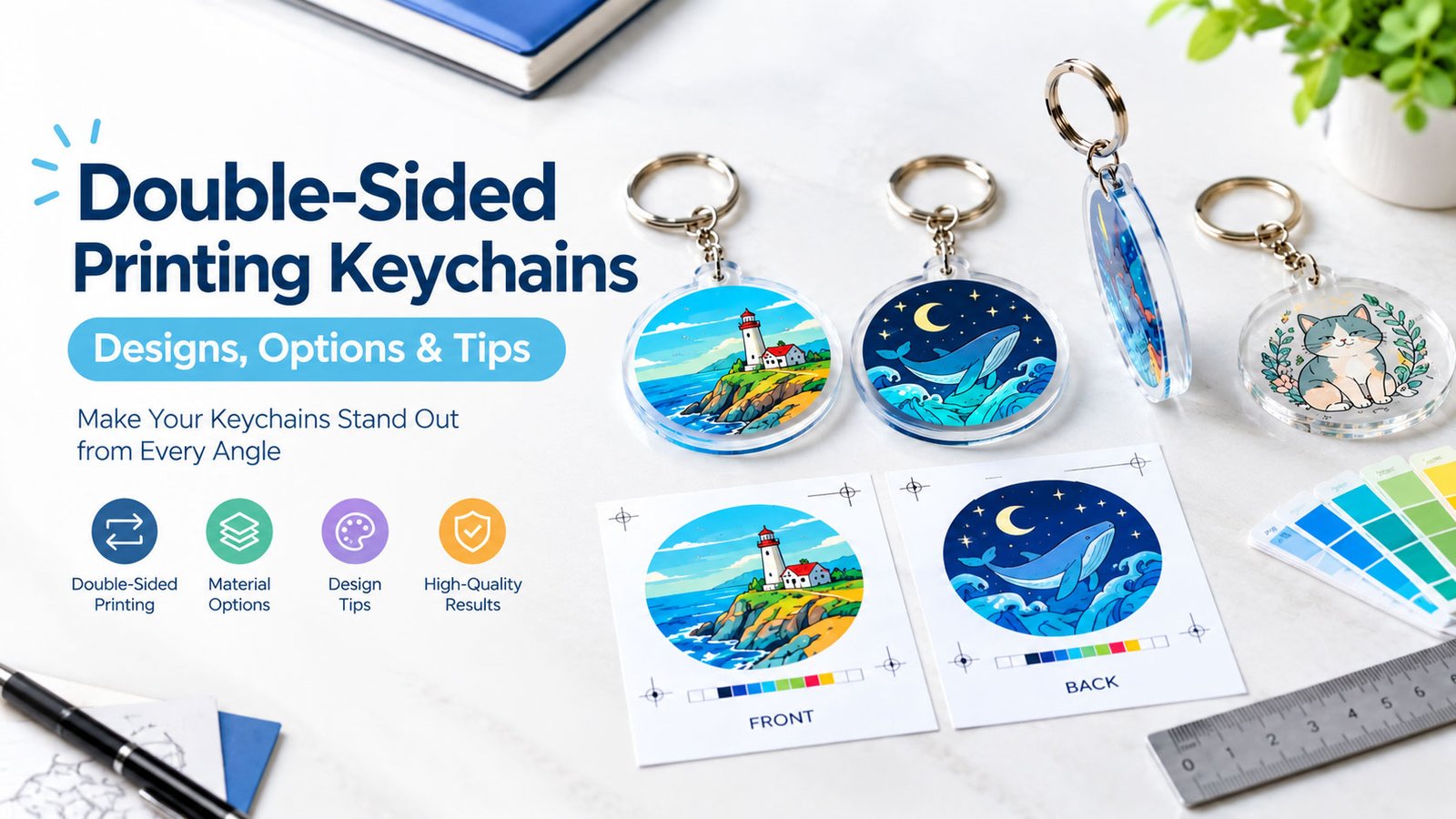
If these are off—even slightly—your final product can look unprofessional or flawed.
In this guide, we’ll break down what alignment and registration mean, how they work, and how to avoid common production issues.
What Is Double-Sided Printing Keychain?
Double-sided printing means printing a design on both the front and back of a keychain. Common items include:
- Acrylic keychains – clear or colored acrylic with artwork on both sides
- Metal keychains – often using UV or screen printing for durable two-sided graphics
- Plastic tags / luggage tags – ID cards, membership tags, or retail hang tags
This technique is popular for:
- Branding (logo on one side, contact info or slogan on the other)
- Creative designs (artwork that continues from front to back)
- Added perceived value – double-sided items feel more premium
Alignment vs Registration: What’s the Difference?
These two terms are often confused, but they refer to different things. Let’s clarify:
| Term | Meaning | Focus Area |
|---|---|---|
| Alignment | Front vs back positioning – how well the designs line up when the product is flipped | Overall placement (centered, straight) |
| Registration | Layer-to-layer precision during printing (e.g., white underlay + color layers) | Technical print accuracy (fractions of a mm) |
In production, both alignment and registration have built-in tolerances. No manufacturing process is 100% perfect, but understanding these concepts helps you design smarter.
Common Methods of Double-Sided Printing Keychains
🖨️ UV Printing (Double-Sided)
Prints directly on both sides using UV-cured ink. Allows full-color, photo-quality designs. Can include a white layer for opacity. Best for acrylic and metal.
🎨 Screen Printing (Double-Sided)
Best for simple, bold designs (2–4 colors). Requires careful manual setup. Higher risk of slight misalignment between sides. Durable and cost-effective for large volumes.
🔄 Reverse Printing (Acrylic)
Design is printed on the back side of clear acrylic and viewed through the front. Protects the print from scratches and gives a glossy, embedded look. Alignment is critical for this method.
Acceptable Tolerance: How Much Misalignment Is Normal for Double-sided Custom Keychains?
In manufacturing, perfect alignment doesn’t exist – there’s always a tolerance (an acceptable range of variation).
Typical Industry Tolerance: ±0.2 mm to ±0.5 mm (about the thickness of 2–5 sheets of paper). This means a slight shift is normal and unavoidable. Ultra-precise mirrored designs that require exact front-to-back matching are risky.
For beginners: if you design expecting 100% perfect overlap, you’ll likely be disappointed. Instead, build in safe margins (1–2 mm) and avoid critical elements that must line up exactly.
Design Tips for Perfect Double-Sided Keychains
- ✅ Avoid edge-to-edge critical elements – Keep important details (text, logos, faces) at least 1–2 mm away from the cut edge.
- ✅ Don’t rely on perfect mirroring – Designs that must line up exactly front-to-back are risky. Instead, use independent designs or allow visual flexibility.
- ✅ Use background bleed – Extend background colors beyond the cut line to prevent visible white edges if a slight shift occurs.
- ✅ Add a white layer (for UV printing) – Improves opacity, prevents transparency issues (especially on acrylic), and makes colors pop.
- ✅ Simplify shapes for screen printing – Avoid thin lines and tiny details; stick to bold, solid elements to minimize registration errors.
Beginner trap: Designing a two-sided keychain where the front and back text must be perfectly centered and mirrored. Because of tolerance (±0.3mm), the text may appear slightly off when held up to light. Solution: use a shared background or add decorative borders that hide minor shifts.
Common Risks of Double-sided Keychains (And How to Avoid Them)
✅ Solution: Add safe zones (1–2mm margin), avoid symmetry-dependent designs, and request a physical sample.
✅ Solution: Limit number of colors, increase spacing between elements, use UV printing for complex art.
✅ Solution: Always use a white ink backing layer. Ask your manufacturer about “white flood” or opaque printing.
✅ Solution: Use reverse printing (print on the back of acrylic) or add an epoxy dome coating for protection.
✅ Solution: Approve a pre-production sample first, then lock in your specifications. Work with experienced manufacturers.
Pro Tips for Double-sided Printing Keychains
📸 Always request a digital mockup
Ask for a visual showing both sides aligned, so you can spot potential issues before production.
📏 Ask about tolerance upfront
Don’t assume perfection – get the manufacturer’s stated alignment tolerance in writing.
🔍 Order physical samples first
Especially for complex double-sided designs. A sample costs little compared to redoing 500 units.
🧭 Consider orientation
Top hole placement affects how people view the alignment. Design with the hole position in mind.
🎨 Use contrasting designs
If the front is dark and busy, make the back simple and light – minor misalignment becomes less noticeable.
When Should You Use Double-Sided Printing for Custom Keychains?
Choose double-sided printing if you want to:
- Maximize branding space (logo + website + social handles on one side, mission statement on the other)
- Create premium products that feel more substantial and gift-worthy
- Add storytelling or layered design (e.g., character front, quote back)
Avoid it if:
- Your design requires perfect alignment (e.g., a cutout shape that must match exactly on both sides)
- Your budget is extremely tight – double-sided printing costs more than single-sided
- Simplicity is more important than impact – sometimes a beautiful single-sided design is enough
Ready to Create Double-Sided Custom Keychains?
Our production experts help you nail alignment, registration, and every design detail. Whether you’re a first-time creator or a seasoned brand, we’ll guide you through materials, printing methods, and tolerances to ensure a flawless result.
Get a Free QuoteResponse within 12 hours · No obligation · Custom artwork review included
Final Thoughts & Quick Checklist
Double-sided printing can significantly upgrade your custom keychains – but only if alignment and registration are handled correctly. Understanding tolerances, designing smartly, and working with the right manufacturer will help you avoid costly mistakes and achieve a polished, professional result.
📌 Bonus: Quick Checklist Before Production
- ✅ Safe margins added (minimum 1–2mm from cut line)
- ✅ No critical elements placed near edges
- ✅ White layer included (for acrylic or transparent materials)
- ✅ Design reviewed for tolerance – no perfect-mirror expectations
- ✅ Physical sample approved before bulk order
- ✅ Manufacturer’s alignment tolerance confirmed in writing
Further Reading & Related Guides
Deepen your knowledge of custom keychains and printing techniques: