How to Save 30% on Your Next Custom Pin Order
Custom enamel pins can add up fast — but with the right approach, you can realistically cut 20–30% off your next order without sacrificing a single point of quality.
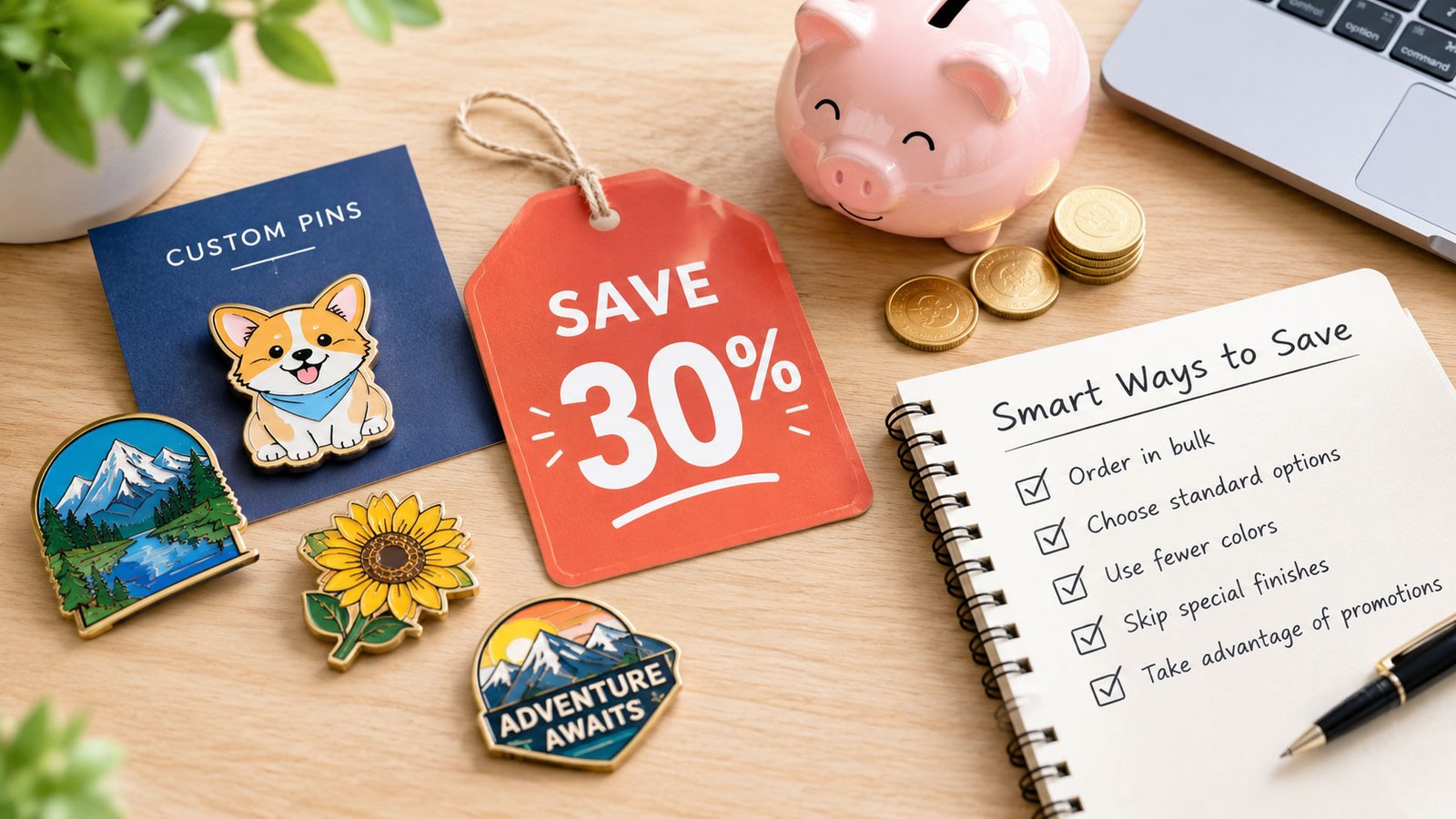
Custom pins are one of the most powerful tools for branding, merch drops, and community building — but costs can add up quickly if you’re not strategic about your choices.
The good news? You can realistically cut 20–30% off your next custom pin order without sacrificing quality. These aren’t tricks — they’re smart production decisions that most buyers simply don’t know about. Here’s exactly what to do.
1 Order in Bulk — The #1 Cost Lever
If you take away only one thing from this guide, make it this: quantity is the most powerful pricing lever in enamel pin production. Most of the cost in a custom pin order comes from fixed expenses — mold creation, setup, and labor allocation. These costs don’t change when you order more. So when you increase quantity, you spread those fixed costs across more units and your per-unit price drops dramatically.
Moving from 100 to 500 pins can cut your per-unit cost by over 48% — that’s your 30% savings target achieved from a single decision. The total spend goes up, but your cost per pin and your profit margin per sale both improve significantly.
If you’re unsure about demand, de-risk bulk ordering with pre-orders, a crowdfunding campaign, or a limited drop with urgency messaging. Selling 50% of your run before you pay for production turns a bulk order into a low-risk investment.
2 Simplify Your Design Without Losing Impact
Design complexity directly drives production cost — through increased mold precision requirements, longer hand-fill labor time, higher error rates, and more color separations. Every element you add to a design adds cost. And the counterintuitive truth is that simpler, bolder designs almost always look more striking on a pin than intricate, complex ones.
- More than 6–8 colors (each filled by hand individually)
- Tiny details and fine linework below 0.3mm
- Gradients (require screen printing upgrade)
- Multiple different plating areas on one pin
- Complex irregular die-cut outlines
- Small text in decorative or serif fonts
- Limit to 4–6 solid colors maximum
- Use bold, clean lines with adequate weight
- Use flat color blocking instead of gradients
- Keep die-cut shapes clean and balanced
- Use bold sans-serif fonts for any text
- Remove micro-details that won’t read at 1–1.5 inches
Print your design at actual pin size before finalizing. If you can clearly read every element at 1.25 inches, you’re in good shape. If anything looks crowded or uncertain, simplify — it’ll look better and cost less.
3 Choose Standard Options — Avoid Custom Everything
Every upgrade and customization sounds attractive when presented as a small per-unit add-on — but they compound quickly. A single design with three special effects can be 30–50% more expensive per unit than the same design with standard options. Choose add-ons intentionally, not automatically.
- Plating: Gold, silver, or black nickel (all same standard price)
- Backing: Rubber clutch (affordable, comfortable, popular)
- Packaging: Standard OPP poly bag
- Enamel type: Soft enamel (best cost-to-quality ratio)
- Shape: Clean die-cut silhouette without cutouts
- Glow-in-the-dark enamel (+moderate cost)
- Transparent / translucent enamel (+moderate)
- Spinner or sliding mechanical parts (+high cost)
- Custom-cut backing cards with complex shapes
- Dual or antique plating finishes (+moderate)
- Premium box packaging (+higher cost)
Black nickel is an underrated choice — it looks premium and editorial at zero extra cost over standard plating. If you want a more distinctive finish without paying for it, black nickel is your best move.
Want a cost-optimized quote based on your specific design? Our team will find the best options within your budget — free, no commitment.
Get a Free Optimized Quote →4 Optimize Your Custom Pin Size Strategically
Enamel pin size directly affects raw material usage, mold cost, and shipping weight. Many buyers default to a larger size without considering that most designs work perfectly — and actually look more polished and proportional — in the 1.25–1.75 inch range.
| Pin Size | Cost Level | Best Use Case |
|---|---|---|
| 0.75 – 1 inch | Cheapest | Simple icons, logos, minimal designs |
| 1.25 – 1.5 inch | Sweet Spot ⭐ | Most designs — best value + visual impact |
| 1.75 inch | Mid | Character designs with moderate detail |
| 2 inch | Mid–High | Complex illustrations, large text |
| 2.5 inch+ | Highest | Statement pieces, premium limited editions |
Jumping from 1.5 to 2 inches can increase your per-unit cost by 15–25% — for a pin that most wearers won’t notice is meaningfully larger. Start with the smallest size that comfortably holds all your design’s essential details.
The 1.25–1.75 inch range is the sweet spot for the vast majority of pin designs. It’s large enough for meaningful detail, small enough to wear comfortably on any garment, and keeps both mold and material costs at their most manageable.
5 Combine Designs in One Order
If you’re launching a collection of 3–6 custom pin designs, ordering them as separate, independent orders is one of the most common and avoidable ways to overpay. Consolidating multiple designs into a single production run unlocks bulk quantity pricing, reduces per-order setup overhead, and gives you significantly more negotiating leverage with your manufacturer.
- Submit 4 designs as 4 separate orders of 100 pins each
- Each order treated independently at 100-unit pricing
- 4× shipping invoices
- No consolidated volume leverage
- Submit 4 designs as one combined order of 400 pins total
- Manufacturer sees 400-unit volume and prices accordingly
- Single shipping invoice
- Lower per-pin cost across all 4 designs
For the best results, standardize your specs across all designs in a combined order: same size, same plating, same backing type. Manufacturers are significantly more flexible on pricing when you consolidate and simplify their production run.
6 Use the Right Manufacturing Method
The production method you choose has a direct impact on cost — and the most popular option isn’t always the most appropriate for your specific design. Matching your design’s complexity to the right manufacturing method is one of the most effective — and most overlooked — cost optimizations available.
| Method | Cost | Best For |
|---|---|---|
| Soft Enamel | Lowest | Best balance of cost and quality — ideal for most designs, merch, and collections |
| Hard Enamel (Cloisonné) | Higher | Premium smooth finish — use for luxury branding or collector-grade limited editions |
| Die Struck (No Color) | Cheapest | Minimalist designs with no color fill — metal-only corporate or commemorative pins |
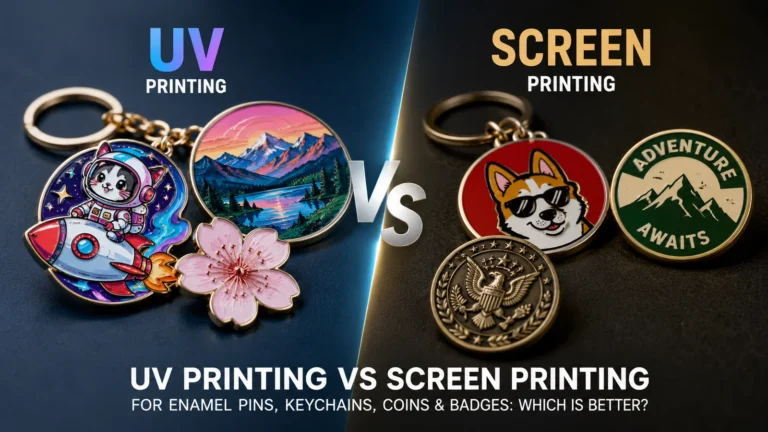
| Printed / UV Printed | Moderate | Designs with gradients, photographic detail, or complex multi-tone artwork |
Soft enamel is the right choice for the majority of custom pin orders. It offers excellent color vibrancy, a satisfying tactile quality, faster production, and meaningfully lower per-unit cost than hard enamel. Unless your audience specifically expects a hard enamel premium finish, soft enamel delivers better value at almost every price point.
7 Plan Your Custom Pin Order Ahead — Avoid Rush Fees
Rush production isn’t just a moderate price increase — it compounds. You pay a rush production surcharge to expedite manufacturing, then you pay again for express air freight to get the pins to you quickly. Combined, rushed orders can easily cost 20–30% more than the same order placed with adequate lead time.
- Rush production surcharge: +10–15% of production cost
- Express air freight vs. standard: +2–4× the shipping cost
- Less time for thorough proof review — higher error risk
- Pressure that leads to approving details you’d otherwise catch
- Potential compromise on sample review to save time
- Design review and proof: 2–4 days
- Mold creation: 3–5 days
- Sample (optional): +5–7 days
- Production: 10–15 days
- QC, packing, and standard shipping: 7–15 days
- Total: 3–5 weeks start to finish
For any event, launch, or campaign with a fixed date, order a minimum of 6 weeks in advance. 8 weeks is safer if you’re requesting a physical sample. Building this buffer into your planning calendar costs nothing and eliminates one of the most avoidable cost categories entirely.
8 Bundle Packaging & Assembly at the Factory
Many Enamel pin sellers receive their pins in bulk, then spend hours mounting them on backing cards and packing individual orders at home. This feels like it saves money — but when you factor in your own time and domestic labor costs, factory-assembled packaging is almost always more economical, especially at larger quantities.
- Ask your manufacturer to mount enamel pins on backing cards before shipping — the factory labor rate is far lower than domestic
- Request individual poly bag packaging at the factory — enamel pins arrive ready to ship directly to customers
- For Etsy or Shopify stores, enamel pins arriving fully assembled save 2–5 minutes per order in fulfillment time
- Factory packaging also reduces transit damage — enamel pins protected individually from the moment they leave production
At scale, factory assembly isn’t just cheaper — it’s more consistent. Every pin is mounted the same way, in the same orientation, with the same presentation. This quality consistency is hard to achieve in manual home packing at speed.
Ready to put these strategies into action? Get a transparent, optimized quote — we’ll help you hit that 30% savings target.
Start My Optimized Order →9 Negotiate — Yes, Really
The majority of custom pin buyers accept the first quoted price without question. This is a significant missed opportunity. Manufacturers have more pricing flexibility than their initial quotes suggest — especially for buyers who demonstrate commitment through order volume, repeat business, or willingness to leave a review.
Negotiate When Ordering 300+ Units
At 300+ pins, you’re in a volume range where manufacturers have meaningful margin to work with. Ask directly for a bulk discount — even 5–10% per unit at this quantity makes a real difference to your total cost.
Ask for Free Mold Fees on Larger Orders
Many manufacturers will absorb the mold fee entirely for orders above a certain quantity threshold. This can save $50–$80 per design — ask specifically: “Is the mold fee waived for orders over X units?”
Offer a Review for a Discount
Manufacturers value verified reviews highly. Many are willing to offer a 3–8% discount in exchange for an honest, detailed review after your order is received. Ask — this works more often than you’d expect.
Leverage Repeat Order History
Once you’ve placed one successful order, you’re a returning client — which carries real value. Ask about loyalty pricing, locked rates for future reorders, or free upgrades (better plating, included backing cards) as a thank-you for repeat business.
The key to successful negotiation is asking at the right moment and with a specific request. “Can we work on the price for this order?” is less effective than “I’m ordering 400 pins — is there a discount available at this volume?” Specific, confident, and clear asks get better results.
10 Work With a Reliable Custom Pin Manufacturer
The lowest-quoted price isn’t always the cheapest outcome. A manufacturer who cuts corners on quality, communicates poorly, or doesn’t honor their defect replacement policy can cost you far more in reorders, delays, and lost sales than a slightly higher per-unit price from a reliable partner.
- Defects requiring reorders at full cost
- Production delays that cause missed event or launch deadlines
- Color mismatches that require expensive reprints
- No replacement or refund policy when quality fails
- Communication barriers that slow problem resolution
- Lost customer trust from products that disappoint
- Consistent quality that eliminates reorder risk
- Design optimization advice that reduces your costs proactively
- Stored molds that make every reorder faster and cheaper
- Honest, proactive communication that prevents problems
- Long-term relationship that compounds savings over time
- Predictable timelines you can build your launch plans around
✅ A trustworthy manufacturer is a compounding cost advantage. Every order you place with them is faster, cheaper, and lower-risk than the first — because your molds are stored, your colors are approved, your specs are on file, and the relationship means they’ll go the extra mile when something needs resolving.
Savings Summary: All 10 Strategies at a Glance
When you combine multiple strategies from this guide, the compounding effect easily reaches — and often exceeds — the 30% savings target. Here’s a quick reference of what each one delivers.
Order in Bulk
The single highest-impact lever — increase quantity, reduce fixed costs per pin.
Simplify Design
Fewer colors, cleaner lines, no micro-details. Looks better, costs less.
Standard Options
Standard plating, rubber clutch, poly bag. Skip effects unless essential.
Optimize Size
Stay in the 1.25–1.75″ sweet spot unless your design demands more.
Combine Designs
Multiple designs in one order triggers better volume pricing across all.
Right Method
Soft enamel for most designs. Die struck for minimalist. Hard enamel for premium only.
Plan Ahead
Eliminate rush fees and express shipping by ordering 6–8 weeks in advance.
Factory Assembly
Mount and pack at the factory — cheaper than doing it locally at scale.
Negotiate
Ask for bulk discounts, free mold fees, and review discounts. Most buyers don’t.
Reliable Partner
Quality consistency and stored molds compound savings across every order.
Bonus: Quick Cost-Saving Checklist
Before placing your next order, check off as many of these as possible:
- Quantity: Can I increase my order quantity — even by 50–100 units — to access better per-unit pricing?
- Design: Can I reduce my color count to 4–6 or remove any fine details that won’t read clearly at pin scale?
- Options: Am I using standard plating, rubber clutch, and poly bag packaging — or are there add-ons I could skip?
- Size: Is my pin at the right size for the design, or could I comfortably reduce it by 0.25 inches without losing impact?
- Combination: If I’m ordering multiple designs, am I submitting them in one consolidated order?
- Method: Have I chosen the production method that matches my design — not the most expensive one by default?
- Timeline: Am I ordering with at least 6 weeks before my deadline — eliminating any need for rush production?
- Negotiation: Have I asked about volume discounts, free mold fees, or a review discount for this order?
✅ Saving 30% on your pin order isn’t about cutting corners — it’s about making smarter decisions at every step. If you checked most of these, you’re already ahead of 90% of buyers. When you combine bulk ordering, design simplification, and good planning, hitting 30% savings is absolutely realistic — while still producing pins your customers will love.
Ready to Place a Smarter Pin Order?
Tell us your design, quantity, and goals. We’ll provide a fully transparent, optimized quote — and flag every opportunity to reduce your cost without compromising quality.
Frequently Asked Questions
Ordering in bulk is by far the most powerful cost lever. Most of the cost in enamel pin production comes from fixed expenses — mold creation, setup, and labor allocation. When you increase quantity, those fixed costs spread across more units and your per-pin price drops dramatically. Moving from 100 to 500 pins can reduce your per-unit cost by 40–50% — achieving your 30% savings target from a single decision.
Simplifying your design can save 10–25% depending on what you remove. Each additional color adds hand-fill labor time and cost. Complex fine details require more precise mold work. Unnecessary effects like glow-in-the-dark or transparent enamel each add 5–20% to unit price. Limiting colors to 4–6, using bold clean lines, and removing micro-details are the most impactful simplification steps.
Yes, noticeably. Larger pins require more raw material and larger, more expensive molds. Moving from 1.5 inches to 2 inches can increase your per-unit cost by 15–25%. The 1.25–1.75 inch range is the sweet spot for balancing visual impact, wearability, and production cost efficiency. Only go larger if your specific design genuinely needs the additional space for detail.
Yes — and most buyers don’t try, which means leaving money on the table. Manufacturers are often willing to offer bulk discounts, waive mold fees for larger orders, provide free upgrades, or give loyalty discounts for repeat orders. The best approach: ask a specific, direct question — “Is there a discount available at 400 units?” or “Is the mold fee waived for orders over 300 pins?” Confident, specific asks get better results than vague requests.
Rush production can add 10–15% to your production cost — plus the significantly higher cost of express air freight. Combined, rushed orders often cost 20–30% more than the same order placed with adequate lead time. Planning with at least 6 weeks before your deadline eliminates rush fees entirely and gives you time for thorough proof review without pressure-induced mistakes.
For maximum cost efficiency: choose soft enamel (best cost-to-quality ratio), standard plating (gold, silver, or black nickel — all same price), rubber clutch backing, and standard OPP poly bag packaging. Avoid special effects like glow-in-the-dark, transparent enamel, spinner parts, or premium packaging unless they’re genuinely essential to your design concept and pricing strategy.
References & Further Reading
- CreatePins — Step-by-Step Guide: How to Order Custom Enamel Pins
- CreatePins — Pricing Custom Enamel Pins for Profit (Cost Breakdown, Calculator & Tips)
- CreatePins — Custom Enamel Pin Hidden Costs You Should Know Before Ordering
- CreatePins — Hard Enamel vs Soft Enamel Pins: The Ultimate Guide (2026)
- CreatePins — Custom Enamel Pin Production Timeline Explained
- CreatePins — Explore More Custom Products