What Thickness Should Your Keychain Be?
One of the most overlooked — but critical — decisions when designing a custom keychain. Thickness affects durability, feel, cost, and overall perceived quality.
Whether you’re creating promotional merch, retail products, or collectible items, this guide will help you choose the perfect keychain thickness for your needs.
We’ll cover what thickness actually means, how it’s measured, how different materials behave, and give you a simple decision framework — so you can place your order with confidence.
What Does “Thickness” Actually Mean?
If you’re new to custom manufacturing, the term “thickness” refers to how deep (or tall) the keychain is when viewed from the side — measured in millimetres (mm). It is not the width or the height of the keychain face; it’s how thick the material is.
📚 Key Terms for Beginners
- Thickness
- The depth of the keychain material measured from front to back, in millimetres.
- Die-cast
- A manufacturing process where molten metal is pressed into a mould to create a solid, shaped keychain.
- Plating
- A thin layer of metal (e.g. gold, silver, nickel) applied to the surface for finish and colour.
- Hard enamel
- A coloured, glass-like fill baked into recessed areas of a metal design — durable and smooth to the touch.
- Soft enamel
- A paint-like coloured fill that sits slightly below the metal borders — more textured than hard enamel.
- Bulk order
- A large quantity production run, typically 50 units or more, which reduces the per-unit cost.
Why Thickness Matters
Keychain thickness directly affects four core factors. Getting it wrong can make your product feel cheap — or unnecessarily expensive for what it is.
For example, a 1.2mm metal keychain used as a free conference giveaway is perfectly appropriate. But if you’re selling that same keychain in a retail store for $12, customers will notice it feels flimsy — and that hurts your brand. Matching thickness to context is essential.
Standard Thickness Options
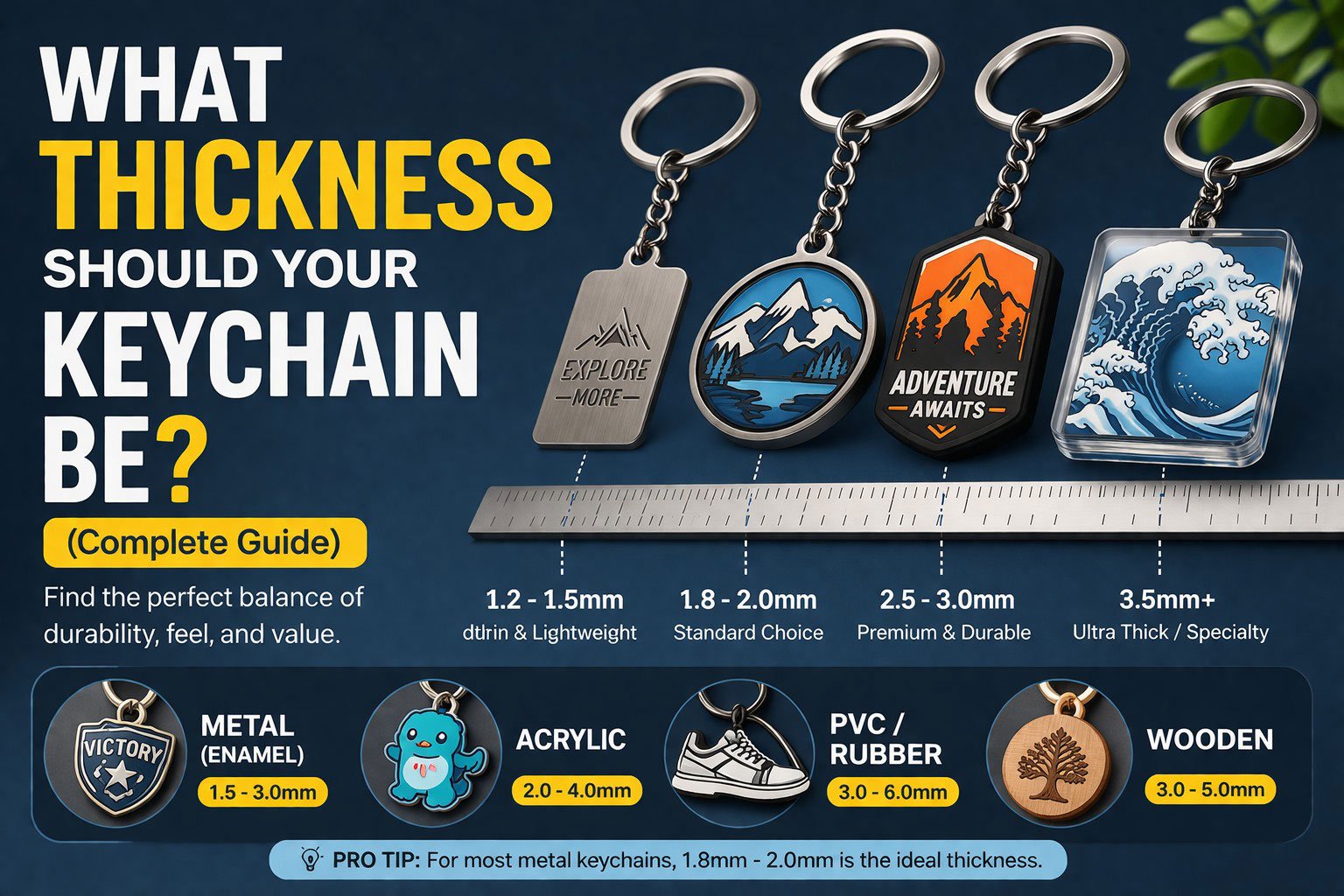
Here are the four most common thickness tiers used across the custom keychain industry. Each one has a distinct purpose and feel — understanding them will help you make the right call for your project.
- Lowest production cost
- Very lightweight — easy to carry
- Great for large bulk orders (500+)
- Fast turnaround at most factories
- Can feel flimsy or cheap
- Prone to bending under pressure
- Less surface depth for complex designs
- Not suitable for retail or premium use
- Balanced weight and durability
- Feels solid without being heavy
- Supports enamel fill cleanly
- Widely available at all factories
- Ideal starting point for beginners
- Slightly higher cost than 1.2mm
- Not the best for ultra-fine 3D detail
- Strong, long-lasting build
- Premium, high-quality feel in hand
- Ideal for intricate or multi-layer designs
- Excellent for sequential numbering engravings
- Justifies a higher retail price point
- Noticeably heavier on a keyring
- Higher per-unit production cost
- May add to shipping weight for large orders
- Extremely durable — nearly indestructible
- Unique, standout physical presence
- Perfect for double-layer or 3D sculpted designs
- Commands premium collector pricing
- Most expensive option
- Heavy — may feel bulky for everyday use
- Overkill for simple flat designs
- Not all manufacturers offer this tier
Thickness by Material Type
Different materials behave differently — and each has its own ideal thickness range. Using the wrong thickness for your material is one of the most common beginner mistakes.
| Material | Recommended Range | Most Common | Why This Range? |
|---|---|---|---|
| 🔹 Metal (Enamel / Die-Cast) | 1.5mm – 3.0mm | 1.8mm or 2.0mm | Metal is inherently strong, so thinner options still hold up well |
| 🔹 Acrylic | 2.0mm – 4.0mm | 3.0mm | Acrylic is brittle when thin; extra thickness prevents cracking |
| 🔹 PVC / Rubber | 3.0mm – 6.0mm | 4.0mm | PVC is flexible and soft, so more thickness is needed for body and structure |
| 🔹 Wood | 3.0mm – 5.0mm | 4.0mm | Wood splits easily when too thin; minimum thickness prevents warping |
Common beginner mistake: Applying metal thickness standards to acrylic or PVC. A 1.5mm acrylic keychain will crack within weeks of normal use. Always check material-specific recommendations before finalising your spec.
How to Choose the Right Thickness
Work through these four questions in order. By the end, you’ll have a clear thickness target to share with your manufacturer.
Define Your Purpose
- Giveaways / promotions: 1.2–1.5mm — cost matters most
- Everyday brand merch: 1.8–2.0mm — balanced and professional
- Retail / paid products: 2.0–2.5mm — perceived value justifies cost
- Collector / limited editions: 2.5mm+ — rarity demands premium feel
If you’re selling your keychains, anything below 1.8mm will likely feel disappointing to a paying customer.
Consider Your Design Complexity
- Simple flat logo or text → 1.5–2.0mm works fine
- Detailed character illustration → 2.0mm minimum for clean enamel fill
- 3D sculpted or layered design → go 2.5mm+ to give depth room
- Sequential numbering engravings → 2.0mm+ for best engraving clarity
Thinner materials don’t allow the engraving and layering depth that complex artwork needs.
Think About the End User’s Experience
- Will it live in a pocket or bag daily? → Weight matters — don’t go too heavy
- Will it be clipped to a bag or lanyard? → Durability is key
- Is it a gift or collector item displayed on a shelf? → Heavier = more premium
- Is it for children? → Lighter options are safer and more comfortable
Balance Cost Against Value
- Every extra 0.5mm adds material and sometimes machining cost
- But thicker keychains command higher prices and generate fewer complaints
- For retail products: the cost difference between 1.8mm and 2.5mm is often $0.10–$0.30 per unit — but the perceived value jump is far larger
For most small sellers and first-time makers, 1.8mm or 2.0mm offers the best return on investment.
⚡ Quick Decision Reference
Pro Tips from Manufacturers
1.8mm is the safest default for metal keychains. When in doubt, start here. It’s accepted by every factory and satisfies most customers.
Pair thickness with the right plating and finish (gold, rose gold, matte black) for a premium look that exceeds its price point.
For enamel designs, slightly thicker metal enhances colour depth — enamel fills look richer and more vivid on 2.0mm+ bases.
Always request a physical sample before committing to a bulk order. Photos don’t convey weight and feel — a sample will tell you everything.
Specify thickness in writing on your order form, not just verbally. Manufacturers handle hundreds of orders — a written spec prevents mix-ups.
For very large orders, calculate total shipping weight before finalising thickness. A 3.0mm vs 1.8mm choice can meaningfully change freight costs at scale.
Common Mistakes to Avoid
These are the errors we see most often from first-time keychain buyers — all easily avoidable once you know about them:
Final Recommendation
If you’re still unsure, these industry-proven standards balance quality, durability, and cost — and are safe choices for any first-time order:
metal keychains
acrylic keychains
These are the most frequently specified thicknesses in the custom keychain industry. They hit the sweet spot between material cost, structural integrity, and customer satisfaction — and they’re what most experienced designers default to.
Frequently Asked Questions
What is the best thickness for a custom keychain?
For most custom keychains, 1.8mm–2.0mm is the industry-standard sweet spot. It offers a balanced combination of durability, weight, and cost. If you’re making premium retail products or collector items, consider 2.5mm–3.0mm for a more substantial feel.
If you’re placing your first-ever order and aren’t sure, go with 1.8mm metal — it’s the most widely supported spec across all manufacturers.
What thickness should an acrylic keychain be?
Acrylic keychains are most commonly made at 3.0mm thick. The recommended range is 2.0mm–4.0mm. Unlike metal, acrylic is a brittle plastic that needs extra thickness to stay rigid and resist cracking — especially along printed edges.
Avoid going below 2.0mm for acrylic. At 1.5mm, acrylic keychains frequently crack under normal keyring use within a few weeks.
Does keychain thickness affect cost?
Yes, but the increase is usually modest. Thicker keychains use more raw material and may require additional production steps. However, moving from 1.8mm to 2.5mm typically adds only $0.10–$0.30 per unit — often well worth it for the improvement in feel and perceived quality.
The bigger cost consideration at scale is shipping weight: thicker keychains are heavier, which can add up meaningfully in a 1,000+ unit order shipped internationally.
What is the minimum thickness for a metal keychain?
The minimum practical thickness for a metal keychain is around 1.2mm. Below this, the metal becomes prone to bending, warping, and snapping at thin points under everyday use.
For keychains that will be used daily on a keyring, treat 1.5mm as your functional minimum. The 1.2mm tier should be reserved for flat, simple designs used as one-time giveaways.
Can I add sequential numbering or engraving to a thick keychain?
Yes — and in fact, thicker keychains (2.0mm and above) are better suited to laser engraving and sequential numbering because there is more surface area and material depth to work with. The engraving looks cleaner and deeper.
On thinner keychains (1.2mm–1.5mm), laser engraving can sometimes partially penetrate the material or produce less defined results. If numbering is important to your design, aim for 2.0mm minimum.
What thickness is best for PVC or rubber keychains?
PVC and rubber keychains are typically made between 3.0mm and 6.0mm thick. Because PVC is soft and flexible, greater thickness is needed to give the keychain enough body and visual presence.
A thickness of around 4.0mm is the most common choice — it provides enough structure for the design to hold its shape while remaining pliable and comfortable to handle.
Should I order a sample before bulk production?
Absolutely — always. Request a physical sample or proof before placing a bulk order, especially if you’re trying a new thickness or material combination. A sample lets you verify the weight, feel, finish quality, and colour accuracy before committing to hundreds or thousands of units.
The cost of a sample (usually $15–$50 including shipping) is negligible compared to the cost of reprinting a 500-unit order because something felt wrong. Never skip this step.
Ready to Create Your Custom Keychains?
Our team helps designers and brands get every detail right — from thickness and material to plating and finish. Whether you’re a first-time maker or a seasoned brand, we’ll guide you through the process.
Get a Free QuoteResponse within 24 hours · No obligation · Custom quote included
Further Reading & Related Guides
Deepen your keychain and accessory knowledge with these hand-picked articles from our blog:
Conclusion
The right keychain thickness can be the difference between a product that feels cheap and one customers love to carry every day. By understanding your purpose, material type, and design complexity, you can confidently choose a thickness that enhances both functionality and brand value.
As a beginner, remember the golden rule: when in doubt, go with 1.8mm for metal and 3.0mm for acrylic. These are the industry defaults for good reason — and they’re a great foundation for your first order.
As you gain experience and get feedback from real customers, you’ll develop an intuitive feel for when to go thicker or thinner. For now, start with the standard — and let a physical sample be your guide.