Why Are Custom Enamel Pins So Expensive?
The real answer to how much do custom enamel pins cost — every factor behind custom enamel pin cost, custom enamel pins price, and general enamel pin pricing, explained in plain language.
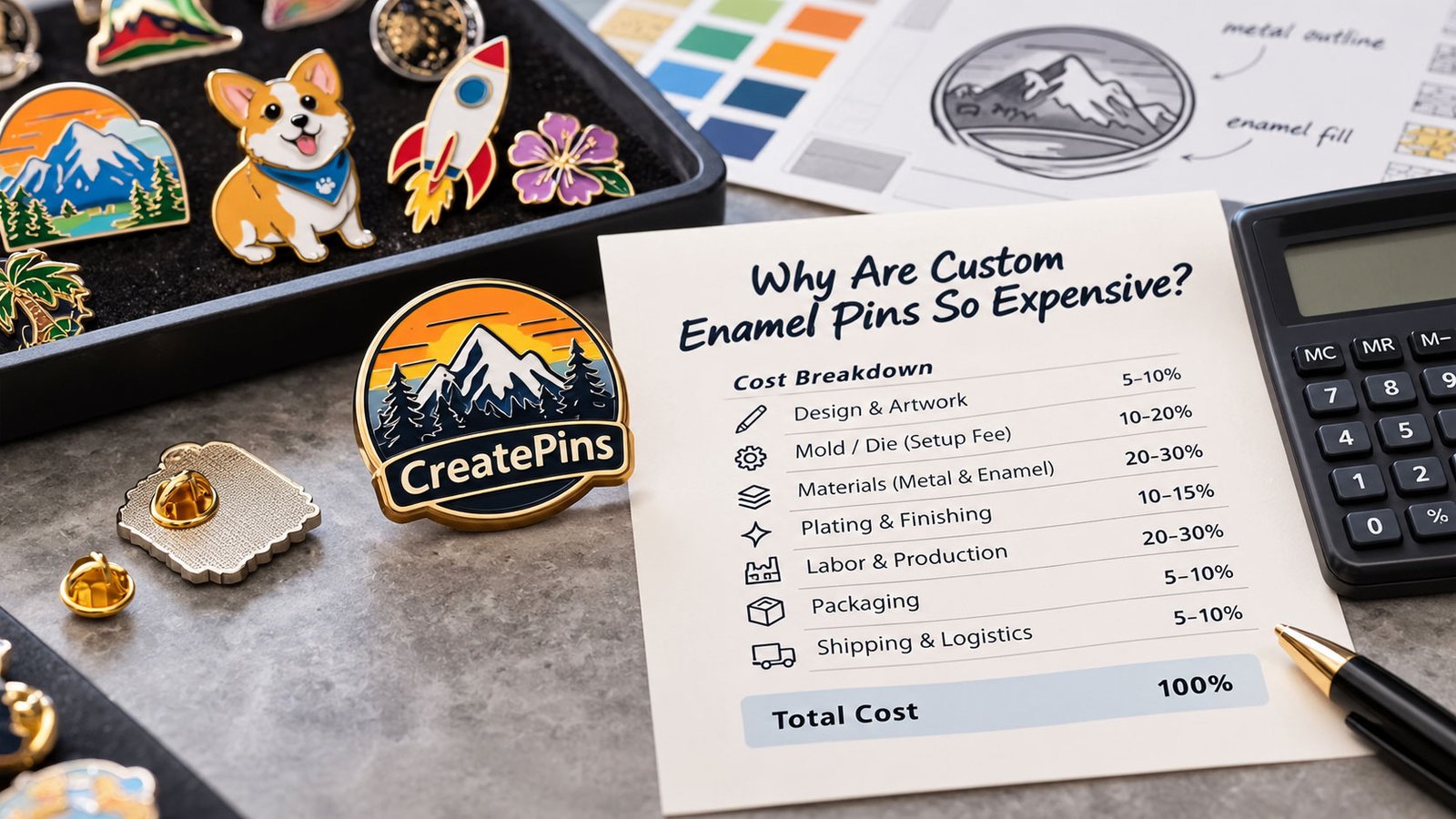
Custom enamel pins can look like simple, small products, but producing a high-quality pin involves far more than pouring enamel color into a piece of metal. From artwork preparation and mold making to plating, enamel filling, polishing, quality control, packaging, and international shipping, many individual costs are built into the final price — which is exactly why custom enamel pins price out higher than the raw materials alone would suggest.
The good news: an expensive quote isn’t automatically a better one. Understanding what you’re actually paying for makes it much easier to compare manufacturers, control your budget, and choose the right specifications. This guide answers why are custom enamel pins so expensive in plain terms, walking through every factor behind custom enamel pin cost and how to get better value without sacrificing quality.
The Short Version
Custom enamel pins cost more than raw materials suggest because the price covers mold creation, metal prep, plating, enamel filling, polishing, quality inspection, packaging, and shipping — not just the metal itself. Small orders also carry a higher cost per pin because fixed setup costs (like the mold) get spread across fewer pieces. There’s no single “price per pin” — enamel pin pricing is always built around your specific size, quantity, enamel type, colors, plating, and finishes.
What Makes Custom Enamel Pins Expensive?
To really answer why are custom enamel pins so expensive, you have to look past the metal itself. Custom enamel pin cost is shaped by pin size, order quantity, enamel type, metal plating, number of colors, mold complexity, artwork complexity, backing and packaging, special finishes, quality-control requirements, shipping method, and the manufacturer’s own business model. A simple 1-inch soft enamel pin ordered in bulk can have a completely different unit cost from a 2-inch hard enamel pin with multiple finishes and detailed artwork — because there is no single universal price per pin.
15 Reasons Custom Enamel Pins Cost What They Do
1. The Metal Is Only One Part of the Cost
Enamel pins aren’t expensive because the raw metal is expensive — the base metal is only one component. A typical pin involves metal preparation, mold creation, stamping or die casting, cutting and shaping, plating, enamel filling, polishing, backing attachment, quality inspection, and packaging. You’re paying for a finished manufactured product across multiple labor and equipment stages, not a small piece of metal.
2. Custom Molds Add an Upfront Cost
Almost every die-struck pin needs a mold created from your approved artwork. The more complicated the design, the harder the mold is to produce accurately — and tooling has to be created before production even starts. A $60 mold costs $6.00/pin at 10 pieces but only $0.06/pin at 1,000 pieces; the mold itself doesn’t get cheaper, the cost just spreads across more pins.
3. Small Orders Are More Expensive Per Pin
Quantity has a major effect on enamel pin pricing. Manufacturers carry fixed setup costs — artwork prep, mold creation, machine and plating setup, color prep, inspection, and packaging prep — whether you order 20 pins or 2,000. A 1,000-pin order won’t cost ten times as much as a 100-pin order because many of those fixed costs are shared across the larger quantity, which is why quantity-based pricing is standard.
4. Pin Size Affects the Price
A 2-inch pin generally needs more metal and enamel than a 1-inch pin, and size also affects mold dimensions, production time, weight, packaging, shipping cost, and post requirements. But bigger doesn’t always mean proportionally pricier — a small, highly detailed hard enamel pin can cost more than a larger, simple soft enamel one.
5. Hard Enamel vs. Soft Enamel Have Different Requirements
Soft enamel fills recessed metal areas and leaves a textured surface — strong contrast, clear outlines, and generally more cost-effective. Hard enamel is filled and polished until smooth and level with the metal, which adds finishing work for a premium, jewelry-like result. Neither is automatically “better” — it depends on your design, budget, and desired look.
6. Complex Artwork Increases Manufacturing Difficulty
A small pin has limited physical space, so artwork with very thin lines, tiny lettering, numerous small color sections, and closely spaced details may need adjustment to become physically manufacturable — which is why professional manufacturers review artwork before production rather than sending your file straight to a machine.
7. More Colors Can Increase Production Complexity
Adding colors doesn’t always dramatically raise the price, but more complicated color layouts add production requirements — every enamel area needs its own clearly separated metal structure. A design with 15 tiny enamel sections is harder to manufacture than one with 3 large color areas, and matching a specific PMS brand color adds its own consistency requirements.
8. Special Plating Can Increase the Price
Gold, silver, black nickel, gunmetal, copper, and matte finishes each carry different pricing. Standard plating is easier to price than unusual or combined finishes — for example, polished gold plus matte metal plus colored enamel on the same pin adds production considerations that a single standard finish doesn’t.
9. Special Effects Add Cost and Complexity
Glitter enamel, transparent enamel, glow-in-the-dark enamel, printed details, screen printing, epoxy coating, cut-outs, moving parts, and dual plating can all make a pin more distinctive — and all add production complexity. If your goal is simply an attractive logo pin, you likely don’t need any of them.
10. Quantity Matters More Than Many Buyers Expect
Always compare the same quantity — a quote for 50 pins can’t be fairly measured against a quote for 500. As a general pattern, 1–20 pieces carry a very high unit cost, 50–100 is lower, 250–500 is often significantly better, and 1,000+ spreads fixed costs across many pieces. These are general patterns, not universal brackets — actual pricing varies by manufacturer and spec.
11. Shipping Can Be a Significant Part of the Quote
The price of the pins isn’t necessarily the total cost of getting them to you. Domestic transport, international shipping, customs costs, and duties or tariffs can all apply depending on destination, package weight, size, service, and delivery speed. If one manufacturer quotes manufacturing only while another quotes a delivered price, the two numbers can look very different even with similar production costs.
12. Quality Control Is Part of the Cost
Checking shape, plating, enamel filling, color consistency, surface finish, metal lines, backing attachment, and packaging all require additional labor and handling. For commercial merchandise, this matters especially because defective products create much larger costs later — reworking or replacing 1,000 defective pins is far more expensive than catching the problem during production.
13. “Free” Design Services Still Have a Cost
Free artwork setup, proofs, revisions, and mockups aren’t actually free to the manufacturer — their design team still spends real time reviewing artwork and preparing production files. Manufacturers offering these services simply build the cost into their overall business model. The more useful question isn’t whether the proof is “free” — it’s what level of design support is actually included before you approve production.
14. A Manufacturer’s Business Model Affects Pricing
A factory, a factory-owned brand, a trading company, a reseller, a sourcing agent, and a design agency working with an outside factory can all sell the “same” pin at different prices, since each model adds different cost layers. Factory-direct doesn’t automatically mean the lowest price either — the manufacturer still covers tooling, materials, labor, equipment, QC, admin, and shipping. Compare equivalent specifications and total delivered cost, not just the model.
15. Why Some Companies Quote Much More Than Others
Send identical artwork and specs to five manufacturers and you may get five different prices — that doesn’t mean four are overcharging. Differences come from facilities, labor costs, overhead, quality standards, plating processes, order quantities, shipping methods, included services, and profit margins. Supplier A at “$400 + $100 shipping” and Supplier B at “$450 including shipping” only differ by $50 once you compare apples to apples.
How to Compare Custom Enamel Pin Quotes
When comparing manufacturers, make sure every quote is based on the same specification:
| Specification | Compare |
|---|---|
| Pin size | Same dimensions |
| Quantity | Same number of pieces |
| Enamel type | Soft or hard |
| Metal | Same plating |
| Number of colors | Same design |
| Backing | Same backing type |
| Special effects | Same requirements |
| Mold | Included or separate |
| Artwork | Design/proof fees |
| Packaging | Included or separate |
| Shipping | Method and destination |
| Duties/tariffs | Included or excluded |
| Production time | Same basis |
| Defect policy | Terms and remedies |
How to Reduce Custom Enamel Pin Costs
You don’t necessarily need to sacrifice quality to lower your budget:
1. Increase the Quantity
If you’ll realistically need more later, ordering more now can lower unit cost — but don’t over-order pins you have no plan to sell or use.
2. Choose an Appropriate Size
If 1.25″ works, you don’t need 2″. Smaller dimensions reduce material and shipping weight — just don’t go so small that artwork becomes unreadable.
3. Simplify Detailed Artwork
Removing unnecessary tiny details makes manufacturing easier and can actually improve the finished appearance.
4. Choose Soft Enamel When Appropriate
If you like the textured look and don’t need a polished surface, soft enamel is often the more practical option.
5. Avoid Unnecessary Special Effects
Glitter, glow, printing, and multiple finishes are attractive, but skip them if your design already works without them.
6. Compare the Total Delivered Price
Ask “what will I actually pay to receive the finished pins” — not just the manufacturing price alone.
Are Expensive Enamel Pins Worth It?
There’s no universal answer — it depends on what you’re buying and what the pins need to accomplish. A $2 pin and a $5 pin can have completely different sizes, materials, finishes, production quantities, enamel types, packaging, QC standards, and shipping arrangements. The cheapest quote isn’t automatically the best value if it excludes important costs or delivers a result that doesn’t meet your needs. Instead of asking “which manufacturer has the cheapest price,” ask “which manufacturer gives me the specifications, quality, service, and delivered cost I actually need?”
What Should Be Included in a Custom Enamel Pin Quote?
- Pin size and pin type
- Enamel type
- Metal plating
- Number of colors
- Quantity
- Mold/tooling cost
- Design or proof cost
- Backing type
- Special finishes
- Packaging
- Shipping
- Duties or tariffs, if applicable
- Production time
- Sample requirements
- Defect/replacement policy
- Payment terms
Why Factory-Direct Pricing Can Be Different
Working directly with a manufacturer means fewer intermediary layers — “Buyer → Factory” has a different cost structure than “Buyer → Reseller → Trading Company → Factory.” But price should never be the only consideration. Also weigh manufacturing experience, production capability, quality control, communication, artwork support, proofing, order tracking, defect handling, shipping, and reviews. A transparent process can be worth more than a small difference in the initial number.
The biggest mistake is judging a quote on price per pin alone. Compare the complete specification and total delivered cost instead.
Frequently Asked Questions
Why are custom enamel pins so expensive?
Custom enamel pin cost includes more than metal and enamel — tooling, plating, enamel filling, polishing, quality control, packaging, and shipping are all built into the price. Small quantities also carry a higher unit cost because fixed setup costs are spread across fewer pieces.
How much do custom enamel pins cost on average?
There’s no single average, since custom enamel pins price out based on size, quantity, enamel type, plating, number of colors, and finishes. Small orders often run several dollars per pin, while larger bulk orders can bring the unit cost down significantly.
Are custom enamel pins cheaper in bulk?
Usually, yes — the unit price decreases as quantity increases because fixed costs like tooling and setup are distributed across more pins. Exact enamel pin pricing still depends on the manufacturer and specifications.
Is hard enamel more expensive than soft enamel?
It can be, since hard enamel requires additional polishing to create a smooth, level surface. Actual custom enamel pins price still depends on the complete specification and production quantity, not enamel type alone.
Is the cheapest enamel pin quote always the best option?
Not necessarily. Quotes can differ in what they include — molds, shipping, packaging, design services, and quality control — so compare equivalent specifications and the total delivered custom enamel pin cost, not the headline number alone.
Does the number of colors affect enamel pin pricing?
It can. The number and complexity of enamel areas affects production requirements, though color count alone doesn’t determine the final price — overall enamel pin pricing depends on the full specification together.
How do I get an accurate custom enamel pins price?
Provide your artwork, pin size, quantity, enamel type, plating, backing, special requirements, and shipping destination — a manufacturer can then build a project-specific quote instead of quoting a generic number.
Final Thoughts
Custom enamel pins may be small, but they’re manufactured products involving tooling, materials, multiple production stages, finishing, inspection, and logistics — which is really the full answer to why are custom enamel pins so expensive. The biggest mistake is judging a quote on price per pin alone — compare the complete specification and total delivered cost instead. Once you understand what actually drives enamel pin pricing, it becomes much easier to see where you can save money, and where spending a little more is genuinely worthwhile for your project.
Ready to See Your Actual Custom Enamel Pin Cost?
Get a project-specific quote based on your artwork, size, quantity, and finish — or start with a quick estimate to see how your specs affect the price.
Want More Than Just Custom Pins?
Discover Raoin.com — your one-stop partner for custom products like tote bags, lanyards, patches, and more.