Custom Emblems for Clothing Brands: The Ultimate Guide to Elevating Your Apparel
Custom emblems add identity, texture, and premium perception to any garment. Here’s everything clothing brands need to know — from types and materials to design tips, placement, and mistakes to avoid.
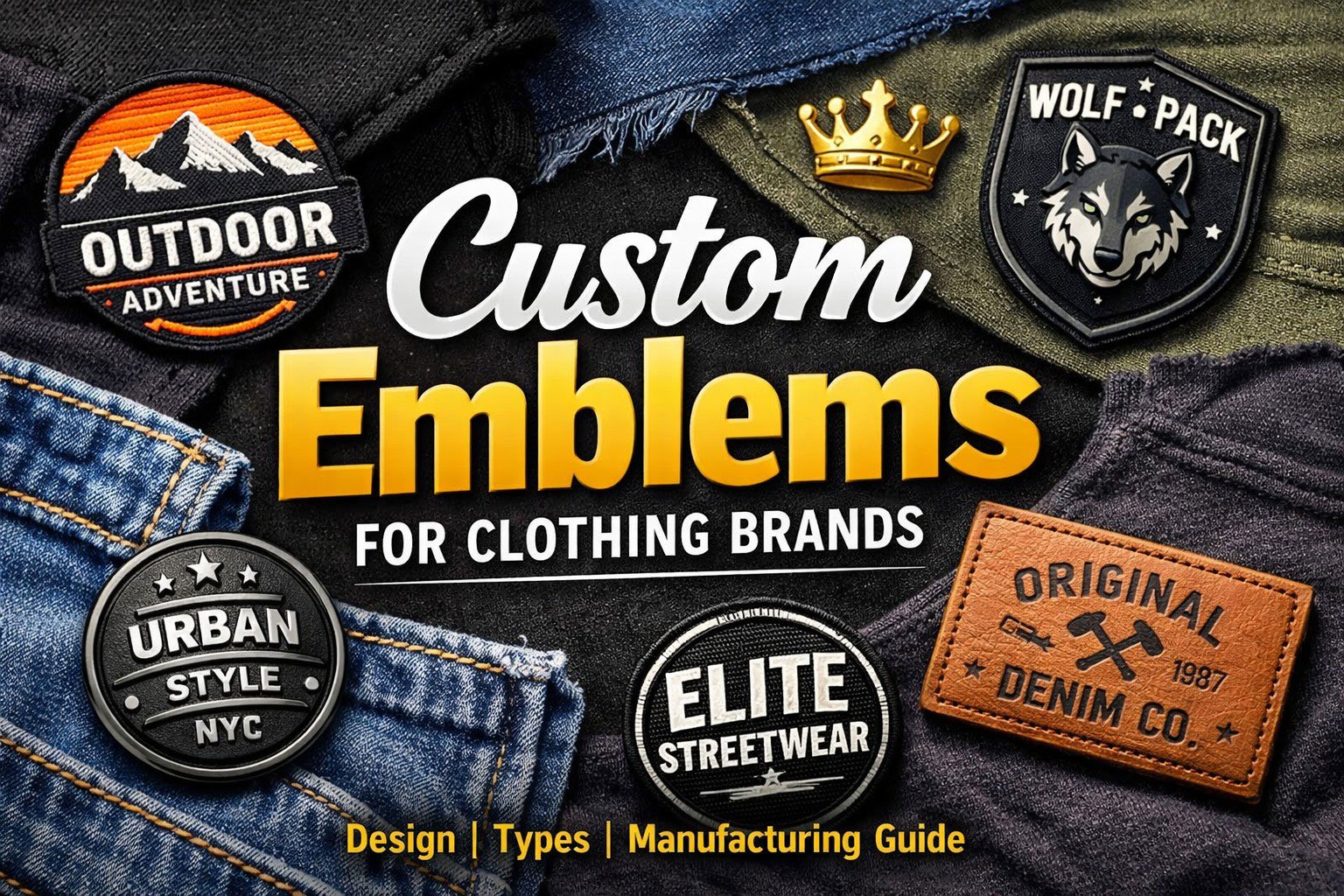
Custom emblems have become one of the most powerful branding tools for clothing brands looking to stand out in a crowded market. Whether you’re launching a streetwear label, a premium fashion line, or a corporate apparel collection, emblems add identity, texture, and perceived value that printed graphics simply cannot replicate.
Unlike screen-printed designs that may fade or crack, a well-crafted emblem is permanent, dimensional, and communicates craftsmanship at first touch. This guide covers everything you need to choose, design, and produce the right emblem for your brand.
What Are Custom Emblems for Clothing?
Custom emblems are decorative branding elements attached to garments — they can be sewn, heat-pressed, or adhered to clothing items and include logos, symbols, or unique design elements that represent your brand. The category encompasses everything from classic embroidered patches to cast metal badges, leather tabs, and modern silicone transfers.
Unlike printed graphics, emblems provide a tactile, dimensional, and premium feel — meaning customers experience them physically every time they wear the garment. This sensory dimension is one of the most powerful — and most underused — aspects of apparel branding.
✅ Emblems transform ordinary clothing into premium, recognizable products. A garment with a quality emblem feels like it was crafted — a garment without one often feels like it was assembled. That distinction is what customers instinctively feel and what drives repeat purchases and brand loyalty.
1 Why Clothing Brands Use Custom Emblems
Stronger Brand Identity
Emblems make your logo more memorable and visually distinct across every garment in your line. A well-crafted emblem instantly communicates professionalism, brand value, and intention — qualities that customers associate with brands worth buying from repeatedly.
Premium Perceived Quality
Metal badges, embroidered patches, and leather labels elevate the perceived quality of your clothing significantly — and often disproportionately to their production cost. Customers associate emblem quality with garment quality, making emblems one of the highest-ROI branding investments available to clothing brands.
Superior Durability
Unlike printed graphics that fade, crack, or peel with repeated washing, high-quality emblems maintain their appearance through years of wear. An embroidered patch or metal badge outlasts the garment itself — making your brand visible for the full life of the product.
Versatile Application
Custom emblems can be applied to virtually any garment type — T-shirts, hoodies, jackets, hats, bags, pants, and more — using different attachment methods suited to each fabric. This makes them a single brand element that works consistently across your entire product line.
Ready to create a custom emblem for your clothing brand? Get a free quote and design consultation from CreatePins.
Get a Free Quote →2 Types of Custom Emblems for Clothing
Each emblem type has a distinct production process, visual character, durability profile, and ideal use case. Choosing the right type for your brand positioning and garment application is one of the most important decisions you’ll make in the emblem process.
Classic, tactile, and visually rich — embroidered patches use layered thread to create designs with genuine depth and texture. The stitched texture catches light in a way no other emblem type can replicate, and embroidery has a heritage quality that resonates strongly with streetwear, workwear, and athletic brands.
- Bold color with visible stitch texture
- Iron-on, sew-on, or Velcro backing options
- Excellent durability through repeated washing
- Best for: logos with solid color areas, text, and iconic symbols
Woven patches use much finer threads than embroidery, allowing for significantly more detail and crisper edges. The result is a flatter, more refined aesthetic that suits minimalist brand identities and logos with fine lines or small text that embroidery couldn’t reproduce reliably.
- Finer detail and smoother finish than embroidery
- Ideal for small logos, fine text, and intricate patterns
- More muted appearance — less tactile depth than embroidery
- Best for: fashion-forward brands, luxury minimalism, detailed logos
PVC patches are flexible, weatherproof, and deliver a bold, modern 3D relief aesthetic that stands apart from all other emblem types. They’re completely waterproof and maintain their shape and color through extreme outdoor conditions — making them the standard for outdoor, tactical, and performance apparel brands.
- Fully waterproof and UV-resistant
- 3D relief design with excellent color vibrancy
- Sew-on or Velcro attachment options
- Best for: outdoor gear, tactical apparel, bags, performance wear
Genuine or synthetic leather patches add a rugged, artisan quality that connects strongly with heritage brand identities. Debossed or laser-engraved logos on leather develop a beautiful patina over time — meaning the emblem actually improves with age alongside the garment it adorns.
- Available in genuine, synthetic, or vegan leather
- Debossed, embossed, or laser-engraved branding
- Sew-on application for permanence
- Best for: denim brands, workwear, heritage fashion, premium accessories
Silicone transfers are applied with heat and pressure and offer a sleek, smooth-touch finish that sits flat against fabric without the bulk of a patch. They’re lightweight, flexible, and move naturally with the fabric — making them ideal for technical performance clothing where traditional patches would add unnecessary weight or friction.
- Flat, smooth finish with a premium soft-touch feel
- Flexible — moves with the fabric without cracking
- No fraying edges or stitching to catch on equipment
- Best for: activewear, sportswear, technical performance apparel
3 Matching Emblem Type to Your Brand Style
The right emblem type isn’t just about what looks good — it’s about what communicates the right brand values to your specific customer. Here’s a practical matching guide across the most common clothing brand positioning categories.
| Brand Style | Recommended Emblem | Why It Works |
|---|---|---|
| Luxury / High-End Fashion | Metal Leather | Weight, permanence, and material quality signal premium positioning instinctively |
| Streetwear / Urban | Embroidery PVC | Bold texture and 3D relief align with streetwear’s emphasis on visual presence |
| Heritage / Denim / Workwear | Leather Embroidery | Natural materials and craft-process aesthetics reinforce heritage brand narratives |
| Minimalist / Contemporary Fashion | Woven Metal | Fine thread detail and clean metal finishes complement restraint-based aesthetics |
| Outdoor / Tactical / Adventure | PVC Embroidery | Weatherproof resilience and bold visual presence match the category’s brand values |
| Activewear / Performance | Silicone | Lightweight, flexible, and flat — adds no bulk or friction to technical performance wear |
| Corporate / Professional Apparel | Metal Woven | Clean, polished finishes project professionalism and institutional brand authority |
When in doubt, request samples of two or three emblem types applied to your actual fabric. The difference between how a metal badge and an embroidered patch feel on the same garment is often immediately decisive — and no amount of digital mockup can fully replicate that physical experience.
4 Popular Placement Options
Strategic placement significantly impacts the perceived quality and visual effectiveness of your emblem. Placement isn’t just an aesthetic decision — it communicates brand hierarchy, garment category, and design intention.
For most clothing brands, the left chest is the primary placement and the sleeve or hem tag is a secondary placement. Using both creates a layered branding experience that signals attention to detail — the kind of quality cue that elevates a garment’s perceived value without the buyer consciously identifying why.
5 Design Tips for Maximum Visual Impact
An emblem’s effectiveness depends as much on how it’s designed as what it’s made from. These design principles apply across all emblem types — and following them prevents the most common visual and production problems.
Keep It Simple
Overly complex designs lose clarity at emblem sizes — especially in embroidery and small metal casting. The most iconic brand emblems are almost always the simplest: a clear shape, a bold logo, a single strong visual idea. Simplification improves production accuracy and strengthens brand recognition.
Focus on Contrast
Your emblem must stand out against the garment it’s applied to. Design with your intended fabric color in mind and ensure strong contrast between the emblem’s dominant elements and the background. Low contrast makes an otherwise well-designed emblem invisible at normal viewing distances.
Size Appropriately
An emblem that’s too large overwhelms the garment and looks imposing; one that’s too small disappears completely. Test at the intended physical size before finalizing. Most chest emblems range from 2–3 inches. Larger back pieces can extend to 5–8 inches. Hat emblems typically fall between 1.5–2.5 inches.
Match Your Brand Aesthetic
The emblem type and design language should reinforce your brand’s visual identity — not contradict it. A minimalist brand should have a refined, restrained emblem. A bold streetwear brand benefits from an expressive, textured one. Consistency between your overall visual identity and your emblem is what creates coherent brand recognition.
Always create your emblem design in vector format (Adobe Illustrator or equivalent) so it can be scaled to any size without quality loss. Provide the manufacturer with vector files — never submit JPEGs or PNGs as your primary artwork for emblem production.
6 Manufacturing Methods
Understanding how each emblem type is produced helps you have more informed conversations with manufacturers, set accurate quality expectations, and make better decisions about which type best serves your needs.
Die Casting (Metal Emblems)
Molten zinc alloy, brass, or iron is poured into a precision steel mold and cooled to create the emblem’s base shape. The surface is then ground, polished, and electroplated with the chosen metal finish. This process produces precise, sharp-edged designs with a heavy, premium feel that can’t be replicated by other methods.
Embroidery Machines (Embroidered Patches)
Automated embroidery machines stitch thread in programmable patterns onto a twill or felt base, following a digitized version of your design. The process ensures consistency across a full production run — each patch is stitched in exactly the same pattern. A heat-seal backing is applied after stitching to enable heat press application.
Injection Molding (PVC Patches)
Liquid PVC resin is injected into a mold at high pressure and cured to form the emblem’s shape and relief design. Different colors are injected and cured in sequence. The result is a flexible, waterproof emblem with clean edges and excellent color saturation. A Velcro or adhesive backing is applied during the final stage.
Laser Engraving (Leather & Metal)
A high-precision laser burns the design into the surface of the leather or metal at exact coordinates. This creates a permanent, sharp impression that can’t fade, peel, or wear away. For leather, the laser also creates a subtle color change at the burn point that enhances depth and legibility.
Heat Transfer (Silicone Transfers)
Silicone is printed or poured into a shaped mold and cured. The resulting flexible silicone emblem is then placed on the garment and bonded using heat and pressure — the heat activates a thermoplastic adhesive that bonds permanently to the fabric fibers without stitching. The result is a seamless, flat integration with the garment surface.
Know which emblem type is right for your brand? Our team handles the production from design to delivery — with free sampling before full production.
Start My Emblem Order →7 Common Mistakes to Avoid
These are the errors that consistently cost clothing brands time, money, and production quality — and all of them are entirely preventable with the right information upfront.
Ignoring Fabric Compatibility
Not all emblems work on all fabrics. Heavy metal badges can tear lightweight jersey or chiffon over time. Rigid sew-on patches may create uncomfortable pressure points on fitted stretch garments. Silicone transfers may not bond properly to very textured or coated fabrics without testing.
Choosing the Wrong Attachment Method
Sew-on emblems offer the most durability but require access to industrial sewing equipment for application. Heat press is faster and suitable for many emblem types but may delaminate on some fabrics with repeated high-temperature washing. Adhesive backing is convenient for soft materials but may not withstand outdoor or heavy-use conditions.
Overcomplicated Designs for the Production Method
Fine text, extremely thin lines, and photographic detail don’t survive the embroidery or casting process well. Embroidery requires a minimum stitch width for stability; die casting requires a minimum wall thickness for structural integrity. Designs that look perfect digitally can lose critical detail in production.
Skipping the Sampling Stage
Approving full production without first reviewing a physical sample is the most expensive mistake in emblem ordering — and the most avoidable. Colors, scale, texture, and the way an emblem sits on fabric can all differ from your expectations until you hold the physical sample in your hands.
8 Cost Factors for Custom Clothing Emblems
Emblem pricing is determined by several interconnected variables. Understanding each one lets you make informed decisions about where to invest and where to optimize — without accidentally cutting the elements that matter most to your brand’s quality perception.
Material
The largest base cost driver. Metal is most expensive; silicone and embroidery are most affordable at volume.
Size & Thickness
Larger and thicker emblems use more material and take longer to produce — cost scales with both dimensions.
Number of Colors
Each additional color in an embroidered or PVC emblem adds production time and complexity.
Order Quantity
Fixed tooling and setup costs spread across more units — bulk orders deliver significantly lower per-unit cost.
Attachment Type
Velcro, iron-on heat seal, adhesive, screw-back, and sew-on all carry different hardware and application costs.
Plating & Finishing
For metal emblems, gold, silver, black nickel, antique finishes, and epoxy overlays each add to unit cost.
Bulk orders significantly reduce cost per unit for all emblem types. If you plan to produce the same emblem across multiple seasons or collections, investing in a larger initial batch almost always delivers better long-term value — and your tooling is reused free on every subsequent reorder.
How to Choose the Right Emblem for Your Brand
Use this framework to evaluate your options before requesting quotes. Answering these four questions will point you clearly toward the right emblem type, material, and approach.
What is my brand positioning?
Luxury and heritage brands → metal or leather. Streetwear and bold identities → embroidery or PVC. Athletic and performance → silicone. Minimalist contemporary → woven or metal. Your emblem should reinforce, not contradict, where your brand sits in the market.
What garments will I apply this to?
Lightweight fabrics (jersey, chiffon) → avoid heavy metal. Performance fabrics (spandex, technical nylon) → silicone heat transfer. Heavy fabrics (denim, canvas, wool) → embroidery, PVC, or metal. Leather or waxed fabrics → laser-engraved leather patches or metal badges.
What durability level do I need?
Daily wear, frequent washing → sew-on embroidered or PVC patch. Outdoor and weatherproof requirements → PVC with Velcro backing. Decorative or display pieces → adhesive metal or acrylic. Long-term permanent fixture → laser-engraved leather or die-cast metal with screw attachment.
What is my budget and quantity?
Small initial test batch (under 100) → embroidery or silicone for best cost. Medium production (100–500) → most emblem types accessible. Large production (500+) → metal or PVC becomes cost-competitive while delivering premium results. Always request pricing at multiple quantity tiers to understand your cost curve.
✅ Custom emblems are more than decoration — they’re a powerful, permanent branding asset that can transform ordinary clothing into premium, recognizable products. By selecting the right materials, refining your design, and working with an experienced manufacturer who samples before mass production, you create emblems that strengthen your brand identity with every wearing.
Ready to Elevate Your Brand with Custom Emblems?
Get a free quote, free design consultation, and expert guidance from CreatePins — factory-direct pricing, worldwide shipping, and sampling before production.
Frequently Asked Questions
Custom emblems are decorative branding elements — patches, badges, labels, or transfers — attached to garments through sewing, heat pressing, or adhesive. Unlike printed graphics, emblems provide a tactile, dimensional, and premium feel. Clothing brands use them to strengthen brand identity, elevate perceived quality, improve product durability, and create recognizable brand signatures that customers associate with quality and intentionality.
The main types are: embroidered patches (classic, textured, durable — best for streetwear and uniforms); woven patches (finer thread, more detail — best for minimalist logos); PVC rubber patches (flexible, weatherproof, bold — best for outdoor and tactical apparel); metal emblems (luxury feel, zinc alloy or brass — best for high-end fashion and denim); leather patches (premium, rugged — best for denim and heritage brands); and silicone heat transfers (lightweight, flexible — best for activewear and performance clothing).
The most effective placement depends on your brand positioning and garment type. The left chest is the most recognized primary branding position. Sleeves work well for secondary branding or collection identifiers. Back placement allows for large statement emblems on jackets and hoodies. Hem tags and neck labels serve as quality-signaling secondary placements that customers discover when wearing the garment. Hat placement — front crown or side — offers one of the highest-visibility positions in fashion.
Pricing depends on material, size, color count, order quantity, and attachment type. Embroidered and PVC patches are typically the most affordable at volume. Metal emblems cost more due to die casting and plating. Leather and specialty options sit at the premium end. Like all custom merchandise, bulk orders significantly reduce per-unit cost. Always request pricing at multiple quantity tiers to understand the full cost curve before committing to a production run.
The most common mistakes are: skipping the sampling step before mass production; ignoring fabric compatibility (heavy metal badges don’t work on lightweight T-shirts); choosing the wrong attachment method; and overcomplicated designs that lose detail at emblem scale. Always request a physical sample, test it on your actual garment, and get your manufacturer to review your design for production compatibility before approving any full production run.
Metal emblems (zinc alloy or brass with gold, silver, or black nickel plating) are the standard choice for luxury and premium fashion positioning — they convey weight, permanence, and craftsmanship that other materials can’t replicate. Leather patches are the second most popular premium choice, particularly for heritage, denim, and workwear brands. The combination of a metal badge on the front and a leather patch on the rear waistband is a common premium apparel signature that signals quality at every interaction point.