What Most Brands Get Wrong About Promotional Pins
Promotional pins look simple — small, affordable, easy to hand out. But that simplicity is exactly why so many brands get them wrong. Here’s how to avoid the 7 most costly mistakes and turn your pins into genuine brand assets.
If you’re investing in custom pins, the difference between forgettable swag and high-impact brand assets often comes down to a handful of avoidable decisions. The result of getting it wrong? Boxes of unused pins, zero brand recall, and a budget that didn’t earn its keep. This guide breaks down every mistake — and exactly what to do instead.
Treating Pins Like Mini Billboards
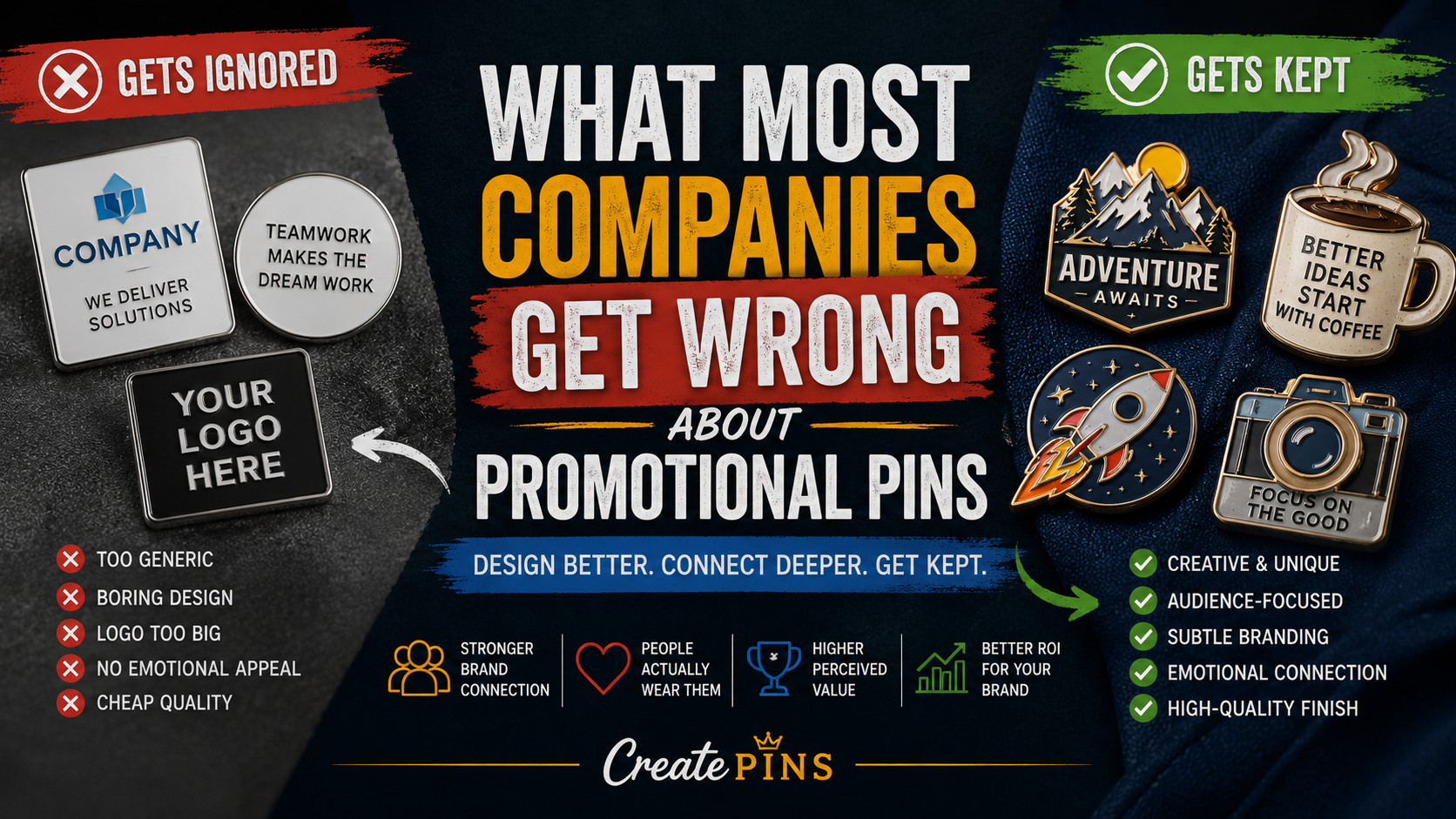
The single most common mistake companies make is trying to cram their full brand identity into a 1-inch metal canvas — logo, tagline, website, color palette, all of it. The pin becomes a tiny corporate ad, and nobody wants to wear an ad.
Here’s the fundamental truth: promotional pins aren’t advertisements — they’re personal items. People wear pins to signal something about themselves, not to broadcast your company’s existence. If a pin says nothing beyond your logo, there’s no reason for someone to put it on their jacket and walk around promoting you for free.
- Logo centered on a plain background
- Company name and tagline squeezed in
- Website URL printed in tiny type
- Corporate colors applied mechanically
- Lifestyle-driven visual with subtle branding
- Inside joke or reference your audience loves
- Symbolic icon that represents shared values
- Something people would wear for the design alone
Ask yourself: “Would someone wear this pin if it didn’t have our logo?” If the answer is no, redesign it.
The brands with the highest pin retention rates are the ones that lead with design and add branding as a secondary element — a small logo on the back stamp, a URL on the backing card, a subtle watermark. The pin earns attention; the brand benefits from association.
Prioritizing Brand Over Aesthetics
Brand guidelines exist for good reasons — consistency, recognition, professionalism. But on a 1-inch enamel pin, rigid adherence to those guidelines often produces something that looks like office merchandise rather than wearable art.
Corporate blues and grays rarely pop at pin scale. A font that works on a billboard looks muddy when engraved in metal at 25mm. Flat, logo-only compositions lack the visual interest that makes someone pick up a pin and think “I want that.”
- Strict corporate color palette — no deviation
- Only approved fonts and logo treatments
- No creative risk to protect consistency
- Result: professional but boring
- Brand colors adapted for contrast and vibrancy
- Creative illustration that evokes brand personality
- Finishes like glitter, glow, or dual-plating
- Result: something people actually want to own
Think of your pin as a brand interpretation, not a brand replica. Your visual identity is the starting point, not the finish line. Use glitter fills, glow-in-the-dark enamel, or creative plating colors to create something visually striking that still feels on-brand.
The goal is to design something that feels like your brand without literally reproducing it. The most memorable promotional pins evoke an emotion or identity — they don’t just display a mark.
Ignoring the Audience
A pin that works for a gaming conference will bomb at a financial services expo. A design that resonates with college students will miss entirely for a B2B audience. Yet most companies produce one generic pin design and hand it to everyone — with predictably mediocre results.
The pins that get kept are the ones that feel like they belong to the person receiving them. That requires understanding your specific audience — their aesthetics, sense of humor, shared references, and values — and designing to that, not to a generic concept of “our customer.”
| Audience Type | What Resonates | Design Direction | Emotional Hook |
|---|---|---|---|
| Tech / Developer | Minimal, clever, symbolic | Clean icon, subtle nerd reference | Wit & insider knowledge |
| Students / Youth | Bold, expressive, fun | Bright colors, character-driven | Identity & self-expression |
| Creative / Artist | Unique, art-first, collectible | Illustrative, limited edition | Aesthetic appreciation |
| Fan / Fandom | Lore-accurate, community-signal | Character or symbol-based | Belonging & fandom pride |
| Non-profit / Cause | Meaningful, symbolic, mission-driven | Clean icon with cause colors | Shared values & advocacy |
| Corporate / B2B | Subtle, premium, professional | Refined icon with quality finish | Prestige & belonging |
| Retail / Consumer | On-trend, instagrammable | Lifestyle image or playful mascot | Style & shareability |
Segment your audience before you design. A pin should feel like it was made specifically for the person receiving it — not for the average of everyone.
If you’re distributing pins at multiple events or to different customer groups, consider creating audience-specific designs rather than one universal pin. The incremental cost is often minimal, and the impact difference is significant. Explore proven enamel pin design ideas that sell across different audience types for inspiration.
Choosing the Cheapest Option
Budget discipline is smart — but there’s a critical difference between being cost-conscious and being penny-wise and pound-foolish. A pin that feels cheap is worse than no pin at all, because it signals low investment in quality and actively harms brand perception.
People judge product quality instantly and unconsciously. When someone picks up a thin, poorly plated pin with a muddy print and a floppy clasp, their brain immediately associates that quality signal with your brand. A $0.50 saving per unit can cost you the entire brand impression the pin was meant to create.
- Dull or muddy enamel colors after production
- Thin metal that bends easily
- Poor plating that tarnishes within months
- Weak butterfly clasps that fall off
- Rough edges or visible imperfections
- Choose the right enamel type for your design
- Select a plating color that complements the artwork
- Use rubber clutch or locking pin backs
- Order a sample before the full production run
- Work with a manufacturer that shows quality standards
Understanding the difference between hard enamel vs soft enamel pins is the first step to making an informed quality decision. Hard enamel offers a jewelry-like smooth finish ideal for premium brand positioning; soft enamel provides a textured, vibrant look at a slightly lower cost.
Quality pins don’t need to be expensive — they need to be appropriate. A well-made soft enamel pin at $1.80/unit beats a cheap hard enamel pin at $1.20/unit every time. Focus on the criteria that actually determine quality, not just price per unit.
Also consider choosing the right pin backing — this is one of the most overlooked quality indicators. A pin that falls off a jacket because of a cheap clasp is a pin that gets lost, not kept.
No Strategy Behind Distribution
You can have the perfect pin design and still waste the entire investment by handing it out wrong. Distribution strategy is arguably as important as the pin itself — because how someone receives a pin directly shapes how much they value it.
The psychology here is simple: people value what feels earned or rare. A pin handed to literally every passing attendee at a trade show carries far less perceived value than a pin given only to people who completed a demo, made a purchase, or reached a milestone. Scarcity and intentionality create desirability.
- Handed to everyone indiscriminately
- No context, story, or meaning attached
- No sense of exclusivity or occasion
- Dumped in a bowl at the front of a booth
- Event-only or limited-run releases
- Reward-based (VIP, milestone, purchase)
- Tied to a campaign, story, or narrative
- Presented personally with brief context
Consider using pins as customer loyalty rewards — given at specific purchase thresholds, membership milestones, or referral achievements. This transforms the pin from a giveaway into a badge of status that recipients genuinely want to earn and display.
Even the language you use when distributing matters. “Here’s a pin” lands very differently than “We only made 200 of these — here’s one for making it to our launch event.” The story you attach to the pin becomes part of how the recipient perceives it every time they see it afterward.
Forgetting Packaging & Presentation
A beautifully designed pin dropped loose into a tote bag or handed across a table with no context is a missed opportunity. The moment someone receives your pin is one of the few times you have their full attention — a brief, tactile, personal interaction. Most companies squander it entirely.
Packaging doesn’t just protect the pin in transit — it frames the experience of receiving it. A pin on a custom backing card with a compelling tagline, your brand story, or even just a QR code linking to your campaign creates an entirely different impression than a bare pin tossed in a bag.
- Bare pin, no backing card or packaging
- No brand story or context provided
- Feels like an afterthought
- Zero unboxing or sharing moment
- Custom backing card with brand story
- QR code linking to a campaign or exclusive content
- Sequential numbering for limited editions
- Premium packaging creates a shareable moment
Presentation can double perceived value without doubling cost. A backing card typically adds $0.10–$0.30 per unit — yet it transforms how recipients feel about the pin from the first second they see it.
Read the full guide to choosing packaging for custom enamel pins — covering backing cards, polybags, gift boxes, and when each is the right choice.
For limited edition pins, consider adding back stamps and sequential numbering — a low-cost addition that significantly increases the perceived exclusivity and collector value of each pin.
No Long-Term Vision
Most companies treat promotional pins as a one-off transaction: design one pin, order it, hand it out, done. They never revisit the concept, never build on it, and never extract the full value that the medium is capable of delivering.
This is a significant missed opportunity. Pins are uniquely positioned as a collectible medium — something people actively seek out, trade, and display. A single isolated pin is a giveaway. A series of pins tied to your brand’s ongoing story is a community-building tool, a loyalty mechanism, and a long-term brand touchpoint that compounds in value over time.
- Single design for a single event
- No connection to previous or future pins
- No collecting behavior encouraged
- Campaign ends, pins are forgotten
- Series of themed pins across events or seasons
- Each pin connects to a larger narrative
- Collectors return to complete their set
- Community builds around the pin program
Brands that do this right turn a $1–$3 product into an ongoing brand touchpoint that drives repeat engagement for years.
Even small businesses can implement this strategy. A local coffee shop, a podcast, a nonprofit — any brand can create a series of 3–4 seasonal or milestone pins that give customers something to look forward to and collect. The goal isn’t scale, it’s intention.
⚠️ Reality Check: Pins Are Not “Set It and Forget It”
A lot of companies operate under this assumption: “Pins are cheap, so even if they don’t work well, the loss is small.” That mindset leads directly to waste — and underestimates how quickly even “cheap” items scale up in real cost.
1,000 poorly designed pins = significant wasted budget + zero brand impressions earned
Missed impressions = the true cost is not just the production spend, but the opportunity cost
Negative perception = a cheap, forgettable pin actively damages brand quality associations
Pins are only “cheap” if they’re effective. The goal is not to minimize production cost — it’s to maximize cost-per-impression over the pin’s lifetime. A $2.50 pin worn publicly for 18 months generates thousands of impressions. A $0.80 pin discarded in week one generates zero. The math is clear.
💡 What High-Performing Promotional Pins Have in Common
After analyzing what separates forgettable giveaway pins from the ones people keep, wear, and talk about — five traits consistently appear:
Design-First
Visually appealing first, branded second. The design earns attention; the brand earns association.
Emotionally Relevant
Connected to the specific audience’s identity, humor, values, or aesthetic — not a generic concept.
Quality That Shows
High enough quality to feel valuable the moment someone holds it. Finish, weight, and backing all matter.
Part of a Story
Tied to a campaign, moment, or narrative — not a random object handed out without context.
Distributed with Intent
Given in a way that creates meaning — earned, exclusive, or tied to a specific milestone or moment.
Part of a Larger System
Designed with future releases in mind — a collectible in a series, not a standalone forgotten item.
🏆 Final Takeaway: It’s a Strategy Problem, Not a Product Problem
Promotional pins don’t fail because enamel pins are ineffective as a medium. They fail because the strategy behind them is flawed. The same product, with the same budget, produces wildly different results depending on how it’s designed, made, and distributed.
❌ When Pins Fail
- Treated as mini ads → people ignore them
- Treated as cheap swag → people discard them
- Generic design → no emotional connection
- Mass distribution → no perceived value
- One-off order → no lasting brand presence
✅ When Pins Succeed
- Treated as wearable identity → people display them
- Treated as collectible design → people treasure them
- Audience-specific design → strong emotional resonance
- Intentional distribution → high perceived value
- Series strategy → ongoing brand touchpoints
The most effective brands using enamel pins don’t think of them as a line item in a swag budget. They think of them as a brand storytelling tool — one that happens to live on people’s jackets, bags, and desks, generating impressions every single day.
Get Expert Help Designing Pins That Actually Get Kept
Our team at CreatePins.com helps brands avoid every mistake in this guide — from design strategy to quality selection to distribution planning. Get a free custom quote and let’s build something your audience will actually wear.
❓ Frequently Asked Questions
📚 Further Reading from CreatePins
🎨 Design Strategy & Avoiding Mistakes
-
The Biggest Enamel Pin Design Mistakes That Ruin Everything (How to Avoid Them)
A deep dive into the most common design errors — from color contrast failures to proportion issues — with production-specific fixes. -
15 Enamel Pin Design Ideas That Always Sell (Proven & Creative)
Proven design concepts that consistently generate high retention and engagement across different audience types. -
Complete Enamel Pin Design Guide (2026)
The comprehensive technical guide to designing pins that translate perfectly from digital artwork to finished metal product.
🔬 Quality, Materials & Finishes
-
Hard Enamel vs Soft Enamel Pins: The Ultimate Guide (2026)
Understand the fundamental quality and aesthetic differences — and which type is right for your specific campaign and budget. -
Essential Criteria for Grading Enamel Pins: Complete Quality Standards & Inspection Guide (2026)
Know exactly what defines a high-quality pin — the grading standards that separate factory-reject pins from production-grade ones. -
The Beginner’s Guide to Enamel Pin Plating Colors
Gold, silver, black nickel, rose gold — learn which plating color best complements your design and brand aesthetic. -
How to Choose the Right Enamel Pin Backings Complete Guide, Risks & Pro Tips (2026)
Butterfly clasp vs rubber clutch vs locking pin backs — the backing choice directly affects how long your pin stays on and gets worn. -
Glitter Enamel Pins: The Complete Guide to Sparkle
How glitter fill works in production, what it costs, and when to use it to maximize visual impact and perceived value. -
Glow in the Dark Enamel Pins: Complete Design Guide (2026)
One of the most talked-about pin finishes — here’s everything you need to design one correctly for maximum wow factor.
📦 Packaging & Presentation
-
Complete Enamel Pin Packaging Guide Types, Costs & Best Practices (2026)
Backing cards, polybags, gift boxes — each option has a specific use case. This guide helps you choose the right one for your campaign. -
Back Stamps & Sequential Numbering for Enamel Pins
How to add back stamps and edition numbering to dramatically increase the collectible appeal of your promotional pins.
🎯 Distribution & Long-Term Planning
-
Custom Pins for Conferences, Trade Shows & Events Design, Pricing & Planning Guide
Everything you need to plan a successful event pin program — from design timelines and booth strategy to pricing and logistics.
Start Your Custom Pin Order with Expert Guidance
Whether you need 100 pins for a local event or 10,000 for a national campaign, CreatePins.com will help you avoid every mistake in this guide. Free design consultation, transparent pricing, and a team that genuinely cares about your results.