Custom Emblem Pricing Guide 2026
Custom emblem prices can vary significantly — and most of that variation is entirely predictable once you understand the three core pricing factors. Here’s everything you need to budget confidently and avoid surprises.
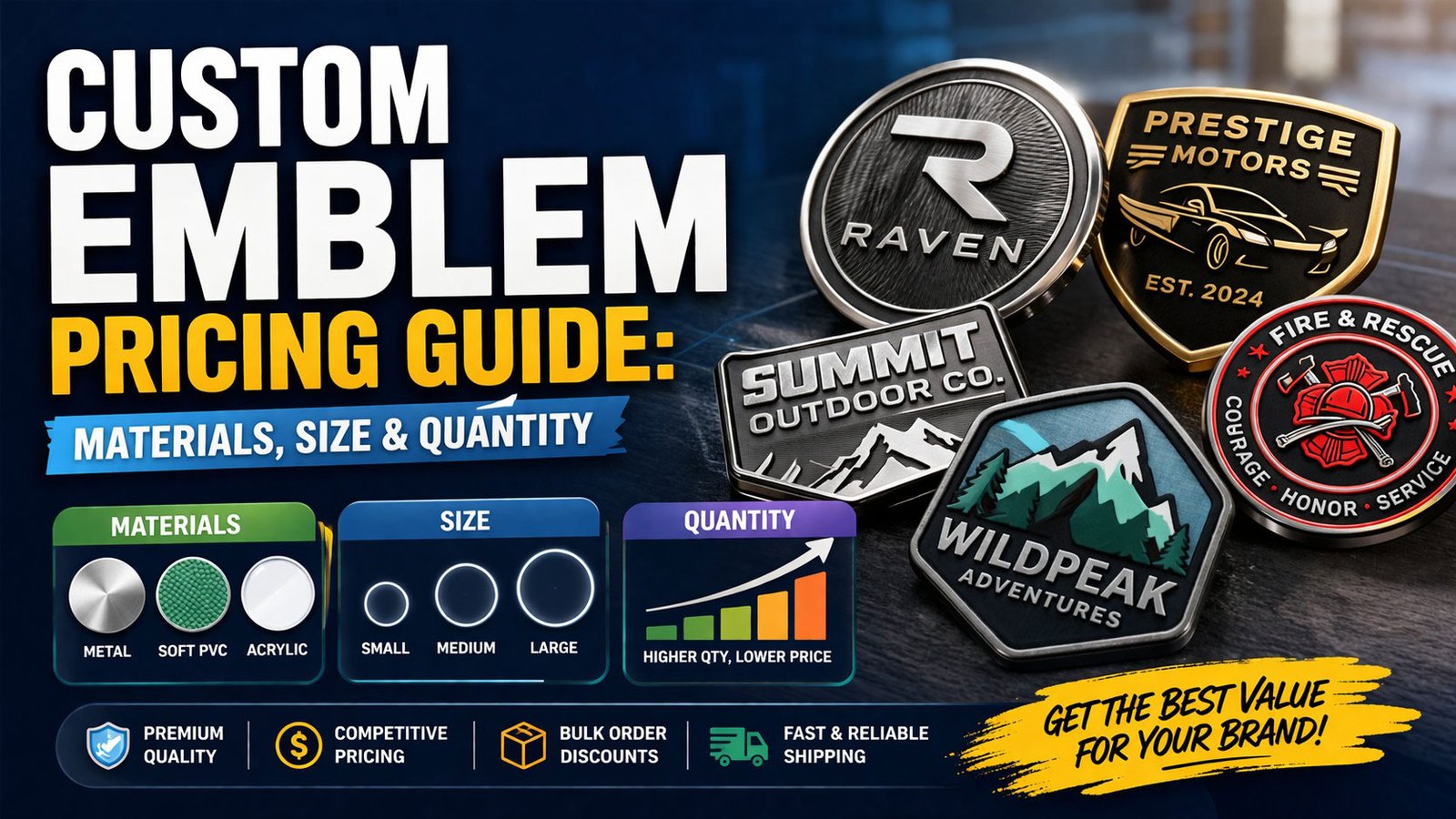
Custom emblems are widely used for branding, uniforms, merchandise, automotive badges, and promotional products. But if you’ve ever requested a quote, you’ve probably noticed prices can vary significantly — sometimes dramatically — between suppliers or even between different configurations from the same supplier.
That variation isn’t random. It comes down to three primary factors: materials, size, and quantity. Understand how each one drives cost, and you’ll be able to plan your budget accurately, optimize your order, and avoid the most common pricing surprises.
1 Materials: The Foundation of Your Custom Emblem Cost
The material you choose is one of the most significant cost drivers because it directly affects durability, appearance, production complexity, and the tooling required. Choosing the right material for your application — rather than defaulting to the most expensive or cheapest option — is where smart emblem buyers find the best value.
Flexible, colorful, and genuinely durable — the most popular choice for outdoor use, bag patches, uniform emblems, and anything requiring bold character designs.
- Flexible and resistant to bending/cracking
- Excellent color vibrancy in 3D relief designs
- Weatherproof and water-resistant
- Great for cartoon-style and character-based artwork
- Best for: Outdoor gear, bags, promotional patches, uniform emblems
Lightweight, glossy, and affordable — ideal for decorative or promotional applications where visual appeal matters more than durability or long-term wear resistance.
- Full-color printing including gradients
- Glossy or matte finish options
- Lightweight for easy shipping
- Less durable than metal or PVC for high-use applications
- Best for: Promotional emblems, decorative badges, short-term merchandise
A modern alternative to PVC with a softer, more premium touch feel — increasingly popular for apparel branding, sportswear emblems, and products targeting lifestyle audiences.
- Soft-touch, flexible, and comfortable
- Excellent for heat-transfer or adhesive application on fabric
- Clean, modern aesthetic appeal
- Slightly higher cost than standard PVC
- Best for: Apparel patches, sportswear branding, lifestyle products
Material Cost Comparison
If your brand emphasizes quality and longevity — and the emblem will be seen as a prestige object — metal is worth the investment. For cost-effective bulk promotional items, outdoor gear, or uniform patches, PVC delivers excellent durability at a fraction of the cost.
Not sure which material fits your project and budget? Our team will recommend the best option and provide a free, fully itemized quote.
Get a Free Quote →2 Custom Emblem Size: Bigger Isn’t Always Better — But It Costs More
Size has a direct relationship with almost every production cost factor: raw material consumption, mold complexity, production time, and shipping weight. Understanding the impact of size lets you make a deliberate choice about whether a larger emblem is genuinely worth the added cost for your specific application.
How size drives up cost:
- More raw material consumed — directly proportional to the surface area of the emblem
- Longer production time — especially for metal emblems with detailed surface finishing
- Larger molds required — mold cost scales with size for die-cast metal and PVC
- Higher shipping costs — increased weight and volume per unit, especially for large bulk orders
Hidden size-related costs:
- Complex shapes: Custom irregular outlines cost more than standard shapes — each cutout or protrusion adds mold complexity
- Greater thickness: Thicker emblems use significantly more material, particularly for metal casting
- More fine details at larger sizes: Larger emblems often include more intricate elements that require additional finishing labor
- Surface area for plating: Metal plating costs scale with the surface area being treated
Optimize your design to fit the smallest size that still clearly communicates every element at its intended viewing distance. An emblem on a jacket or bag is typically viewed from 2–4 feet away — test your design at that distance before deciding whether you genuinely need a larger size.
3 Custom Emblem Quantity: The Biggest Factor in Unit Price
If material sets your base cost and size determines your material consumption, quantity is where the most dramatic savings are available. The economics of emblem production are driven by fixed setup costs — tooling, molds, and production preparation — that don’t change regardless of how many units you produce. The more units you make, the thinner each one’s share of those fixed costs becomes.
Why bulk orders are significantly cheaper:
Custom emblems require tooling (molds or dies) that are created specifically for your design. This is a fixed one-time cost — typically $40–$100+ depending on material and complexity. At 50 units, each pin carries a large share of that tooling cost. At 500 units, that same tooling cost adds only a fraction of a cent per unit. Everything else about production also benefits from economies of scale: labor is more efficiently allocated, material purchasing improves, and per-shipment costs are amortized across more units.
| Quantity | Unit Price Level | Best For |
|---|---|---|
| 50 pcs | High | Samples, small teams, testing designs |
| 100 pcs | Medium–High | Most common starting point for new brands |
| 300 pcs | Medium | Growing brands, uniform orders, event giveaways |
| 500+ pcs ⭐ | Low — Best Value | Established brands, wholesale, ongoing promotional use |
| 1,000+ pcs | Lowest | Large-scale campaigns, automotive manufacturers |
Tooling is typically a one-time cost that is reused for all future orders of the same design. Once you’ve paid the mold fee, every subsequent reorder of the same emblem only incurs production cost — making reorders significantly cheaper than the initial run.
If you plan to reorder the same design, investing in a larger initial batch saves money long-term. Calculate your expected annual demand and consider ordering 6–12 months’ worth at once to unlock better per-unit pricing and avoid repeated tooling fees.
Ready to get a transparent, quantity-tiered quote for your custom emblems? Our team provides pricing across multiple quantities so you can make an informed decision.
Get My Multi-Quantity Quote →4 Additional Cost Factors You Shouldn’t Ignore
Beyond the three primary factors, several secondary costs can meaningfully affect your total investment. Understanding them upfront prevents the invoice surprises that frustrate buyers who received only a base production quote.
Design Complexity
More colors mean more production steps. Intricate details require more labor and more precise tooling. 3D relief designs cost more than flat designs. Every layer of complexity adds to production time and unit cost.
Plating & Finishing (Metal)
Gold, silver, black nickel, antique, and matte finishes each require different electroplating processes. Special coatings — epoxy dome, glow, glitter — add further cost. Plating cost scales with the emblem’s surface area.
Attachment & Backing Options
Standard adhesive backing is typically included. Screw-and-bolt attachments for automotive emblems, magnetic backings, pin-post hardware, or iron-on patches for fabric all add to unit cost and should be specified upfront.
Packaging
Standard individual poly bags are usually included. Custom backing cards, branded retail boxes, or premium display packaging each add cost per unit. For retail products, packaging investment is usually worth it. For internal or B2B use, standard packaging often suffices.
Shipping & Import Costs
Air freight is fast but significantly more expensive than sea freight. For smaller urgent orders, air is often the only practical option. Import duties and customs fees at your destination country can add 5–20% to total cost and are frequently omitted from initial quotes.
Rush Production Surcharges
Requesting faster production than standard timelines adds a meaningful premium — typically 10–20% of production cost. Combined with the higher cost of express shipping, a rushed order can cost 25–35% more than the same order placed with adequate lead time.
Always request a fully landed cost quote — production + tooling + shipping + any applicable import duties — before approving any order. The base production price is rarely the full price you’ll pay.
5 How to Optimize Your Custom Emblem Budget
If you want high-quality custom emblems without overspending, these proven strategies consistently deliver the best value — across every material type and application.
Choose the Right Material for Your Use Case
Don’t pay for metal if PVC meets your performance and aesthetic requirements — and don’t compromise to acrylic if durability is genuinely important. Match material to application: metal for permanent prestige items, PVC for outdoor and high-volume promotional use, silicone for apparel, acrylic for decorative and promotional merchandise.
Optimize for Size Efficiency
Choose the smallest size that clearly communicates your design at its intended viewing distance. A smaller, beautifully executed emblem nearly always looks more intentional than an oversized one. Test your design at actual size before finalizing dimensions — many buyers discover they can reduce size without losing any visual impact.
Order in Bulk — Especially for Reorders
The per-unit cost at 500 units can be 40–60% lower than at 100 units. If you have ongoing demand, ordering a 6–12 month supply at once delivers significant savings. And once your tooling is paid for, every reorder becomes even more cost-effective because you only pay production cost.
Simplify Your Design Strategically
Reducing color count, avoiding unnecessary fine details, and keeping shapes clean all reduce production cost without necessarily reducing visual impact. A well-designed two-color emblem often looks more sophisticated than a crowded five-color one — and costs significantly less to produce.
Reuse Molds — Stay With One Manufacturer
Switching manufacturers for a reorder means paying the tooling fee again — because molds are proprietary to each factory. Staying with a reliable manufacturer and reusing existing tooling eliminates this cost entirely on subsequent orders. The long-term savings compound significantly across multiple reorders.
Plan Ahead to Eliminate Rush Fees
Order with at least 4–6 weeks lead time before any event, launch, or delivery deadline. Rush production surcharges combined with express shipping can add 25–35% to your total cost — a predictable and entirely avoidable expense with adequate planning.
Quick Custom Emblems Pricing Summary
Custom emblem pricing isn’t random — it’s the product of deliberate choices about three core factors. Here’s the framework in one place:
Material
Biggest impact on base unit cost. Metal is premium. PVC is the versatile workhorse. Acrylic is the budget option. Choose based on application, not assumption.
Size
Affects material usage, mold cost, and shipping. Every unnecessary inch adds cost. Optimize to the smallest size that serves your visual purpose.
Quantity
Biggest impact on per-unit price. Fixed tooling costs spread across more units = dramatically lower cost each. Bulk ordering is the single most effective lever.
✅ The best pricing comes from balancing all three factors — not optimizing just one. A smaller, simpler emblem in PVC ordered at 500 units will almost always deliver better total value than a large metal emblem at 50 units — even if the per-unit price looks similar at first glance. Plan holistically and you’ll consistently get more for your budget.
Get a Transparent Custom Emblem Quote
Tell us your material, size, and quantity — we’ll provide a fully itemized quote with no hidden costs and pricing at multiple quantity tiers so you can make the most informed decision.
Frequently Asked Questions About Custom Emblems
All three core factors — material, size, and quantity — significantly affect the final price in different ways. Material sets your base unit cost. Size determines how much raw material is consumed. Quantity is where the most dramatic per-unit savings occur, because fixed tooling costs are spread across more units. The best pricing comes from balancing all three rather than optimizing just one in isolation.
PVC (soft rubber) is generally the most cost-effective material for emblems that need to be durable, colorful, and produced at volume. Metal (zinc alloy, brass) costs more due to tooling and finishing but delivers a premium look and longer lifespan. Acrylic is the most budget-friendly but less durable. For most promotional and outdoor applications, PVC offers the best balance of cost and performance.
Size directly increases material usage, production time, mold cost, and shipping weight. For metal emblems, surface area also determines plating cost. Complex shapes, greater thickness, and fine detail work further increase costs at larger sizes. Optimizing your design to fit within a smaller footprint without losing visual clarity is one of the most effective — and often overlooked — ways to reduce emblem cost.
Most manufacturers show significant per-unit cost reductions moving from 50 to 100 units, again from 100 to 300 units, and again at 500+. Orders of 500 or more typically access the lowest per-unit price tier. The tooling fee is a one-time fixed cost — once paid, reorders of the same design only incur production cost. If you plan to reorder the same design, a larger initial batch almost always saves money long-term.
Common hidden costs include tooling or mold fees (typically a one-time charge of $40–$100+), additional costs for metal plating or special finishes, attachment hardware upgrades (screws, magnetic backings), custom packaging (backing cards, boxes), international shipping and any applicable import duties (which can add 5–20%), and rush production surcharges. Always request a fully itemized landed cost quote before approving any order.
Metal is the right choice when premium appearance and long-term durability are primary requirements — particularly for automotive badges, high-end brand merchandise, corporate awards, and any application where the emblem will be a long-term fixture rather than a promotional item. When your audience expects a premium, weighty emblem that signals quality and permanence, the higher cost of metal is justified and expected.
References & Further Reading
- CreatePins — Get a Free Custom Emblem Quote
- CreatePins — How to Choose Durable Metal Keychain Finishes
- CreatePins — What Enamel Pin Manufacturers Don’t Tell You Before Ordering
- CreatePins — Custom Enamel Pin Hidden Costs You Should Know Before Ordering
- CreatePins — Custom Enamel Pin Production Expectations & Tolerances
- CreatePins — How to Order Enamel Pins (Step-by-Step Guide)
- CreatePins — Complete Enamel Pin Packaging Guide: Types, Costs & Best Practices (2026)
- CreatePins — UV Printing vs Screen Printing for Enamel Pins, Keychains, Coins & Badges: Which Is Better?