Custom Lanyard Design Guide: Printing Methods, Specifications, Attachments, Costs & Production Tips
A beginner-friendly walkthrough of custom printed lanyards — how to pick a printing method, size, attachment and artwork setup before you order.
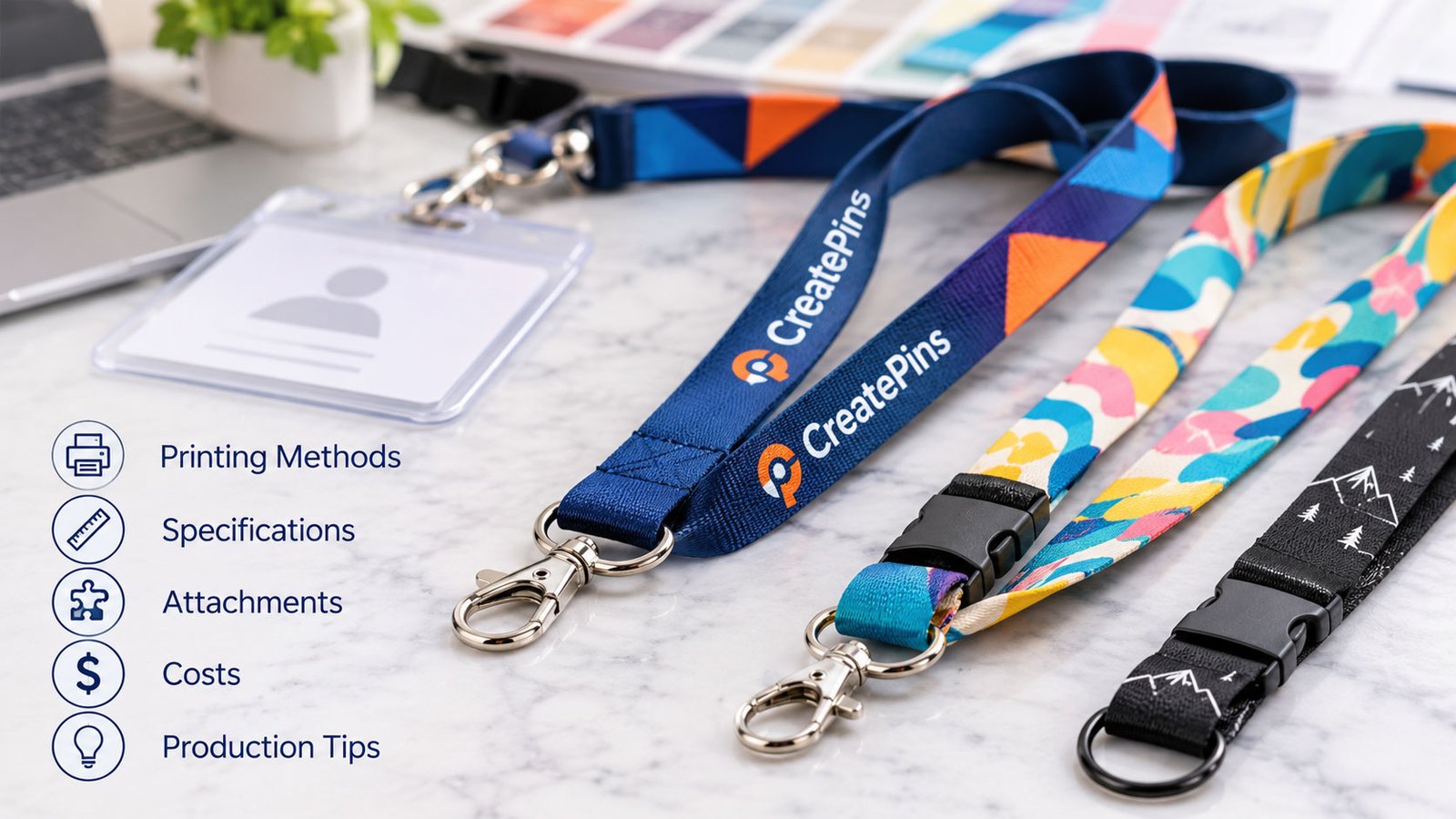
Custom lanyards show up everywhere — trade shows, conferences, schools, offices, exhibitions — because they solve a simple problem: people need somewhere to put their ID badge, access card or keys. For a brand, that’s also all-day exposure on every chest in the room.
But a good lanyard is more than a logo slapped on fabric. The printing method, material, width, hardware and artwork layout all change how it looks, how long it lasts and what you’ll pay. First-time buyers often get stuck on the sheer number of decisions.
The basics are the same whether you’re ordering for a school, a conference or a company. This guide walks through each choice in plain language — printing methods, standard specs, hardware options, repeat lengths and bleed, MOQs, costs, timelines and the mistakes that trip up first-timers.
Quick-start summary for beginners
- Printing: dye sublimation for colorful, detailed artwork; screen printing for simple logos; woven for a durable textured look.
- Width: 15 mm and 20 mm are the most common for events and offices.
- Hardware: pick the attachment based on how people will actually use the lanyard.
- Artwork: use vector files, follow the supplier’s template, add bleed, keep key elements inside the safe area.
- Ordering: compare quotes on identical specs, and get a digital proof before production.
1. Understanding Different Custom Lanyard Printing Methods
Printing method is the single biggest lever on how your lanyard looks and how much artwork it can carry. It determines what’s even possible before you start drawing. If you’ve worked with other merch, our comparison of UV printing vs screen printing shows the same trade-offs on other products.
1.1 Dye Sublimation
For polyester lanyards, dye sublimation is the go-to. Your design is printed on transfer paper with sublimation inks, then pressed into the fabric with heat. The ink soaks into the fibers instead of sitting on top, so the finish is smooth — no raised ink layer, no cracking edges.
What you get: full-color artwork, gradients, photos, detailed logos, edge-to-edge printing, and vibrant colors that hold up. It’s also the most flexible method for repeating patterns and multicolor designs.
Best for: corporate branding, event lanyards, colorful promo designs and custom illustrations.
1.2 Screen Printing
Screen printing pushes ink through a mesh screen onto the material. Each color gets its own screen, so this method rewards simple designs with solid colors and clear logos — and punishes anything complex.
The upside is strong, opaque color coverage and predictable results on straightforward branding. The catch: setup costs rise with every color, fine details and gradients are hard to reproduce, and aligning multiple colors takes careful work.
Best for: minimalist company logos, simple text and limited-color lanyards.
1.3 Woven Lanyards
Woven lanyards skip ink entirely. Colored threads are woven into the fabric so the design becomes part of the strap itself. The result is a textured, durable finish that won’t rub off over time.
The trade-off is color range. You’re limited to thread colors, and fine details or gradients simply don’t translate — complex artwork usually needs simplifying before it goes to the loom.
Best for: premium corporate lanyards, employee IDs and long-term daily use.
1.4 Heat Transfer Printing
Heat transfer applies a printed design to the lanyard using heat and pressure. On the right polyester and with the right transfer material, it can produce sharp, detailed graphics.
Durability depends heavily on the transfer material and manufacturing process, and some versions leave a noticeable surface layer. Compatibility with the chosen fabric has to be checked before you commit.
Best for: designs that need detailed graphics where the transfer process is a good match.
Which method should you choose?
| Printing method | Color capability | Design complexity | Main advantage |
|---|---|---|---|
| Dye sublimation | Full color | High | Vibrant, edge-to-edge artwork |
| Screen printing | Usually limited colors | Low to medium | Solid logo colors |
| Woven | Thread colors | Low to medium | Durable textured design |
| Heat transfer | Process-dependent | Medium to high | Detailed graphics |
For most colorful promotional work, dye sublimation is the safest default. Simple logos and a traditional textured look point to screen printing or woven. If you’re not sure, send your logo to the supplier and ask which method reproduces it best — that conversation usually settles it faster than any chart.
Beginner tip: match the method to your artwork
Count the colors in your logo. One or two flat colors usually point to screen printing or woven. Gradients, shadows, photos or many colors point to sublimation. Colors also look different on fabric than on a screen, so check the digital proof carefully before approving it.
2. Standard Custom Lanyard Specifications
Before you start drawing, lock down the basics. Width, length and material affect appearance, comfort, which attachments will fit, and the final cost.
2.1 Common Widths
| Width | Approximate size | Typical application |
|---|---|---|
| 10 mm | 0.39 inches | Slim promotional lanyards |
| 15 mm | 0.59 inches | Standard ID lanyards |
| 20 mm | 0.79 inches | Popular corporate and event lanyards |
| 25 mm | 0.98 inches | Wider designs with greater logo visibility |
Put these specs in a short note you can send to every supplier for quotes. The 15 mm and 20 mm options cover most event and corporate use. A wider strap has more room for logos and patterns, but it also feels heavier and less discreet around the neck.
2.2 Common Lengths
A typical adult neck lanyard runs roughly 900–1000 mm (35–39 inches) overall, though exact specs vary by manufacturer and construction. Always confirm the finished length with your supplier.
When designing, think about:
- Where the badge will sit when worn.
- Whether it will be used with a badge holder.
- Who’s wearing it (adults, students, staff or visitors).
- Whether a breakaway safety buckle is required.
Keep the overall strip length, the finished loop length and the printable artwork length separate in your head — they’re not the same measurement, and mixing them up is one of the most common beginner errors.
2.3 Common Materials
- Polyester: the workhorse. Lightweight, flexible, durable, and the best match for dye sublimation.
- Nylon: smoother surface, slightly different hand-feel. Suits certain printing and branding applications.
- Woven polyester: the design is built into the fabric with colored threads instead of printed.
- Tubular polyester: rounded, cord-like construction with a different look from flat straps — common in casual promo pieces.
Before artwork production starts, confirm material availability and printing compatibility with your supplier.
3. Custom Lanyard Attachments and Accessories
Hardware decides how people actually connect their cards, keys and badges. The right attachment makes the lanyard easy to use every day; the wrong one makes it annoying. If you also make keychains, our guide to custom keychain attachment types covers similar hardware.
3.1 Metal Lobster Clasp
A popular connector for ID holders, badge reels and small accessories. Spring-loaded, easy to clip on and off.
Recommended for: corporate ID lanyards, conference badges and everyday office use.
3.2 Swivel Hook
Rotates so attached accessories don’t twist — especially useful when people constantly turn or reposition their ID badges.
Recommended for: employee ID, event badges and access cards.
3.3 Bulldog Clip
A basic, no-fuss attachment for holding ID cards and badge holders. Standard on plenty of event and office lanyards.
Recommended for: trade shows, conferences and temporary event ID.
3.4 Keyring
A metal ring lets users attach keys and other small accessories.
Recommended for: promotional giveaways, branded merch and everyday key carry.
3.5 Plastic Buckle Release
A detachable buckle lets the lower section come off without pulling the whole lanyard over the head — handy when users need separate access to keys or cards.
3.6 Safety Breakaway Buckle
Releases under tension to reduce the risk of entanglement. This matters most in schools, healthcare facilities and workplaces where lanyards can catch on equipment.
Don’t confuse this with an ordinary detachable buckle — they serve different purposes. Confirm the intended safety function and any applicable requirements with your manufacturer.
3.7 Additional Hardware and Accessories
- Plastic badge holders.
- Metal badge reels.
- Retractable ID holders.
- Double-ended hooks.
- Mobile phone attachments.
- Metal rings and connecting loops.
| Use case | Suggested attachment |
|---|---|
| Conference or trade show badge | Simple metal hook or bulldog clip |
| Daily office access card | Lobster clasp, swivel hook or badge reel |
| School or healthcare setting | Safety breakaway buckle |
| Branded giveaway for keys | Keyring |
| Frequent separate access to keys | Plastic buckle release |
Tip: pick attachments around real usage. A conference attendee may only need a simple metal hook; an employee who scans an access card all day will appreciate a retractable badge reel. Whichever option you pick, ask for a photo or sample of the actual hardware before approving the order.
Ready to choose your lanyard setup?
Browse printing methods, specifications and attachments — then request a quote for your own custom printed lanyards.
4. Custom Lanyard Design Guide: Repeat Lengths, Bleeds and File Prep
Artwork prep is where a lot of lanyard projects quietly go wrong. A lanyard is a long, narrow strip — not a rectangle like a flyer — so your design has to land correctly after the material is printed, cut and assembled. Our artwork prep guide for custom keychains walks through the same principles on a different product.
4.1 Understanding the Layout
A typical lanyard design is a repeating artwork section along the strap: a company logo, a website address, a short slogan, decorative graphics, or a repeating background pattern.
Before designing, confirm the printable width and length with your manufacturer. A 20 mm-wide lanyard may have a printable area slightly narrower than its nominal finished width, depending on fabric and production method. Never assume the finished dimensions match the artwork template dimensions.
4.2 What Is a Repeat Length?
A repeat length is the distance along the strap before the same pattern starts again. If one repeat contains a logo, a brand name, a decorative element, and some space, and the repeat is 100 mm, the same pattern appears roughly every 100 mm along the strip.
Repeat length is one of the key specs to confirm with your supplier. The ideal number depends on logo size, text length, overall lanyard length and the look you’re after. These ranges are design suggestions rather than fixed manufacturing standards:
| Repeat length | Works well for |
|---|---|
| 50–80 mm | Small, simple repeating logos |
| 80–120 mm | A useful starting range for logos with short brand names |
| 120–200 mm | Larger logos, slogans and more detailed artwork |
Confirm the actual repeat length and print layout with your supplier before you finalize the artwork.
4.3 Avoid Repeating Logos Too Frequently
One of the most common mistakes is packing logos too tightly together — it makes the lanyard look crowded and hurts readability. Instead:
- Leave enough space between repeated elements.
- Keep logos large enough to stay recognizable.
- Keep long text away from the stitching area.
- Preview the artwork as a continuous strip, not an isolated rectangle.
For a clean corporate look, a simple logo-and-text pattern usually beats a design stuffed with graphic elements.
4.4 Bleed
Bleed is extra artwork that extends beyond the intended cut line. It prevents white edges or unprinted gaps caused by small cutting or alignment variations.
As a starting point, suppliers may ask for roughly 2–3 mm of bleed around the artwork edges — but this isn’t a universal standard. If the finished strap is 20 mm and the supplier asks for 2 mm of bleed on each side, the artwork width becomes 24 mm. Always follow the supplier’s actual template rather than a generic number.
4.5 Keep Important Elements Away from the Edges
Don’t place small text, logos or essential details too close to cutting or stitching edges. As a starting point, keep about 2–3 mm of internal safe space where the printable width allows. The real safe area depends on the production template.
4.6 File Formats
For custom printed lanyards, vector artwork is generally preferred. Recommended formats:
- AI (Adobe Illustrator).
- EPS.
- PDF (vector-based).
- SVG, where supported.
High-resolution PNGs can also work for certain printing processes. For raster art, 300 DPI at the intended print size is a useful guideline — but resolution alone doesn’t guarantee good print quality. Check small text, fine lines and low-resolution logos carefully.
4.7 Color Mode and Color Matching
For print production, CMYK is common, though the exact workflow depends on the printing method. Dye sublimation may use a manufacturer-specific RGB or CMYK workflow. If your brand needs specific colors, provide:
- Pantone references where available.
- CMYK values.
- Original vector logos.
- A visual reference for color matching.
Monitor colors can differ from the finished product. Fabric texture, ink, temperature and equipment all affect the final appearance.
4.8 Artwork Checklist Before Submission
- Confirm the finished lanyard width.
- Confirm the printable artwork dimensions.
- Set the correct repeat length.
- Include the requested bleed.
- Keep important content inside the safe area.
- Check logo proportions and text readability.
- Convert fonts to outlines when submitting vector files.
- Confirm color references.
- Check that the pattern repeats seamlessly.
- Confirm attachments, positions and hardware requirements.
5. How Much Do Custom Lanyards Cost?
There’s no single universal price. The number you get depends on material, dimensions, printing method, accessories, quantity and destination — different specs mean different manufacturing processes.
5.1 Material and Printing Method
Standard polyester lanyards with full-color sublimation are usually the most economical for promo orders. Special materials, woven construction and more complex printing requirements push the price up.
5.2 Width and Length
These are core specs, and wider/longer lanyards use more material. A 25 mm-wide strap typically uses more material than a 15 mm version of the same length.
5.3 Attachments and Accessories
The hardware you choose affects the final price. A basic metal hook often costs less than a combination of a swivel hook, safety buckle, detachable buckle, badge reel or extra metal accessories. Material, finish and hardware quality matter too.
5.4 Order Quantity
Quantity is one of the biggest pricing factors. Larger orders lower the unit cost because setup, printing and production expenses spread across more pieces.
5.5 Packaging and Shipping
Individual packaging, custom backing cards, extra accessories and express delivery can all increase the total. When comparing quotes, check whether the price includes:
- Printing.
- Hardware.
- Assembly.
- Individual packaging.
- Shipping.
- Applicable duties or tariffs.
5.6 How to Get an Accurate Quote
To get a useful quote, prepare this information:
- Lanyard width and finished length.
- Material preference.
- Printing method.
- Artwork or design reference.
- Attachment type.
- Required quantity.
- Packaging requirements.
- Delivery country or destination.
With those details, a manufacturer can recommend suitable options and calculate an accurate price instead of giving you a vague ballpark.
6. Common MOQ Requirements
MOQ stands for Minimum Order Quantity — the smallest number of units a manufacturer accepts for a product or process. For custom lanyards, it depends on printing method, material, setup requirements and factory arrangements.
| Production type | Common indicative MOQ |
|---|---|
| Dye sublimation polyester lanyards | 50–100 pieces |
| Screen-printed lanyards | 100–500 pieces |
| Woven lanyards | 100–500 pieces |
| Specialty materials or constructions | 100–500+ pieces |
These are planning ranges, not guaranteed minimums. Some suppliers accept smaller runs; others require more. Before ordering, confirm whether the MOQ applies per design, per color or per specification — ordering 500 pieces across five designs is treated differently from 500 pieces of one design.
7. How Long Does Custom Lanyard Production Take?
Planning around an event? Work backward from the date. Production time depends on printing method, quantity, material availability, hardware selection, artwork approval and factory workload. These are indicative planning estimates:
| Production stage | Estimated time |
|---|---|
| Artwork preparation and digital proof | 1–3 business days |
| Standard sublimation production | 7–12 business days |
| Screen printing | 7–12 business days |
| Woven lanyard production | 10–15 business days |
| Quality inspection and packing | 1–3 business days |
These aren’t guaranteed turnaround times — confirm actual lead times with your manufacturer. Shipping is additional, and standard international shipping can take longer than express depending on destination, method, customs clearance and local delivery conditions.
Tips for Avoiding Production Delays
- Submit complete artwork files from the beginning.
- Confirm dimensions and attachments before approving the proof.
- Respond quickly to artwork revisions.
- Confirm the required delivery date before production.
- Don’t change specs after artwork approval.
- Allow extra time during busy promo seasons.
For an exhibition, conference or corporate event, start ordering several weeks ahead. Planning around a calendar? Check the 2027 US convention calendar and the 2027 manufacturing schedule for holiday closures.
8. Common Custom Lanyard Design Mistakes
Even a well-planned project can run into trouble if the artwork or specs aren’t prepared correctly. Here are the mistakes to avoid.
Mistake 1: Text That’s Too Small
Lanyards have a narrow print area, and small text becomes unreadable when the strap hangs around the neck.
Fix: use short text, readable fonts and appropriately sized logos. Skip unnecessary slogans and long website addresses.
Mistake 2: Ignoring the Repeat Pattern
A design can look great as a single panel but awkward when repeated along the full strap.
Fix: preview the entire repeating pattern and check spacing between logos, text and graphics.
Mistake 3: Forgetting Bleed
Artwork that stops exactly at the cut line may produce unwanted white borders.
Fix: follow the manufacturer’s bleed requirements and extend background colors beyond the cutting boundary.
Mistake 4: Placing Important Elements Too Close to the Edge
Logos or text near the edge can be affected by cutting, folding or stitching.
Fix: keep essential artwork within the recommended safe area.
Mistake 5: Choosing the Wrong Attachment
A basic hook may not suit a lanyard that holds multiple keys or a frequently used ID card.
Fix: think through real usage before selecting hardware.
Mistake 6: Not Considering the Finished Wearing Position
A design can be technically correct but end up upside down or badly positioned when worn.
Fix: confirm the orientation of both sides, the connection point and the finished loop arrangement with your manufacturer.
Mistake 7: Assuming Every Method Supports Full-Color Artwork
Screen printing and woven construction have different design limits than sublimation.
Fix: choose a printing method based on the complexity of your artwork, not just how a sample image looks.
Mistake 8: Comparing Quotes Without Checking Specs
A cheaper quote may leave out certain attachments, packaging or delivery costs.
Fix: compare quotes using identical specs: width, length, material, printing method, hardware, quantity and shipping. Our lists of questions to ask a manufacturer and how to compare manufacturers help here.
9. Tips for Professional Branding
To make your lanyards look professional and represent your brand well, keep these principles in mind:
- Keep the design simple. A clear logo and a short brand name usually beat a pile of decorative elements.
- Use strong color contrast. Make sure logos and text stand out against the fabric.
- Choose the right width. 15 mm suits many standard uses; 20–25 mm gives you more room for branding.
- Create a seamless repeat. The pattern should flow naturally without awkward gaps or overlaps.
- Think about both sides. Decide whether to print one or both sides, and whether the design should stay readable when worn.
- Match attachments to the application. Corporate ID, giveaways and event-access lanyards often need different hardware.
- Request a digital proof. Review layout, color, dimensions and attachment positions before approving mass production.
Planning lanyards for an event? Also read our guides to conference and trade show products and event giveaways.
10. Beginner Glossary
These terms show up in every supplier quote and design guide, so learn them before you order:
- Bleed: extra artwork beyond the cut line that prevents white edges.
- Safe area: the inner zone where text and logos stay protected from cutting and stitching.
- Repeat length: the distance before the artwork pattern starts again.
- Sublimation: a heat-transfer process where ink soaks into polyester fibers.
- Pantone: a standard color-matching system used to specify exact brand colors.
- Vector file: artwork built from shapes and lines that can be resized without losing quality.
- Digital proof: a preview of your artwork on the lanyard template before production starts.
- MOQ: the minimum order quantity a supplier will accept.
- Breakaway buckle: a safety release that opens when the lanyard is pulled with force.
11. Frequently Asked Questions
What are the best custom lanyard printing methods?
Dye sublimation is a versatile choice for colorful polyester lanyards because it supports full-color graphics, gradients and detailed artwork. Screen printing suits simple logos, while woven lanyards are ideal for durable, thread-based designs.
What are the standard custom lanyard specifications for width?
Common widths include 10 mm, 15 mm, 20 mm and 25 mm. The 15 mm and 20 mm options are popular for corporate identification and promotional events.
What is a standard custom lanyard length?
A typical adult neck lanyard has an overall strip length of approximately 900–1000 mm. The exact finished length depends on the construction and intended use.
What file format should I use for custom lanyard artwork?
AI, EPS and vector PDF files are generally preferred. High-resolution PNG files may also work, depending on the printing method and manufacturer requirements.
How much bleed should I add to my lanyard design?
A bleed of approximately 2–3 mm may be used as an initial reference, but requirements vary by manufacturing process. Always request the actual artwork template from your supplier.
How often should the logo repeat on a lanyard?
There is no fixed standard. A repeat length of approximately 80–120 mm can be a useful starting point for simple logo-and-text patterns. The ideal spacing depends on the artwork and lanyard dimensions.
What is the MOQ for custom lanyards?
Common MOQs range from approximately 50 to 500 pieces, depending on the printing method and supplier. Always confirm whether the minimum quantity applies per design or per order.
How long does it take to manufacture custom lanyards?
Standard production may take approximately 7–15 business days after artwork approval, depending on the printing method, quantity and factory schedule. Shipping time is additional.
Which custom lanyard attachments can I choose?
Common custom lanyard attachments include lobster clasps, swivel hooks, bulldog clips, keyrings, detachable buckles and safety breakaway buckles. Availability depends on the manufacturer.
Can I print different designs on the same lanyard?
Yes. A repeating pattern can combine different logos, text and decorative elements. Arrange the artwork carefully so the final strap looks balanced.
Order Custom Lanyards for Your Brand or Event
Have a design ready? Send us your artwork, preferred specifications and order quantity to get started. Let’s turn your design into custom printed lanyards that represent your brand.