Custom Magnet Design Guide: Types, Design Tips, Costs, Risks & Applications
A beginner-friendly, start-to-finish custom magnet design guide covering every major custom magnet type, how to design for each one, real cost factors, common risks, and which type fits your project.
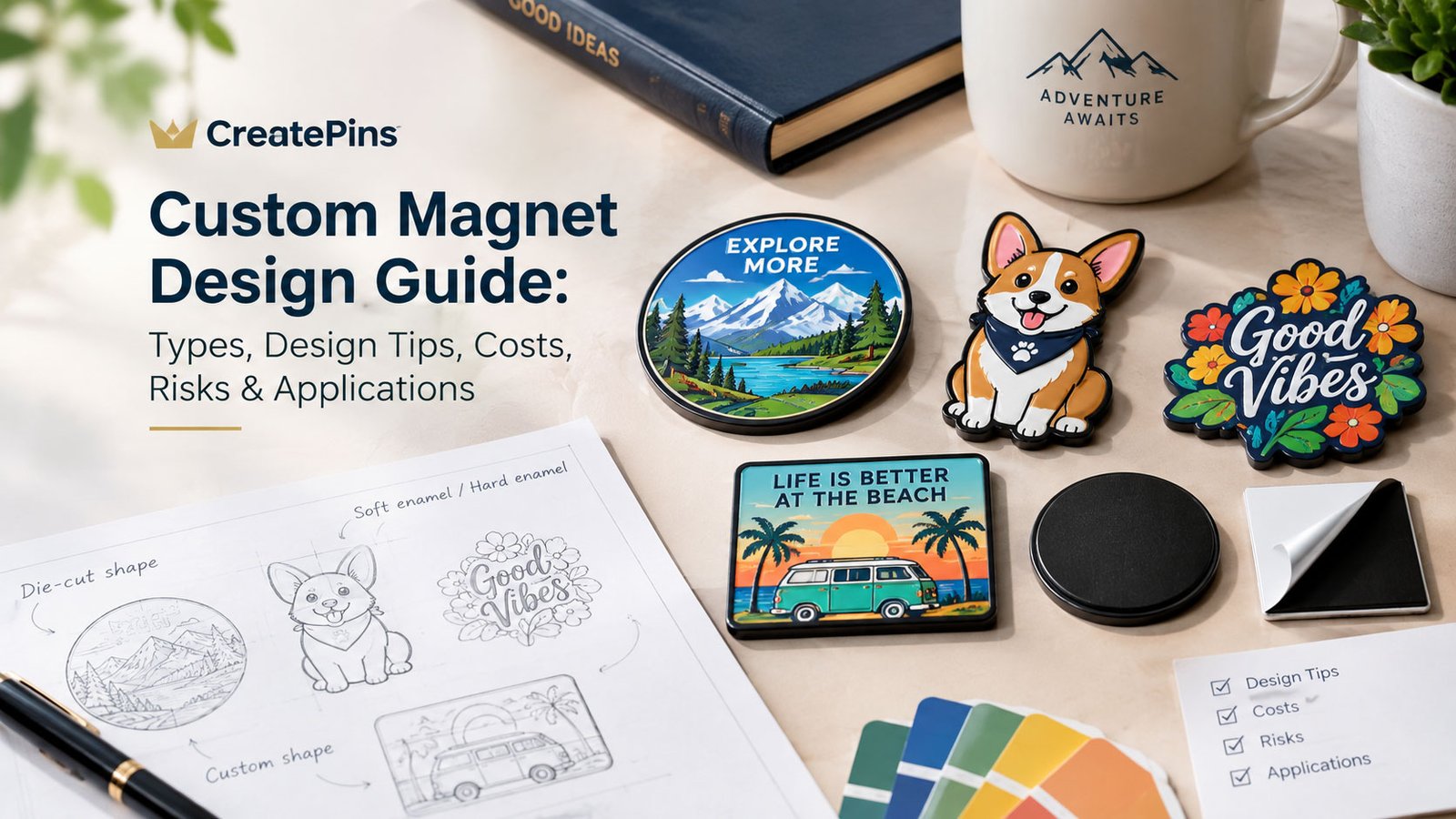
Custom magnets are an effective way to turn artwork, logos, illustrations, characters, slogans, and brand identities into physical promotional products. They can become refrigerator magnets, business giveaways, retail merchandise, event souvenirs, collectibles, vehicle magnets, signage, and branded accessories. But not every magnet is manufactured the same way — the material, production method, magnet strength, size, thickness, artwork complexity, finishing options, and intended application all affect the final result. A design that works perfectly for a flexible promotional magnet may not suit a detailed metal magnet, and a large vehicle magnet needs very different specs from a small collectible.
This custom magnet design guide walks through the major custom magnet types, how to design for each one, what to consider when ordering, common risks, cost factors, and which type fits which application — everything a beginner needs before placing a first order.
In This Custom Magnet Design Guide
- What Are Custom Magnets?
- How to Choose the Right Type
- Custom Magnet Types Compared
- 9 Custom Magnet Types Explained
- Custom Magnet Design Guide
- Design Tips by Magnet Type
- Custom Magnet Cost Factors
- Common Custom Magnet Risks
- Custom Magnet Applications
- Preparing Your Artwork
- How to Order Custom Magnets
- Frequently Asked Questions
What Are Custom Magnets?
Custom magnets are magnets manufactured according to your specific artwork, shape, dimensions, colors, materials, and finishing requirements — instead of buying a standard rectangular or circular magnet, you can create one based on almost any design. Common examples include company logos, brand mascots, character artwork, illustrations, promotional messages, event logos, sports designs, food and beverage branding, tourism souvenirs, artist merchandise, limited-edition collectibles, school logos, wedding favors, custom refrigerator magnets, and retail merchandise. Custom refrigerator magnets in particular are one of the most common entry points for first-time buyers, since they’re inexpensive to test and widely understood.
The manufacturing method should match the artwork and intended use. A simple logo with strong outlines may work beautifully as an enamel magnet, while a full-color photograph is generally better suited to a printed magnet — which is really what most of this guide is about.
How to Choose the Right Custom Magnet Type
Before designing anything, answer five basic questions:
What will the magnet be used for?
A promotional giveaway has very different requirements from a collectible or a retail product.
How detailed is the artwork?
Fine lines, small text, gradients, photographs, and complex illustrations all influence which manufacturing method will work.
What appearance do you want?
A raised metal look, recessed enamel, a smooth printed surface, a transparent effect, a soft rubber feel, a dimensional 3D shape, or a natural wood finish — each points toward a different construction.
How strong does the magnet need to be?
A small fridge magnet may only need a light magnetic backing; a larger sign or vehicle application needs a different magnetic material and thickness entirely.
What is your target cost?
Custom magnet cost can vary significantly depending on construction, size, quantity, mold requirements, printing, plating, packaging, and magnetic backing.
Custom Magnet Types Compared
Before diving into each construction individually, here’s how the most common custom magnet types stack up side by side:
| Type | Best For | Design Detail | Durability | Relative Cost | Main Advantage |
|---|---|---|---|---|---|
| Metal / Die-Struck | Logos, collectibles, premium merch | Medium–High | High | $$$ | Premium metal appearance |
| Soft Enamel | Logos, characters, promo merch | Medium | High | $$–$$$ | Strong color + metal outlines |
| Hard Enamel | Premium retail merch | Medium | Very High | $$$ | Smooth polished surface |
| Printed Metal | Photos, detailed illustrations | Very High | High | $$–$$$ | Excellent full-color detail |
| Acrylic | Illustrations, characters, art merch | Very High | Medium | $$ | Bright, modern appearance |
| PVC / Rubber | Logos, outdoor/promo uses | Medium–High | Very High | $$–$$$ | Flexible and durable |
| Flexible Sheet | Signs, promotions, vehicle graphics | High | Medium | $–$$ | Large-area applications |
| Wood | Rustic, natural, souvenir products | Medium | Medium | $$–$$$ | Natural appearance |
| 3D / Die-Cast | Premium collectibles | High | Very High | $$$$ | Dimensional appearance |
Relative cost is a general comparison, not a fixed quotation — actual custom magnet cost depends on dimensions, quantity, construction, artwork, finishing, packaging, shipping, and manufacturing requirements.
9 Custom Magnet Types Explained
Here are the nine custom magnet types you’re most likely to encounter, along with what each one is best for and its biggest design risk.
Metal Custom Magnets
Metal magnets combine metal components with a magnetic backing; depending on construction, the metal may be die-struck, die-cast, etched, plated, or combined with enamel or printed elements. Best for brand logos, premium promotional products, artist merchandise, collectibles, club merchandise, souvenirs, and limited editions. They work particularly well with clear outlines, distinct shapes, strong contrast, and limited color areas.
Design tip: keep important details large enough to stay visible at finished size, and specify your plating finish clearly (gold, silver, black nickel, gunmetal, copper).
Soft Enamel Magnets
Soft enamel magnets use recessed enamel colors separated by raised metal lines — one of the most recognizable constructions for branded products. Best for brand merchandise, promotional giveaways, artist merchandise, club logos, character designs, and small-batch products. They offer strong color contrast, visible metal outlines, attractive texture, good durability, and many plating options.
Design tip: use clear metal borders between colors and avoid extremely narrow channels, tiny isolated details, and very small text.
Hard Enamel Magnets
Hard enamel is filled and polished until the surface is smooth and roughly level with the metal borders — commonly chosen for premium-looking merchandise, retail products, corporate gifts, and limited editions. It suits clean logos, geometric designs, bold illustrations, and limited color palettes especially well.
Design tip: because the surface is polished, color separation and artwork precision matter more than usual.
Printed Metal Magnets
Printed metal magnets use a printed image on a metal surface rather than relying on enamel fill, making them ideal for highly detailed artwork — photographs, complex logos, maps, gradients, and detailed character art. Printing allows far more visual detail than traditional enamel construction, including shading and photographic imagery.
Design tip: use high-resolution artwork; vector files for logos, high-res raster for photographs, and check resolution, color profile, bleed, and finished dimensions.
Acrylic Magnets
Acrylic magnets are printed or decorated acrylic with a magnetic backing — popular for anime-inspired merchandise, character artwork, artist shops, mascots, and colorful retail merchandise. They offer bright colors, detailed artwork, lightweight construction, and a modern appearance.
Design tip: keep the outer silhouette easy to recognize even with complex interior artwork, and clearly mark any transparent sections.
PVC and Rubber Magnets
PVC and rubber magnets use flexible or semi-flexible material and can include raised and recessed areas — useful when durability and a tactile feel matter, for outdoor promotions, sports merchandise, industrial branding, and children’s products.
Design tip: use bold shapes and clear layers, and identify exactly which portions should be raised vs. recessed for 3D effects.
Flexible Sheet Magnets
Flexible sheet magnets use flexible magnetic material with printed artwork on the surface — ideal when the magnet needs to cover a larger area, such as vehicle graphics, promotional signs, business information, temporary signage, and oversized custom refrigerator magnets used as household reference boards. They’re lightweight, large, easy to store, relatively economical, and easy to apply and remove.
Design tip: use high-contrast artwork and make any contact information large enough to read from the intended viewing distance.
Wooden Custom Magnets
Wooden magnets combine a wood surface with a magnetic backing, often chosen when the material itself is part of the aesthetic — tourism souvenirs, rustic branding, wedding favors, and nature-themed merchandise.
Design tip: wood grain can affect how printed colors appear — discuss a white base layer if you need very bright, consistent color.
3D and Die-Cast Magnets
3D and die-cast magnets create dimensional shapes, raised surfaces, or sculpted details — used when the physical form itself is central to the design, for premium collectibles, mascots, character merchandise, and automotive branding.
Design tip: design with physical depth in mind rather than as a flat illustration, and ask your manufacturer to review minimum thickness, undercuts, and overall weight.
Custom Magnet Design Guide
Choosing the right magnet type is only the first step in this custom magnet design guide — good artwork still needs to be adapted to the manufacturing process, whether you’re producing custom refrigerator magnets, event giveaways, or premium collectibles.
Start With the Finished Size
Don’t design only at large screen size — a logo that looks great at 2,000 pixels may become unreadable at 1.5 inches. View artwork at actual finished size and ask: can text still be read, are lines still visible, are colors distinguishable, is the shape recognizable? If not, simplify.
Use Vector Artwork Whenever Possible
AI, EPS, SVG, or editable PDF let manufacturers scale designs, edit outlines, separate colors, and adjust line thickness. High-resolution PNG can also work, particularly for printed designs.
Keep Small Text to a Minimum
Text is one of the most common problems in small custom magnets — a short phrase can work, a paragraph generally won’t. If text is essential, increase size, use a simpler font, and boost contrast.
Pay Attention to Line Thickness
Extremely thin lines are hard to manufacture consistently, especially in enamel, PVC, rubber, die-struck, and die-cast magnets. Ask your manufacturer for minimum line and spacing requirements first.
Design for Color Separation
Enamel and molded products need clearly defined color areas — avoid relying on subtle gradients unless you’re going with printed construction, which handles gradients much more easily.
Consider the Magnet Backing
The backing affects holding strength, weight capacity, cost, and thickness. A small lightweight magnet may need only a simple magnetic sheet; a larger metal magnet needs a stronger magnetic component.
Design Tips by Magnet Type
The right approach differs across custom magnet types — use this quick-reference table to match your artwork style to the right construction:
| Type | Design Priority | Avoid | Best Artwork |
|---|---|---|---|
| Soft Enamel | Strong outlines, separated colors | Tiny details | Logos, icons, characters |
| Hard Enamel | Clean shapes, polished color areas | Excessive micro-detail | Premium logos |
| Printed Metal | High-resolution artwork | Low-resolution images | Photos, detailed illustrations |
| Acrylic | Clear silhouette, bright artwork | Fragile protrusions | Character art |
| PVC/Rubber | Bold raised/recessed shapes | Ultra-thin details | Logos, mascots |
| Flexible Sheet | Readability at distance | Tiny text | Signs and advertising |
| Wood | Contrast with wood surface | Details that disappear in grain | Rustic artwork |
| 3D/Die-Cast | Physical depth and proportion | Unrealistic fine details | Sculpted designs |
Custom Magnet Cost Factors
There’s no single price for a custom magnet — final custom magnet cost depends on multiple variables, and understanding custom magnet cost upfront helps you avoid surprises on the final invoice:
1. Magnet Type
Simple flexible magnets cost less; multi-stage metal, 3D, or premium enamel constructions cost more.
2. Size
Larger magnets need more material — for metal, this also raises weight, packaging, and shipping cost.
3. Quantity
Tooling and setup costs spread across more pieces, lowering the per-unit cost at higher volumes.
4. Mold or Tooling
Die creation, mold creation, 3D tooling, and setup all add cost — ask whether tooling is included and who owns the mold.
5. Number of Colors
More colors add complexity for enamel/molded magnets; full-color printing is often more practical for complex artwork.
6. Plating & Finishing
Gold, silver, black nickel, gunmetal, copper, and matte finishes can each affect price.
7. Magnet Backing
A larger or stronger magnet needs a more substantial (and costlier) backing component.
8. Packaging
Backing cards, polybags, header cards, barcodes, and custom boxes should be included in your quote if selling at retail.
9. Shipping
Compare what’s included — standard vs. express shipping, customs charges, and duties can change the real delivered cost significantly.
Unit Price vs. Total Cost
When comparing suppliers, calculate the landed cost, not just the factory unit price:
Then: Landed Unit Cost = Total Landed Cost ÷ Quantity. A manufacturer offering a lower magnet unit price may not have the lower overall order cost once tooling, shipping, and packaging are added back in.
Common Custom Magnet Risks
Risk 1: Artwork Is Too Detailed
A detailed design can look excellent digitally but fail to manufacture cleanly at small size. Solution: simplify small details and request a production proof.
Risk 2: Text Is Too Small
Small text is one of the easiest ways to create an unusable magnet. Solution: increase text size or remove unnecessary wording.
Risk 3: Wrong Manufacturing Method
A photograph isn’t normally an ideal candidate for traditional enamel construction. Solution: match the production process to the artwork.
Risk 4: Magnet Is Too Weak
A large or heavy magnet may not stay attached if the backing is undersized. Solution: tell the manufacturer the intended application and approximate weight.
Risk 5: Magnet Is Too Thick or Heavy
A large dimensional magnet can become inconvenient if unnecessarily heavy. Solution: balance appearance, durability, and magnetic strength.
Risk 6: Color Expectations Undefined
Colors look different on monitors, proofs, and physical products. Solution: provide PMS references and request a proof.
Risk 7: No Production Proof
Producing a large quantity without confirming artwork risks expensive corrections. Solution: review a digital proof, and request a physical sample for larger projects.
Risk 8: Ignoring Packaging
A correctly manufactured magnet can still arrive poorly suited for retail presentation. Solution: plan packaging at the start of the project.
Risk 9: Comparing Quotes Incorrectly
One supplier may include tooling and shipping while another lists them separately. Solution: compare complete delivered costs using identical specifications.
Custom Magnet Applications
Brand Promotion
Enamel, printed metal, PVC, and flexible magnets are common — the best choice depends on cost, appearance, durability, and detail priorities.
Artist Merchandise
Printed metal and acrylic shine for gradients and shading; enamel works when artwork simplifies into strong shapes and color areas.
Retail Collectibles
Hard enamel, metal, acrylic, and 3D magnets all suit retail products where appearance, durability, and brand presentation matter most.
Tourism Souvenirs
Printed metal, acrylic, wood, die-cast, and enamel all appear frequently — the right pick depends on whether you want traditional, premium, colorful, or inexpensive.
Events & Conferences
For large promotional quantities, a simple logo magnet is often more practical than a complicated dimensional design.
Vehicle Applications
Large flexible magnetic sheets suit business identification and temporary advertising — pay attention to surface compatibility, installation, and weather exposure.
Magnet Type ↔ Application Comparison
| Application | Recommended Types | Why |
|---|---|---|
| Corporate giveaway | Soft enamel, printed metal, PVC | Branding + durability |
| Premium merchandise | Hard enamel, metal, 3D | Higher-end appearance |
| Artist merchandise | Acrylic, printed metal, enamel | Detailed artwork |
| Character merchandise | Acrylic, PVC, enamel, 3D | Strong visual impact |
| Photo magnet | Printed metal, acrylic | Full-color detail |
| Tourism souvenir | Metal, wood, acrylic, printed | Flexible visual styles |
| Event giveaway | Flexible, printed metal, enamel | Scalable production |
| Vehicle signage | Flexible sheet | Large-area coverage |
| Outdoor branding | PVC/rubber, suitable flexible materials | Durability |
| Rustic products | Wood | Natural appearance |
| Collectibles | Metal, hard enamel, 3D | Premium physical construction |
| Children’s merchandise | PVC/rubber, acrylic | Colorful designs and shapes |
How to Prepare Artwork for Custom Magnets
Before sending artwork to a manufacturer, prepare the following:
- Artwork: AI, EPS, SVG, PDF, high-resolution PNG, or other editable files
- Dimensions: finished size (e.g., 50mm × 35mm or 2 inches wide); for irregular shapes, give max width and height
- Thickness: your target thickness, if it matters for your application
- Colors: each color clearly identified, with PMS references for brand work
- Plating: preferred metal finish, for metal magnets
- Backing: magnetic sheet, small disc, multiple magnets, or a stronger backing
- Quantity: required quantity per design, listed separately for multiple designs
How to Order Custom Magnets
Choose the Magnet Type
Decide whether your artwork suits enamel, printed metal, acrylic, PVC, flexible sheet, wood, or another construction.
Determine the Size
Choose your finished dimensions.
Prepare Your Artwork
Provide the highest-quality artwork available.
Specify Colors and Finishing
Tell the manufacturer your preferred colors, plating, and surface finish.
Specify Quantity
List the quantity for each design.
Request a Detailed Quote
Ask for product cost, mold/tooling cost, sample cost, packaging, shipping, and production time.
Review the Proof
Check the complete production artwork carefully.
Approve Production
Production should begin only after the proof and specifications are confirmed.
Inspect the Finished Magnets
For larger orders, establish quality expectations before manufacturing begins.
Custom Magnet Design Checklist
- Magnet type selected
- Finished size confirmed
- Thickness confirmed
- Artwork prepared
- Small text checked
- Fine lines checked
- Colors confirmed
- Plating selected
- Magnetic backing specified
- Packaging requirements confirmed
- Quantity confirmed
- Tooling cost confirmed
- Shipping cost confirmed
- Production time confirmed
- Proof requested
- Proof approved
- Quality expectations discussed
A successful custom magnet balances Artwork + Material + Size + Magnet Strength + Durability + Cost + Application — design the artwork around the manufacturing process, not the other way around.
Frequently Asked Questions
What is the best material for custom magnets?
There’s no single best material for every project. Printed metal suits detailed full-color artwork, enamel suits logos with clearly separated colors, acrylic works well for colorful illustrations, and PVC is useful when flexibility and durability matter.
Are custom magnets expensive?
Custom magnet cost varies considerably based on type, size, quantity, tooling, colors, finishing, backing, packaging, and shipping. Larger quantities reduce the effective unit cost since fixed tooling costs spread across more pieces.
Do custom magnets require a mold?
Some do and some don’t. Metal, enamel, PVC, rubber, and 3D constructions often require tooling, while some printed or flexible magnets can be made without a custom mold. Always ask whether a tooling fee applies.
Can I use gradients on a custom magnet?
Yes, but it depends on construction — printed magnets reproduce gradients easily, while traditional enamel and molded magnets suit clearly separated color areas better than continuous gradients.
Can I make a custom-shaped magnet, like custom refrigerator magnets in an unusual shape?
Yes. Most custom magnet manufacturing methods accommodate irregular shapes — custom silhouettes work especially well for logos, characters, mascots, and illustrations, including custom refrigerator magnets shaped around your artwork.
Should I order a sample first?
A sample is worthwhile for large, expensive, highly detailed, or technically complicated projects — it lets you evaluate physical size, colors, construction, finish, and magnetic strength before committing to full production.
How can I reduce custom magnet costs?
Simplify the design, choose an appropriate construction, order an efficient quantity, avoid unnecessary finishing, and compare complete delivered quotes rather than unit prices alone — without sacrificing the magnet’s intended function or quality.
Final Thoughts: Design the Magnet Around the Application
The best custom magnet design isn’t necessarily the cheapest or most complicated option — the right choice starts with the intended application. For a premium logo product, consider metal or enamel. For photographs, gradients, or highly detailed illustrations, printed metal or acrylic usually work better. For a flexible, durable product, PVC or flexible magnetic material makes more sense, and for large temporary signage, flexible sheet magnets beat small rigid constructions. Before placing a production order, ask your manufacturer to review the artwork, confirm production requirements, provide a detailed custom magnet cost breakdown, and supply a proof for approval — that preparation prevents most of the common problems covered in this custom magnet design guide.
Ready to Turn Your Artwork Into a Custom Magnet?
Whether you’re planning custom refrigerator magnets, a premium collectible line, or large-format vehicle signage, share your artwork, desired size, magnet type (if you know it), quantity, and intended application — we’ll recommend the right construction and send a detailed quote.