How Technology Is Transforming Enamel Pin Manufacturing: CNC, Digital Design & AI Innovations
From CNC engraving for enamel pins and digital enamel pin design to advanced enamel pin techniques like laser cutting and electroplating — a complete look at the modern enamel pin manufacturingprocess that’s making pins sharper, faster, and more creative than ever before.
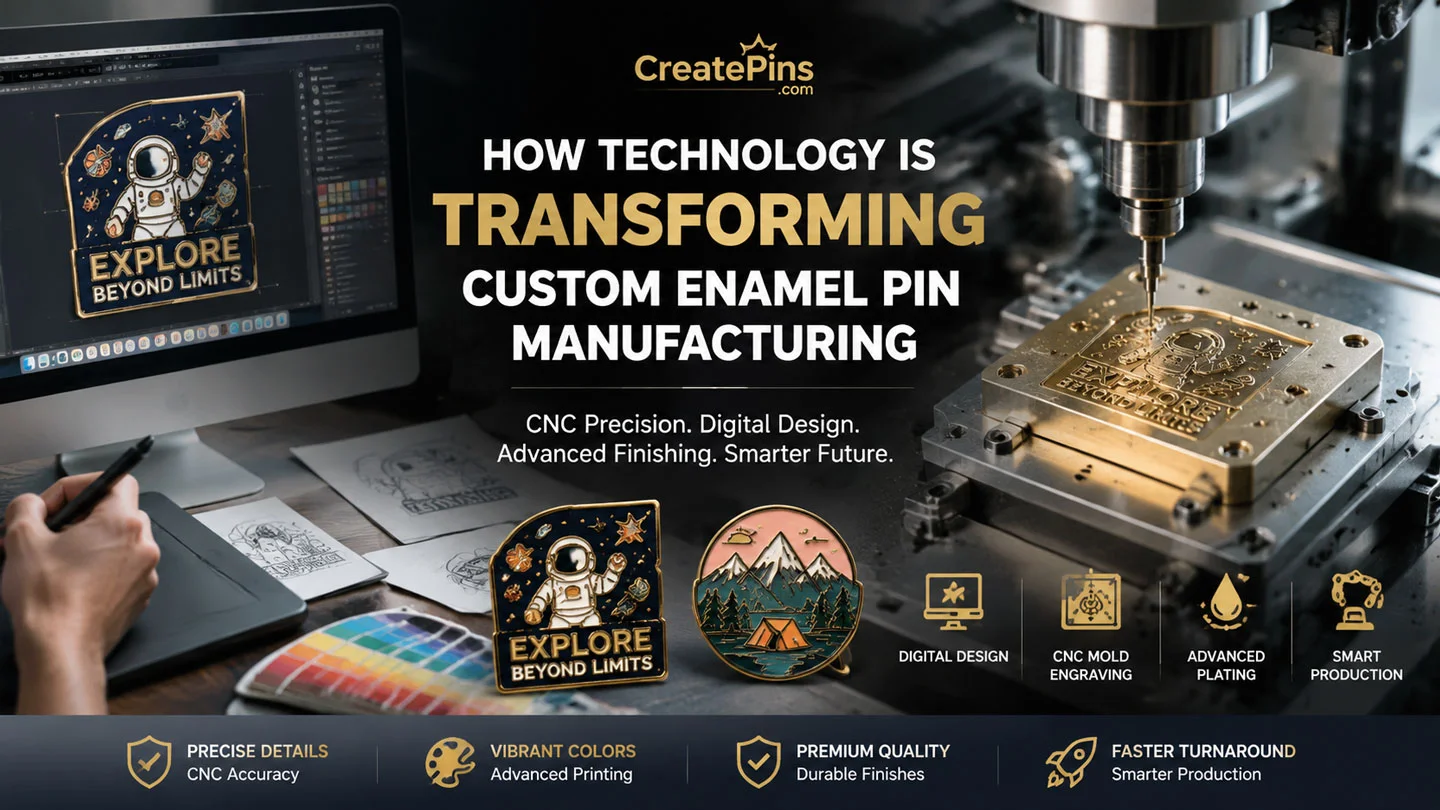
The custom enamel pin manufacturing industry has evolved dramatically over the past two decades. What once required hand-drawn artwork, manual mold engraving, and months of lead time has been transformed by digital enamel pin design, precision CNC engraving for enamel pins, and a host of advanced enamel pin techniques that make the entire process faster, more accurate, and more creative.
In this guide, we break down every major technological advancement that is reshaping the enamel pin manufacturing process — and explain how these innovations benefit pin creators, brands, and collectors alike.
How Far Pin Manufacturing Has Come
To understand the impact of modern technology, it helps to know what the process looked like before digital tools were standard. As recently as the early 2000s, custom pin orders typically involved:
- Hand-drawn artwork sent via post or fax
- Manual mold engraving — a time-consuming process prone to inconsistency
- Limited color options with no standardized matching system
- Weeks or months of production lead time
- Quality defects discovered only upon delivery
- Difficult international communication and limited visibility into production status
Today, technology has addressed nearly every one of these pain points — reducing timelines, improving accuracy, and opening up new creative possibilities for pin designers worldwide.
1. Digital Design & Vector Artwork
Digital Design Tools
PrecisionThe foundation of every high-quality enamel pin is clean, precise artwork — and digital enamel pin design has made this achievable for designers at all skill levels. Programs like Adobe Illustrator, CorelDRAW, and Affinity Designer allow creators to build vector artwork — mathematically defined shapes that can be scaled, modified, and exported with zero quality loss.
Unlike hand-drawn designs or raster images, vector files provide the mold manufacturer with exact path data for every metal line and color boundary. This direct digital-to-mold workflow eliminates the interpretation errors that occurred when manufacturers had to manually interpret analog artwork.
Key Benefits for Pin Production
- Perfectly clean linework — no hand-tremor, smudging, or interpretation errors
- Accurate sizing and proportions — design at exact pin dimensions from the start
- Easy color separation — each enamel fill area is a distinct, clearly defined closed shape
- Rapid design revisions — adjusting a line or color takes seconds, not hours
- Consistent results — the same vector file will produce identical molds every time
- Direct manufacturer compatibility — .AI and .EPS files can be fed directly into CNC systems
2. CNC Mold Engraving
CNC (Computer Numerical Control) Mold Engraving
PrecisionThe metal mold — or die — is the core of every enamel pin. It’s the physical stamp used to press the pin’s shape and metal line pattern into the base metal sheet. Before CNC technology, this mold was carved by hand by skilled engravers, a slow process that introduced human variability into every single mold. Today, CNC engraving for enamel pins has revolutionized this step.
Modern pin factories use CNC engraving machines — computer-controlled cutting tools that carve the mold from a digital file with microscopic accuracy. The machine follows the exact vector paths from your design, translating digital lines directly into physical metal with no manual interpretation required.
How CNC Improves Pin Manufacturing
- Extreme precision — achieves metal line widths as fine as 0.3mm
- Eliminates human mold-carving error — identical molds every time
- Handles intricate detail — complex linework, tiny text, layered geometric patterns
- Consistent results across batch sizes — the 500th pin looks identical to the first
- Faster mold production — CNC engraving is significantly quicker than hand engraving
- Design complexity at no extra cost — intricate designs are no harder for a CNC machine than simple ones
3. Improved Color Matching Systems
Standardized Color Matching
QualityColor accuracy is one of the most critical — and historically inconsistent — aspects of the enamel pin manufacturing process. Without a standardized reference system, “blue” could mean dozens of different shades depending on the pigment batch, the factory, or the country. Modern manufacturing solves this through the Pantone Matching System (PMS) — the global standard for specifying and reproducing consistent colors.
How the Pantone System Improves Pin Production
- Universal color language — PMS 286 C means the same specific blue at every factory in the world
- Digital-to-physical color accuracy — screen colors are calibrated to match physical Pantone swatches
- Consistent reorders — a pin reordered a year later can match the original batch exactly
- Brand color integrity — critical for logos and official merchandise that must match brand guidelines
- Controlled pigment mixing — enamel pigments are measured and mixed to match specific Pantone targets
Digital Color Proofing
Beyond Pantone, modern manufacturers also provide digital proofs — accurate color renderings of the final pin before production begins. These proofs show all enamel colors with their Pantone references, allowing designers to review and approve color choices before a single pin is produced. This digital approval process replaces costly and slow physical color-proof rounds.
4. Advanced Plating Technology
Electroplating & Surface Finishing
QualityThe metal plating on an enamel pin — the shiny gold, silver, or black coating on the raised metal lines — is applied through an electroplating process. Electroplating involves submerging the pin base in a chemical bath and using electrical current to bond a thin layer of the target metal (gold, silver, etc.) to the surface.
Modern electroplating technology has dramatically improved the durability, consistency, and variety of available finishes. Controlled bath temperatures, precise timing, and advanced plating solutions mean finishes are now more scratch-resistant, more corrosion-resistant, and more consistent across entire production batches than older methods allowed. These are among the most important advanced enamel pin techniques for achieving a premium look.
Available Plating Finishes
5. Precision Enamel Filling
Precision Enamel Filling Equipment
PrecisionOnce the metal base is stamped and plated, each individual color area must be filled with liquid enamel paint and then cured. This process — seemingly simple — requires significant precision, especially in designs with many small color sections or fine details. Modern filling equipment has dramatically improved both the accuracy and efficiency of this step.
How Modern Enamel Filling Technology Helps
- Controlled dispensing nozzles — deliver precise amounts of enamel to specific areas without overflow
- Reduced color bleed — minimizes enamel crossing into adjacent metal-separated areas
- Consistent fill depth — uniform enamel surface across the entire pin batch
- Faster production speeds — semi-automated filling increases throughput for large orders
- Better results on small areas — critical for complex multi-color designs with tiny detail regions
Specialty Enamel Options
Modern enamel technology also supports a range of specialty fill materials that unlock new creative effects:
- Translucent enamel — allows the metal plating to show through for a jewel-like, stained-glass effect
- Glitter enamel — metallic or colored sparkle particles suspended within the fill
- Glow-in-the-dark (photoluminescent) enamel — absorbs ambient light and emits it in darkness
- Soft-touch / matte enamel — produces a rubberized, velvety surface texture
- UV-reactive enamel — changes appearance under ultraviolet light
6. Laser Cutting & Special Die-Cut Effects
Laser Cutting Technology
CreativeTraditional enamel pins were limited to relatively simple shapes — circles, ovals, rectangles, and basic outlines. Laser cutting technology has fundamentally expanded what’s possible for pin silhouettes and internal details, enabling creative designs that would have been impossible or prohibitively expensive to produce with conventional stamping methods alone.
What Laser Cutting Enables
- Custom die-cut silhouettes — the pin shape follows the exact outline of your character or design
- Internal cut-out sections — open “windows” within the pin body for a layered, three-dimensional effect
- Extreme detail on edges — spiky, intricate, or organic outlines that standard stamping couldn’t achieve cleanly
- Layered multi-part pins — separate metal pieces assembled into a single pin with depth and dimension
- Dangles and articulated elements — moving parts attached to the main pin body by jump rings
Popular Creative Applications
- Character pin designs that follow the body outline of a creature or figure
- Sword, wand, or weapon pins with complex thin-tip silhouettes
- Pins with internal circular or star-shaped cut-outs
- Layered enamel and metal sandwich designs
- Pins with attached dangle elements (stars, hearts, chains, crystals)
7. Digital Quality Control & Inspection
Digital Inspection Systems
QualityQuality control has traditionally been a manual, visual process — inspectors checking pins one by one under magnification. While skilled human inspection remains important, modern factories supplement it with digital inspection tools that can identify defects more consistently and earlier in the production process.
Technology-Enhanced Quality Checks
- Optical measurement systems — verify mold dimensions against the original digital file before stamping begins
- Colorimetric scanners — check enamel fill colors against Pantone reference values after firing
- Surface inspection cameras — identify enamel overflow, bubbles, or uneven fill across batch samples
- Plating uniformity testing — measure plating thickness and adhesion consistency
- Pull-force testing — verify that pin backs are securely attached to the required strength specification
- Batch sampling protocols — statistically sample across the production run to catch batch-wide issues early
Benefits for Customers
Digital quality control directly benefits pin buyers by:
- Significantly reducing the rate of defective pins reaching customers
- Ensuring color consistency between the proof and the finished product
- Catching mold wear issues before they affect large quantities
- Providing documented quality records for large institutional or brand orders
8. Faster Production & Global Communication
Digital Workflows & Global Production
SpeedBefore the internet and digital communication tools transformed global trade, ordering custom enamel pins from an overseas manufacturer was a slow, opaque process. Artwork had to be mailed physically, proofs returned by post, and production status was largely unknown until the finished goods arrived weeks or months later.
Today, technology has compressed and clarified every stage of that communication loop:
- Instant online artwork submission — upload design files in seconds from anywhere in the world
- Rapid digital proofing — receive a detailed manufacturing proof within days rather than weeks
- Remote proof approval — review and approve proofs online with clear version tracking
- Production progress visibility — track order status through manufacturing stages
- Direct designer-factory communication — resolve questions and request changes in real time
- Digital payment and invoicing — secure, traceable international transactions
How CreatePins Leverages Digital Workflows
At CreatePins.com, streamlined digital workflows mean creators worldwide can submit artwork, review proofs, request revisions, and manage their entire custom pin order through a transparent, responsive online process — with the support of a dedicated team available to guide them at every stage.
9. AI Design Integration
Artificial Intelligence in Pin Design
EmergingThe most recent technological shift affecting pin design and manufacturing is the rise of AI-powered image generation tools. Platforms like Midjourney, DALL·E, and Stable Diffusion allow designers to generate visual concepts in seconds — drastically accelerating the ideation phase of pin design.
How AI Is Influencing Pin Design Today
- Rapid concept generation — explore dozens of design directions in the time it once took to sketch one
- Style exploration — test character styles, color palettes, and compositions before committing to detailed artwork
- Mood board creation — quickly visualize a collection aesthetic or thematic direction
- Reference imagery — generate visual references for a human designer to refine and vectorize
- Variations on demand — quickly produce color or style variants of an existing concept
Current Limitations of AI for Pin Manufacturing
While AI tools are powerful for concept work, they cannot yet replace the precision required for manufacturing-ready artwork:
- AI images are raster (pixel) files — must be redrawn as vector before production
- AI tends to produce gradients and textures incompatible with enamel fill
- Fine details from AI images often disappear at physical pin scale
- Metal line structure must be manually defined — AI has no concept of manufacturing constraints
The most effective workflow combines AI for rapid inspiration and creative exploration, followed by a skilled designer refining and vectorizing the concept for production. Learn more in our dedicated guide: Turning AI Art into Manufacturable Enamel Pins.
Then vs. Now — Manufacturing Comparison
Here’s a direct comparison of the traditional pin manufacturing process versus what modern technology makes possible today:
| Aspect | Traditional Methods | Modern Technology |
|---|---|---|
| Artwork preparation | Hand-drawn, sent by post or fax | Digital vector files, instant online upload |
| Mold creation | Manual engraving — slow, variable | CNC machine engraving — precise, consistent |
| Color accuracy | Subjective, batch-to-batch variation | Pantone-matched, digitally verified |
| Design complexity | Limited by manual mold capability | Complex linework, die-cuts, layered effects |
| Plating options | Gold and silver, limited variety | 10+ finishes including rainbow, rose gold, antique |
| Proof review | Physical proofs by post — weeks of delay | Digital proofs online — days to review and approve |
| Quality control | Manual visual inspection only | Digital scanning, colorimetry, standardized testing |
| Production time | Months from concept to delivery | 2–3 weeks for standard orders |
| Design ideation | Manual sketching and iteration | AI tools for rapid concept generation |
| Specialty effects | Very limited | Glitter, glow, translucent, UV, soft-touch enamel |
The Future of Pin Manufacturing
The technologies that have already transformed pin manufacturing continue to advance — and new developments on the horizon promise even greater creative and production possibilities for pin creators.
- 1Increased Automation in Enamel Filling
Robotic enamel dispensing systems are becoming more sophisticated, enabling finer color placement in increasingly small design areas — unlocking more detailed multi-color designs without sacrificing production speed.
- 2AI-Assisted Design Refinement
Beyond concept generation, AI tools are beginning to assist with the vectorization and manufacturing prep stages — automatically identifying problem areas in a design and suggesting corrections before submission.
- 33D Printed Prototype Molds
Additive manufacturing (3D printing) technologies are increasingly being used to produce prototype molds for design verification before committing to full metal tooling — reducing sampling cost and time for new pin concepts.
- 4Sustainable Material Advances
Environmental technology improvements are producing more sustainable electroplating processes with lower chemical waste, and new alloy formulations are reducing reliance on less sustainable base metals.
- 5Real-Time Production Tracking
Expanding digital manufacturing platforms will give customers real-time visibility into exactly where their order is in the production process — from mold creation through plating, enamel fill, QC, and shipping.
What This Means for Pin Creators
For artists, brands, and Kickstarter creators, these advances mean the barrier to entry for professional custom enamel pin manufacturing continues to lower — while the creative ceiling rises. Today it has never been easier to turn a digital concept into a high-quality collectible pin ready for your audience.
At CreatePins.com, modern manufacturing technology is combined with experienced craftsmanship and dedicated customer support to produce durable, high-quality custom enamel pins — for independent artists, growing brands, and everything in between.
- Digital artwork preparation guidance and design assistance
- CNC-precision mold production for every custom order
- Pantone color matching and enamel color chart reference
- 10+ metal plating finish options
- Specialty enamel effects: glitter, glow, translucent, soft-touch
- Die-cut and laser-shaped pin silhouettes
- Accurate digital proofs before any production begins
- Physical sampling available for orders of 500+ pins
- Streamlined online ordering and production tracking
Frequently Asked Questions
Ready to Bring Your Pin Design to Life?
CreatePins.com combines modern manufacturing technology with experienced craftsmanship to produce high-quality custom enamel pins — from first design concept through to finished product delivery.
References & Further Reading
- Get a Free Custom Pin Quote – CreatePins
- Turning AI Art into Manufacturable Enamel Pins
- Hard Enamel vs Soft Enamel Pins: The Ultimate Guide
- The Ultimate Guide to Enamel Pin Add-Ons: Glitter, Glow, Epoxy & More
- The Beginner’s Guide to Enamel Pin Plating Colors
- Technical Tips for Enamel Pin Design
- Essential Criteria for Grading Enamel Pins
- Common Enamel Pin Defects & How CreatePins Prevent Them
- Why Enamel Pin Colors Look Slightly Different From Your Screen Mockup
- Custom Enamel Pin Order Process Explained