No Minimum Order Custom Pins
What You Need to Know Before You Buy
Custom enamel pins are no longer just for large brands ordering thousands at a time. But “no minimum order” comes with nuances most first-time buyers don’t expect — including pricing surprises, hidden setup costs, and sweet spots that save you significant money.
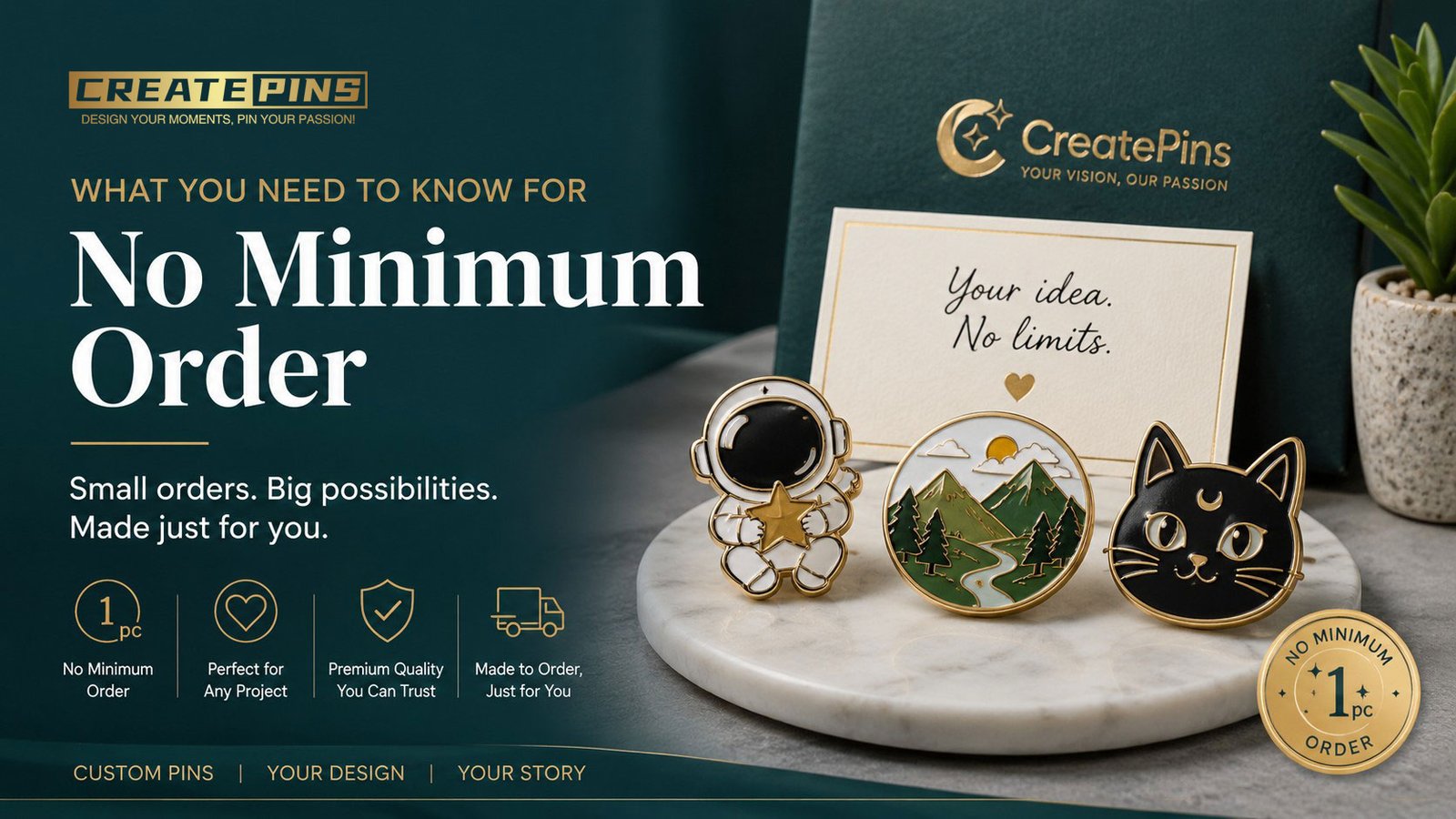
Artists, startups, schools, nonprofits, wedding planners, and small businesses can all create custom pins today without committing to huge quantities. But ordering small comes with real trade-offs that aren’t always obvious upfront. This guide explains everything you need to know — what “no minimum” really means, why small orders cost more, where the sweet spot is, and how to get the best value no matter your quantity.
👥 Who Benefits Most From No Minimum Orders
No minimum or low minimum custom pin orders have made custom pin manufacturing genuinely accessible to a much wider range of buyers. If you fall into any of these categories, small-batch ordering was essentially designed for you.
Independent Artists & Illustrators
Online Creators & Streamers
Startups & Small Brands
Schools & Student Orgs
Wedding & Event Planners
Nonprofits & Causes
Etsy Shops & Makers
Convention Sellers
Subscription Box Brands
The common thread: buyers who want to test demand, manage cash flow, or create something personal — without the commitment and risk of a large production run.
📌 What “No Minimum Order” Really Means
A no minimum order policy means you can technically order any quantity — even just 1, 5, or 10 pins. Traditionally, enamel pin manufacturers required minimum orders of 50 to 100 pieces because production involves setup work that costs nearly the same regardless of quantity ordered.
Modern manufacturing workflows now allow smaller production runs — but the underlying fixed costs don’t disappear. They still exist. The difference is that instead of refusing small orders, manufacturers now accept them — but pass those fixed costs through to the buyer in the form of a higher per-unit price.
“No minimum” does not mean “cheap.” In fact, small quantity orders are almost always the most expensive per piece. The fewer pins you order, the more each individual pin costs — because the same fixed setup fees are divided across fewer units. Understanding this changes how you plan your order.
The Fixed Costs Behind Every Pin Order
Whether you order 10 pins or 1,000 pins, the manufacturer incurs these costs before a single pin is produced. These setup expenses are fixed — meaning they don’t scale with quantity.
A metal mold is cut for your specific shape — required even for standard shapes
Your design is converted into production-ready specifications for the factory
Each enamel color is individually matched and prepared before filling begins
Production equipment is set up and calibrated specifically for your order
Gold, silver, black nickel — each plating requires its own bath setup
A sample is produced and inspected before full production is approved
Backing cards, polybags, and any custom packaging require their own prep
Skilled workers set up each stage — time that doesn’t reduce with fewer units
💸 Why Small Orders Cost More Per Pin
The math behind pin pricing is straightforward once you understand it — and it explains why first-time buyers are often surprised by quotes for small quantities.
Imagine total setup and fixed costs of $120 for a given pin order. Here’s what happens to the per-unit cost as quantity changes:
📊 Per-Unit Cost vs Quantity — How Setup Costs Dilute
This is why some counterintuitive things happen in pin pricing:
- →10 pins may cost nearly half as much in total as 50 pins — meaning each pin costs 5× more
- →50 pins may cost only slightly less in total than 100 pins
- →The actual material cost of additional pins is often far less than you’d expect
Moving from 30 pins to 50 pins may increase your total invoice by only $15–$25, while your per-unit cost drops dramatically. Similarly, moving from 50 to 100 pins often provides a major improvement in cost efficiency for a relatively small total increase. Always ask your supplier for a quote at 50 and 100 units before settling on a smaller quantity.
For creators, artists, and small businesses, 50–100 pins is usually enough to validate designs with real audience demand, build inventory for conventions or online shops, create the sense of limited availability that drives fan interest, and avoid the immediate pressure of reordering before you’ve sold through.
Many first-time buyers are surprised to discover that increasing from 30 pins to 50 pins may only increase the total invoice by a small margin — while significantly improving cost efficiency and giving them far more flexibility.
Reordering very small quantities later can sometimes cost more overall than ordering slightly higher quantities upfront — especially if mold fees apply again or production scheduling means longer lead times for tiny batches. See the full enamel pin cost and pricing guide to understand exactly how quantity affects your total invoice.
🔍 3 Reasons People Choose Small Batch Orders
Testing New Designs
The most common reason. Artists and brands want to validate demand before committing to a large inventory investment that might not sell.
- Validate designs with real audience feedback
- Gauge interest before scaling production
- Reduce risk of unsold inventory
- Experiment with color variations
- Test limited edition concepts
Intentional Limited Editions
Some buyers want low quantities — because scarcity increases perceived value and creates collector excitement around the design.
- Convention-exclusive numbered editions
- Event giveaways or VIP merch
- Team recognition or milestone pins
- Anniversary or commemorative collections
- Artist series with intentional rarity
Personal & One-Off Projects
Not every pin order is for business. Many customers order small quantities for purely personal reasons where buying 100+ pins makes no practical sense.
- Weddings and bachelorette parties
- Family reunions and milestones
- Club or team recognition
- Graduation gifts
- Memorial and tribute items
Pilot Launches & Kickstarters
Launching a pin line, Kickstarter campaign, or Etsy shop? Small batches let you build product images and gather early reviews before committing to full production scale.
- Generate product photos before scaling
- Gather early buyer reviews and feedback
- Assess real sales velocity before reordering
- De-risk crowdfunding campaigns
- Build social proof for larger runs
⚙️ Best Pin Specs for Small Orders
If you’re ordering a small quantity, your design and spec choices directly determine how affordable your order will be. Simpler specifications dramatically reduce per-unit costs at low quantities. Here’s what to prioritize — and what to avoid if budget is a concern.
- Soft enamel construction
- Standard metal plating (gold, silver, black nickel)
- 1–4 enamel fill colors
- Standard butterfly clutch back
- Simple or standard shapes
- Pin size under 1.5 inches
- Clean bold artwork with clear outlines
- Single attachment point
- Glitter enamel fill — extra filling process
- Glow-in-the-dark enamel — specialty materials
- Screen printing — separate setup per color
- Translucent / epoxy enamel
- Metal cutouts — complex tooling
- Spinner or sliding mechanisms
- Multiple mold requirements
- Custom back stamp — extra mold prep
Simpler isn’t just cheaper — it’s often better for pin production. Bold shapes, strong silhouettes, and clean outlines consistently reproduce more faithfully at pin scale than intricate detailed artwork. Review the complete enamel pin design guide and the top mistakes new pin makers make before finalizing artwork for a small run.
🔵 Soft vs Hard Enamel for Small Runs
For no minimum or small-batch orders, the enamel type you choose has a meaningful impact on both cost and final appearance. Understanding the difference helps you make the right call for your specific goals and budget.
Soft Enamel
- Lower production cost — ideal for small runs
- Faster manufacturing turnaround
- Recessed enamel creates textured, tactile feel
- Vibrant, bold color results
- More flexible for complex multi-color designs
- Easier for small-batch production scheduling
- Best choice for most small orders
Hard Enamel
- Smooth, jewelry-like surface flush with metal
- Higher perceived quality and durability
- Premium look for corporate or collectible pins
- Slightly higher cost — especially at low quantities
- Longer production process
- Best when premium positioning justifies the cost
- Choose when quality signals matter most
For most small-batch orders where budget is a primary concern, soft enamel is the practical starting choice. If you’re positioning pins as premium collectibles or corporate gifts where the polished finish is part of the product value, hard enamel is worth the additional cost. Read the full hard enamel vs soft enamel comparison and learn how to choose the right enamel type for your specific design.
🚚 How Shipping Affects Small Orders
Shipping is one of the most overlooked cost factors for small pin orders — and it can become a surprisingly large percentage of your total spend when ordering very small quantities.
📦 Shipping Cost as % of Total Order Value
A critical insight: shipping costs for 50 pins are often very similar to shipping costs for 10 or 20 pins. International shipping minimums still apply, and the base handling cost is relatively fixed. This means that in terms of per-unit shipping cost, ordering more pins is significantly more efficient — another reason why 50+ units is typically the practical starting point.
To reduce shipping’s impact on small orders: avoid rush production (express shipping costs can be 2–3× standard), combine multiple designs into a single shipment where possible, and consider ordering slightly more pins to achieve better per-unit shipping value. Always confirm whether international orders may incur additional customs duties or import fees not included in the initial quote.
⏱ Production Timelines for Small Orders
Small quantity does not automatically mean faster production. Many factories schedule small orders alongside larger production batches, meaning the lead time can be similar regardless of how many pins you’re ordering.
| Stage | Typical Time | Notes |
|---|---|---|
| Artwork Approval | 1–3 Days | Revisions may extend this — aim to submit print-ready artwork |
| Mold Production | 2–4 Days | Required even for standard shapes — cannot be skipped |
| Sample Production | 3–7 Days | Always recommended before full run approval |
| Full Manufacturing | 7–15 Days | Small runs may be batched with larger orders |
| Quality Inspection | 1–2 Days | Included in most professional manufacturer processes |
| Standard Shipping | 5–12 Days | Varies by origin country and destination |
| Total (Standard) | 3–5 Weeks | Plan well in advance for events or campaign launches |
| Rush Production | +Premium Fee | Available but significantly increases total cost |
Always confirm whether your quoted timeline includes artwork revision time, sampling and approval, actual production days, shipping transit, and potential customs delays — not just one of these stages. Many buyers plan for the shipping time only, then are surprised by the full lead time. If you have a hard event deadline, work backwards from that date and add a one-week buffer for unexpected delays.
⚠️ Common Mistakes Buyers Make With Small Orders
Ordering Too Few Pins Then Reordering
Many first-time buyers order only 10–20 pins to “test the water,” then realize demand exists and need to reorder. The second order may cost nearly as much as the first due to setup fees — and two orders often cost significantly more in total than a single larger order would have. If you have reasonable confidence in demand, ordering slightly more upfront typically saves money long-term. Ask your supplier to quote you at your target quantity, at 50, and at 100 — the differences are often surprising.
Making the Design Too Complex for Scale
Tiny details, thin lines, excessive colors, and highly intricate artwork create two problems: they increase production costs (especially at low quantities), and they often don’t reproduce faithfully at small pin sizes. Bold, clean designs with strong silhouettes consistently produce better results — and cost less to produce. Review design guidelines for manufacturable pins before submitting artwork to avoid costly revision rounds.
Ignoring Pin Size Impact on Cost
A small increase in pin size can significantly affect pricing — more metal, more enamel, more material overall. For budget-conscious small runs, 1 inch to 1.5 inches is often the ideal range. Large or oversized pins (2 inches+) use considerably more material and also increase shipping weight, affecting both production and delivery costs. Always check whether a slight size reduction could meaningfully reduce your total invoice.
Forgetting Packaging Costs
Backing cards, polybags, custom boxes, and retail packaging can add unexpected costs — especially at low quantities where the per-unit packaging cost is highest. Custom packaging becomes significantly more economical at larger volumes. For small runs, consider simple poly bags with a standard backing card to keep costs manageable, and reserve custom packaging investment for when you’re ordering at quantities that justify it. Read the complete packaging options guide to understand what each format costs and delivers.
Not Asking About Mold Retention Policy
One of the most overlooked questions when placing a small order: how long does the manufacturer retain your mold? If you plan to reorder later, mold retention is critical — manufacturers who store molds for 1–2 years allow you to reorder without paying full setup fees again, making future orders significantly more cost-effective. Always ask specifically: mold storage duration, reorder minimum quantity, and whether reorder pricing is reduced compared to initial order pricing.
💡 6 Tips to Save Money on Small Pin Orders
Keep the Design Simple
Fewer colors, cleaner shapes, and bold outlines reduce both production complexity and the risk of quality issues. A well-executed simple design consistently outperforms a complex design that’s pushed the limits of what’s achievable at pin scale.
Use Standard Plating Colors
Gold, silver, black nickel, and copper are the most economical plating options because they’re the most commonly used and require no special bath setup. Specialty platings like rose gold or antique finishes add cost — save these for when you’re ordering at quantities where the premium is better diluted.
Avoid Rush Production
Rush or expedited production fees can add 30–60% to your total order cost. Standard production timelines are dramatically more affordable. Plan at least 5–6 weeks out from your event or launch date to avoid needing rush service — and build in a week of buffer for unexpected delays.
Combine Multiple Designs
If you’re planning to order more than one design, combining them into a single shipment reduces shipping costs and may allow you to qualify for better production pricing. Some manufacturers offer setup discounts when multiple designs are ordered simultaneously from the same artwork package.
Increase Quantity Slightly
Always request pricing at your target quantity, at 50, and at 100. The total cost difference between 30 and 50 pins is often surprisingly small, while the per-unit improvement is significant. A marginal increase in total spend can deliver substantially better economics across the whole order.
Use One Mold for Variants
Color variants and alternate colorways can often share the same mold — meaning you can create multiple pin versions for the cost of a single mold setup fee. This is an effective way to offer variety without doubling setup costs, particularly useful for limited edition series or color options on the same design.
Ask whether your manufacturer offers reorder discounts if the mold already exists from a previous order. Many manufacturers reduce or waive tooling fees for reorders, which means a second production run is significantly more economical than your first — especially if you order slightly more the second time. This is one of the best reasons to establish a relationship with a trusted manufacturer early.
Get a Custom Quote — Any Quantity, Any Design
Whether you need 25 pins for a personal event or 500 for a product launch, our team at CreatePins.com will give you transparent pricing, honest guidance on quantity sweet spots, and expert support from artwork to delivery.
❓ Frequently Asked Questions
📚 Further Reading from CreatePins
💰 Pricing, Quality & Specifications
-
Custom Pin Pricing Estimate: Accurate Enamel Pin Cost Guide
A transparent breakdown of every cost factor — quantity, size, enamel type, plating, and special finishes — so you can budget accurately before requesting a quote. -
Hard Enamel vs Soft Enamel Pins: Differences, Costs & Design Tips
Understand the quality, aesthetic, and cost differences between the two main enamel types — and which is right for your small-batch order. -
How to Choose the Right Enamel Type for Your Pin Design
Match your design’s visual style to the correct enamel type for the best production outcome on a tight budget. -
Essential Criteria for Grading Enamel Pins
Know exactly what quality standards to look for when approving your sample — especially important for first-time small orders. -
Quick Guide to Custom Enamel Pin Plating Colors
Gold, silver, black nickel, antique — understanding plating options helps you choose the most cost-effective finish for your design.
🎨 Design & Production
-
Enamel Pin Design Guide: How to Create Manufacturable & High-Quality Pins (2026)
The complete technical guide to designing pins that translate faithfully from digital artwork to finished product — critical reading before submitting files for a small order. -
Top 10 Enamel Pin Mistakes New Pin Makers Must Avoid
The most common first-order errors — from choosing the wrong manufacturer to skipping the sample approval stage — that cost buyers money and time. -
Choosing the Right Pin Backing for Enamel Pins
Butterfly clasp vs rubber clutch vs locking back — the backing choice affects both cost and how long your pin stays secure when worn.
📦 Packaging & Presentation
-
Guide to Choosing Packaging for Custom Enamel Pins
Backing cards, polybags, gift boxes — understand what each option costs and delivers so you can make the right packaging call for your budget and quantity. -
Enamel Pin Design Guide: Back Stamps & Sequential Numbering
How to add numbering and back stamps to dramatically increase the perceived value of small-batch limited edition pins.
🚀 Strategy & Use Cases
-
Custom Pins for Conferences, Trade Shows & Events: Complete Planning Guide
How to plan quantity, design, and distribution for event pins — with timelines and budgeting guidance for first-time exhibitors. -
Are Custom Enamel Pins Worth It for Small Businesses?
An honest ROI analysis of custom pins for small businesses and independent creators — including when small orders make financial sense. -
Long-Term Merch Planning: Build Successful Custom Pin Collections
Start small and scale smart — how to plan a multi-release pin strategy that grows with your audience and improves economics over time.
Transparent Pricing, Any Quantity — No Surprises
At CreatePins.com, we give you honest pricing across multiple quantity tiers so you can make the smartest decision for your budget and goals. No pressure, no hidden fees — just great pins and expert guidance from first quote to final delivery.