How to Turn Enamel Pin Design into Jewelry — Earrings, Necklaces, Rings & Bracelets
Production differences, design specifications, safety requirements, cost data, and expert tips for converting enamel pin artwork into wearable ornaments.
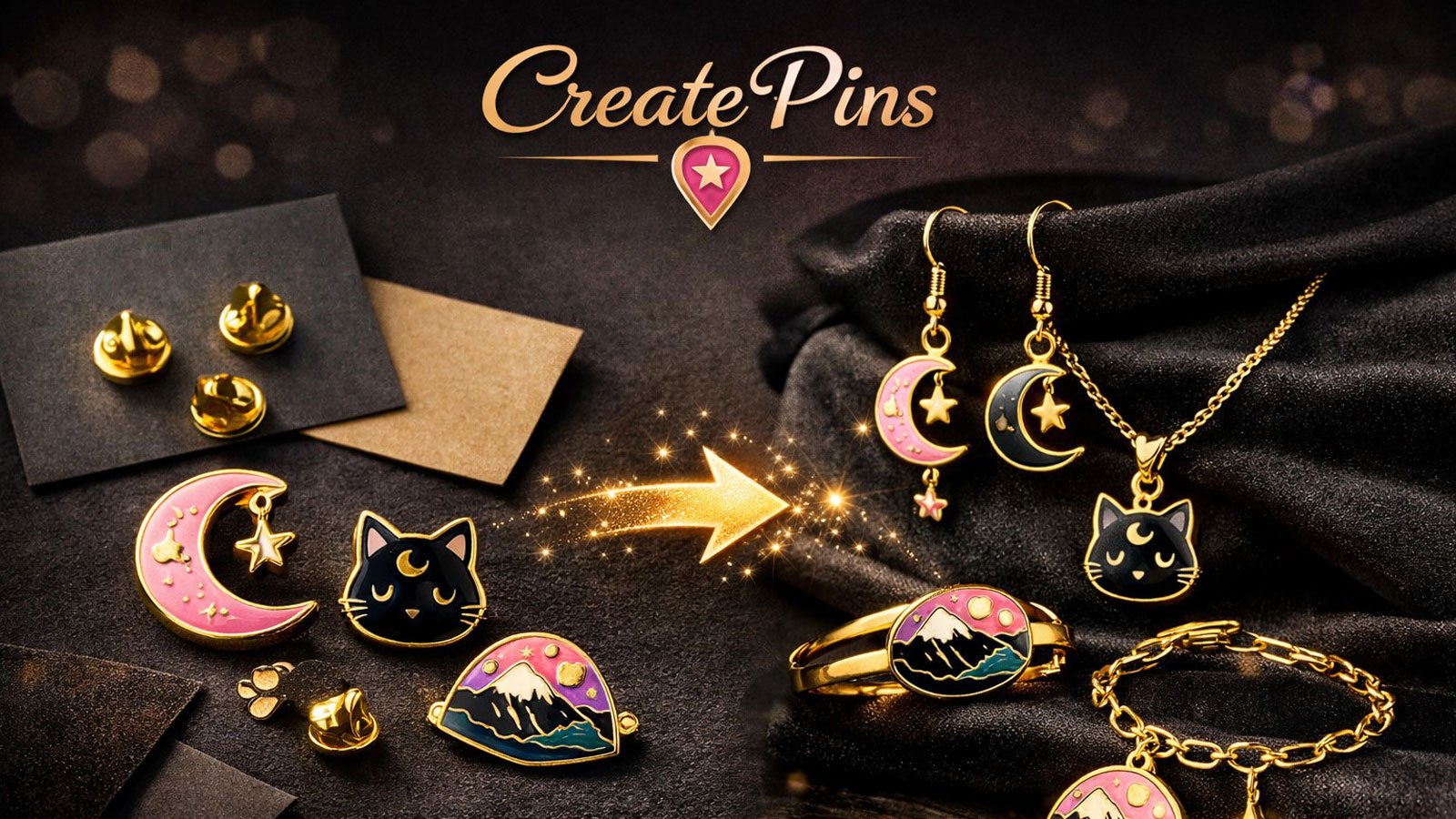
Love your enamel pin designs so much you wish you could wear them beyond a jacket or bag? Converting your enamel pin artwork into jewelry — earrings, necklaces, rings, or bracelets — is one of the most effective ways to expand your product line, increase average order value, and offer something genuinely new to your audience without the cost of creating entirely new designs from scratch.
The process is more straightforward than it sounds, but it has specific technical requirements that differ meaningfully from standard pin production. Jewelry pieces are worn directly on the body, which changes everything from metal choice to weight limits to plating specifications. This guide covers every factor you need to understand before your first jewelry production run.
No new design cost — your existing pin artwork becomes the foundation, reducing development investment significantly.
Higher price points — jewelry consistently commands 2–4× the retail price of equivalent-sized pins, improving revenue per design.
New audience reach — customers who don’t wear pins regularly may still buy earrings or necklaces from their favorite artist.
📌 The most successful pin-to-jewelry conversions don’t simply duplicate pin designs at smaller scale — they adapt the most visually essential element of the design for the specific jewelry format, then optimize for wearability.
Key Production Differences
Enamel pins and jewelry share many manufacturing steps — die-striking, plating, and enamel filling — but their functional requirements diverge significantly because jewelry lives on the body rather than attached to fabric or accessories.
| Feature | Enamel Pins | Jewelry (Body-Worn) |
|---|---|---|
| Base Metal | Iron, zinc alloy, or brass | Brass, zinc alloy, or stainless steel |
| Metal Thickness | 1.5–2.0 mm typical | 1.0–1.5 mm (lighter for comfort) |
| Plating Requirements | Any decorative finish | Nickel-free & sweat-resistant required |
| Attachment Hardware | Pin post & butterfly/rubber clutch | Jump rings, earring hooks, chains, ring bases |
| Weight Limit | 8–12g per pin (comfortable) | ≤ 5g per earring (body-worn limit) |
| Edge Finishing | Standard smooth | Polished round edges required (skin contact) |
If you’re adapting an existing pin mold, it may need to be scaled down or retooled to reduce weight and thickness — particularly for earrings and rings. For cost efficiency, CreatePins can adjust your existing artwork and retool only the necessary parts of the mold rather than creating an entirely new one from scratch. Ask about mold reuse discounts when submitting your quote.
Specifications by Jewelry Type
Each jewelry format has specific dimensional, weight, and attachment requirements. These specs are based on real manufacturing data and wearability testing — not theoretical guidelines.
Earrings
Necklaces
Rings
Bracelets
💍 Ready to see how your pin design translates to jewelry? Submit it for a free adaptation review — our team models size, weight, and attachment options before you commit to production.
Get a Free Jewelry QuoteSafety & Wearability Requirements
Jewelry pieces undergo more frequent body contact, movement, and exposure to sweat and moisture than pins. These safety requirements are non-negotiable — they protect both your customers and your brand reputation.
Nickel-Free Plating — Always
Always specify nickel-free, hypoallergenic plating for any jewelry item that contacts skin. Standard decorative pin platings may contain nickel, which causes dermatitis in a significant portion of wearers. This is a legal requirement in many markets, not just a best practice.
Sweat & Moisture Resistance
Avoid non-plated iron bases entirely for jewelry — iron will rust with repeated skin contact and moisture exposure. Use brass or stainless steel as the base metal. Brass + nickel-free gold plating provides 2+ years of color retention under normal wear conditions.
Edge Polishing — No Sharp Points
All edges must be fully rounded and polished for comfort. Die-cut pin shapes that include pointed elements (stars, animal ears, crown points) need edge smoothing before jewelry production — sharp metal against skin causes discomfort and potential scratching.
Epoxy Coating (Recommended)
An epoxy dome or clear coat over the enamel surface adds meaningful protection for rings and bracelets — the pieces most subject to abrasion and contact. Zinc alloy with epoxy coating reduces surface scratching by approximately 30% compared to bare enamel. Worth the small additional cost for pieces worn daily.
Brass + nickel-free gold plating → 2+ years color retention under normal daily wear conditions
Zinc alloy + epoxy coat → approximately 30% reduction in surface scratch rate vs bare enamel
Stainless steel base → highest corrosion resistance, ideal for sweat-exposed bracelet and ring designs
Design Simplification & Adaptation
Before submitting artwork for jewelry production, request digital mock-ups or 3D previews to verify attachment placement, orientation, and visual balance at actual jewelry size. What reads well at pin scale may need adjustment at earring or ring scale.
Pre-Production Design Checklist
Rather than shrinking your entire pin design to jewelry scale, consider isolating the most visually impactful element and making that the jewelry piece. A pin featuring a detailed character with background elements often works better as an earring that features just the character’s face or a key symbolic object from the design — bold, simple, and readable at 15–20mm.
Cost & Lead Time – Turn Enamel Pin Design into Jewelry
Indicative pricing for enamel pin designs converted to jewelry. All prices include the attachment hardware specified (hooks, chains, ring bases, clasps). These are reference ranges — exact pricing depends on design complexity and order quantity.
| Jewelry Type | Avg. Mold Fee | Unit Price | Includes |
|---|---|---|---|
| Earring Pairs | $68–$85 | $2.80–$4.50 | Two matched charms + earring hooks |
| Necklaces | $68–$90 | $3.50–$5.50 | Charm + 18–20″ chain + jump ring |
| Rings | $65–$80 | $3.00–$4.00 | Charm + adjustable ring base |
| Bracelets | $68–$90 | $4.00–$5.80 | Charm(s) + link chain + clasp |
Lead time: 10–15 business days after artwork approval
MOQ: 50 pieces per design recommended — lower quantities available for samples before a full run
Mold reuse: If adapting an existing pin mold, CreatePins offers mold reuse discounts — ask about this when submitting your quote
Why Work with CreatePins
Converting enamel pin designs into jewelry is both creative and technical — you need a manufacturer who understands both the art side and the wearability requirements. CreatePins has helped hundreds of artists and brands complete pin-to-jewelry conversions successfully.
Free artwork adjustment for jewelry adaptation — our team scales, retouches, and optimizes your existing pin artwork for the jewelry format at no additional charge.
Nickel-free hypoallergenic plating options confirmed across all jewelry orders — your customers’ safety is built into the production process.
Mold reuse discounts for pin-to-jewelry conversions — if you have an existing pin mold, you won’t pay full mold fees for jewelry adaptations.
Express sampling and mock-up proofing before full production — see exactly how your pin design looks as jewelry before committing to your order quantity.
Ready to Transform Your Pin Designs into Jewelry?
Get a custom quote for converting your enamel pin designs into earrings, necklaces, rings, or bracelets — includes free artwork review and mock-up proofing.
Start Your Custom Jewelry Quote →Free artwork adaptation · Nickel-free plating · Mold reuse discounts available
Frequently Asked Questions
Common questions about converting enamel pin designs into jewelry.
In many cases yes — but with modifications. Pin molds often need to be scaled down or retooled to reduce weight and thickness for jewelry. Earrings must stay under 5g each, which typically means reducing size to 0.5–1.0 inch. Rings require designs under 0.6 inch wide. CreatePins offers mold reuse discounts and handles all artwork adaptation for jewelry conversion during the quoting process.
Always use nickel-free, hypoallergenic plating for any jewelry piece. Standard pin platings may contain nickel which causes skin reactions in a significant portion of wearers — this is also a legal requirement in many markets. Brass base with nickel-free gold plating delivers 2+ years of color retention under normal wear. Stainless steel bases provide the best corrosion resistance for pieces that contact sweat regularly.
Enamel earring charms should measure between 0.5 and 1.0 inch (12–25mm) and weigh under 5g each. Larger or heavier designs cause ear fatigue and stress on the earring hook. If your pin is larger than 1.0 inch, scale it down or isolate the most visually impactful element for the earring version rather than trying to shrink the entire design.
Indicative costs: earring pairs run $68–85 mold fee with $2.80–$4.50 per unit (two charms and hooks); necklaces run $68–90 mold with $3.50–$5.50 per unit including chain; rings run $65–80 mold with $3.00–$4.00 per unit including adjustable base; bracelets run $68–90 mold with $4.00–$5.80 per unit including chain and clasp. Lead time is 10–15 days after artwork approval, with a recommended 50-piece MOQ (samples available at lower quantities).
Usually yes. Jewelry is smaller and viewed at closer range than pins, changing what detail is legible. For jewelry reduce lines thinner than 0.2mm; limit colors to 6 or fewer; maintain 0.1mm minimum spacing between colors; ensure loops are at least 2.5mm diameter for structural integrity. Designs with bold, simple lines translate best from pin to jewelry scale. For complex pin designs, consider isolating the most iconic element rather than shrinking the entire composition.
References & Further Reading
- CreatePins — Hard Enamel vs Soft Enamel Pins — Differences, Costs & Design Tips
- CreatePins — The Complete Beginner’s Guide to Enamel Pin Plating Colors & Materials
- CreatePins — How to Choose the Correct Pin Backings — all clutch and post types explained
- CreatePins — How to Choose the Perfect Size & Thickness for Your Enamel Pin Design
- CreatePins — Common Enamel Pin Types — Differences, Costs & Mistakes (2026)
- CreatePins — Best File Formats for Custom Enamel Pins (AI vs PSD vs PNG)
- CreatePins — The Ultimate Guide to Enamel Pin Add-Ons: Glitter, Glow, Epoxy & More
- CreatePins — The Biggest Enamel Pin Design Mistakes That Ruin Everything
- CreatePins — What Brands Get Wrong About Promotional Pins
- CreatePins — 🌐 Explore More Custom Products