Minimalist vs. Detailed Enamel Pin Designs: Which Style Sells Better?
A complete guide to choosing between minimalist enamel pins and detailed enamel pins — and how to make the right call for your audience, size, and budget.
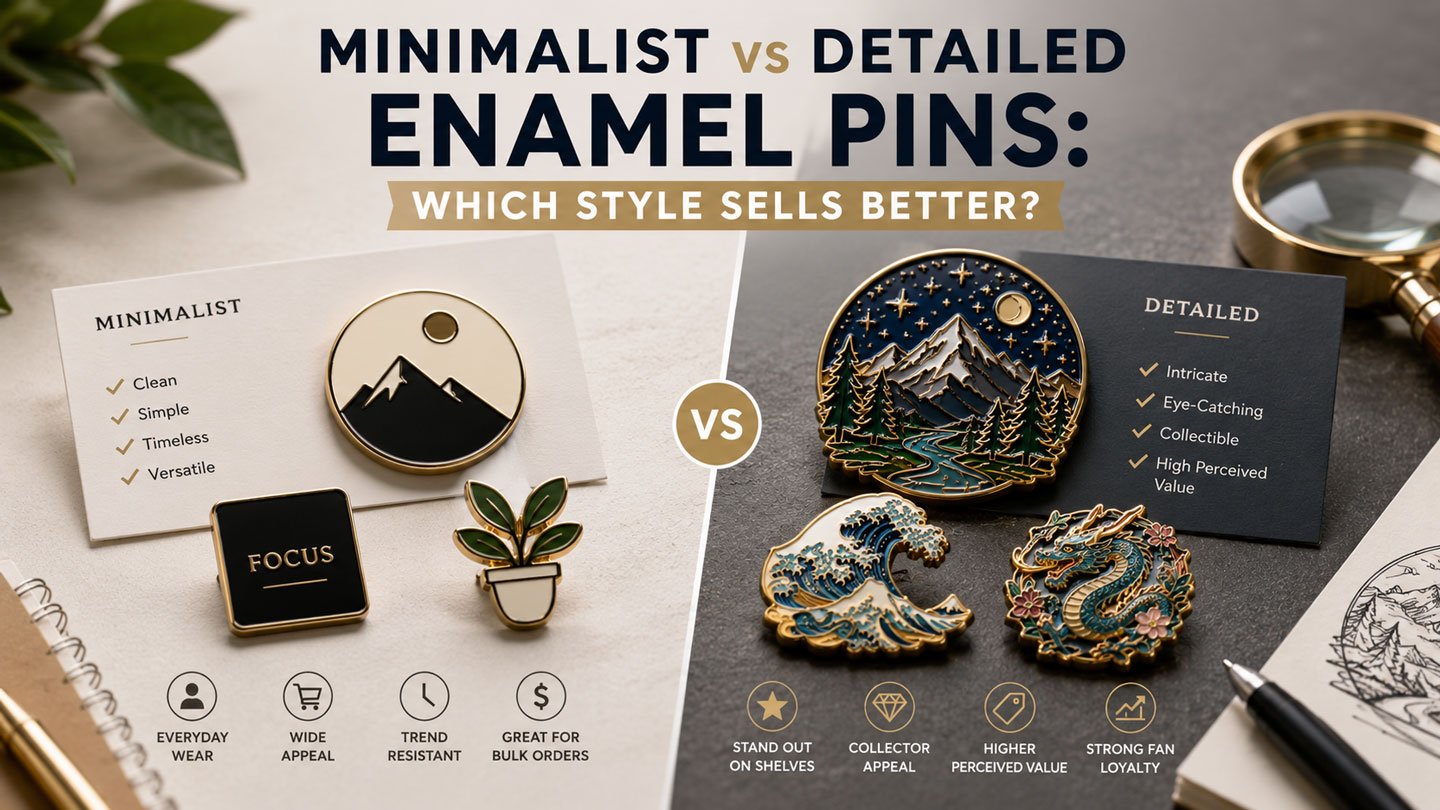
When you sit down to plan a custom enamel pin, one of the very first decisions is surprisingly hard: should the design stay simple and minimalist, or should it pack in as much detail as possible? A minimalist enamel pin design leans on a few bold shapes, limited colors, and clean lines. A detailed enamel pin design leans on intricate artwork, multiple colors, tiny elements, and layered visual storytelling. Both approaches sell extremely well — the real question isn’t which style is “better,” it’s which style is better for your audience, your pin size, your production method, and where you’re selling.
This guide breaks down minimalist vs detailed enamel pin designs in full detail: what defines each style, the concrete advantages of both, how pin size and line thickness actually limit your options, and a practical framework for deciding which approach fits your next pin project. Whether you’re weighing minimalist enamel pins against detailed enamel pins for a single release or planning a whole custom enamel pin design collection, the same core principles apply.
The Quick Answer
Neither style automatically wins. Minimalist enamel pins tend to have the edge in recognition, small sizes, branding, and fast visual communication. Detailed enamel pins tend to have the edge in storytelling, character representation, and collector appeal. The right choice depends on your concept, your pin’s physical size, and who you’re selling to — and for a lot of custom enamel pin design projects, the strongest answer is actually a middle ground called “controlled detail,” covered further down. Comparing minimalist enamel pins against detailed enamel pins side by side, as we do below, makes the trade-offs much easier to see at a glance.
What Is a Minimalist Enamel Pin Design?
A minimalist enamel pin design uses a small number of visual elements to communicate an idea clearly and quickly. Typical characteristics include:
- Simple shapes and clean outlines
- A limited color palette
- Large, confident areas of enamel
- Minimal or no text
- Strong visual contrast
- Few decorative details
- An easy-to-recognize silhouette
A minimalist cat pin, for example, might be nothing more than two ears, a simple face, an outline, and one or two colors — rather than trying to reproduce every detail of a realistic cat. Minimalism isn’t the same as “basic”: a well-executed minimalist enamel pin design can be extremely distinctive and memorable.
What Is a Detailed Enamel Pin Design?
Detailed enamel pins contain significantly more visual information — complex illustrations, multiple characters, fine linework, small decorative elements, intricate patterns, several enamel colors, small lettering, layered compositions, and sometimes shading or printed details. Detailed enamel pin designs are especially popular for anime and fandom artwork, fantasy artwork, original character designs, illustration-based brands, collector pins, artist merchandise, and convention exclusives.
So, Which Style Actually Sells Better?
Neither style automatically sells better — that’s the most important takeaway of this whole guide, and it’s really the heart of the minimalist vs detailed enamel pin designs debate. A minimalist design can become a bestseller because customers instantly understand it. A detailed design can become a bestseller because collectors enjoy discovering its visual details. Instead of asking “minimalist or detailed,” ask: “what kind of design will make my target customer stop scrolling, recognize the concept, and want to own it?” That framing leads to much better decisions than picking a style in the abstract.
Why Minimalist Enamel Pins Can Sell Extremely Well
Minimalist enamel pins have several concrete advantages in the marketplace, beyond just looking “clean.”
1. Instant Recognition
A strong minimalist design communicates its subject almost instantly — a ghost, a mushroom, a cat, a coffee cup. On social media and online stores, where a customer may only glance at a product for a moment, a clear silhouette captures attention immediately.
2. Built for Small Sizes
Enamel pins are physically small. Artwork that looks fantastic on a 4,000-pixel screen can become crowded and unreadable at 0.75 inches. Minimalist enamel pins naturally avoid this problem, because large shapes and strong lines stay recognizable after scaling down.
3. Readable From a Distance
Someone viewing a pin on a jacket from several feet away won’t see tiny details — they’ll see shape, color, and silhouette. That makes minimalist designs especially effective on clothing, bags, hats, and event merchandise.
4. Stronger Branding
Many successful logos rely on few colors, simple geometry, and distinctive silhouettes. The same principle applies here — a clean design often communicates a brand more effectively than a highly detailed illustration.
5. More Versatile
Simple artwork can travel easily across a whole merchandise line — the same design can become a pin, keychain, sticker, patch, magnet, or social media icon with minimal rework.
Why Detailed Enamel Pins Can Sell Extremely Well
Detailed enamel pins have their own major strengths, and for the right audience, detailed enamel pins can outsell a minimalist design entirely.
1. More Storytelling
A detailed pin can communicate an entire scene rather than a single idea — a dragon, a castle, mountains, clouds, and a decorative frame become a miniature piece of artwork rather than a simple icon.
2. Rewards Visual Discovery
Detailed enamel pins reward customers who look closely — a hidden character or a tiny detail noticed after the first glance can increase the emotional appeal of a collector-oriented product.
3. Stronger Character Representation
For anime-inspired merchandise, original characters, mascots, and game-inspired designs, recognizable detail can be a core part of why a customer wants the product — stripping too much away can make a character feel less “itself.”
4. Feels More Premium
A well-executed detailed pin can look like miniature artwork, supporting a higher perceived value — especially paired with hard enamel, special plating, numbered editions, or premium packaging. Complexity alone doesn’t guarantee this, though; a busy design that turns muddy at small scale can look worse than a simple, well-executed one.
Minimalist vs. Detailed Enamel Pin Designs: Direct Comparison
Here’s how minimalist enamel pins and detailed enamel pins stack up side by side across the factors that matter most for selling and manufacturing:
| Factor | Minimalist | Detailed |
|---|---|---|
| Recognition | Excellent | Good–Excellent |
| Small pin sizes | Excellent | More challenging |
| Production simplicity | Usually easier | More demanding |
| Visual storytelling | Moderate | Excellent |
| Branding | Excellent | Good |
| Character artwork | Good | Excellent |
| Collector appeal | Good | Excellent |
| Social media thumbnail | Excellent | Good |
| Small text | Limited | More challenging |
| Manufacturing tolerance | More forgiving | Less forgiving |
| Best for | Icons, logos, simple concepts | Characters, scenes, artwork |
The Most Important Factor: Pin Size
One of the biggest mistakes designers make is choosing the artwork first and thinking about the physical size afterward. Instead, let your intended pin size guide your design decisions from the very beginning.
Favor simple shapes, bold outlines, minimal detail, limited text, and strong color contrast.
Significantly more freedom — moderate detail, character features, more colors, and small decorative elements become practical.
Detailed illustrations become much more practical — enough space for complex characters, multiple objects, and decorative borders.
Considerably more room for detailed artwork, though production limits still apply — bigger doesn’t mean unlimited detail. See our enamel pin size and thickness guide for the full breakdown.
Line Thickness and Typography Matter More Than You’d Think
Fine lines are one of the biggest challenges when converting artwork into a physical pin. A common starting recommendation is a minimum line thickness of around 0.2mm (0.008″); thicker lines generally give more production tolerance and better visual clarity, while very thin lines can become difficult to manufacture, lose definition, or fill incorrectly. The exact minimum varies by design, size, and manufacturing process, which is why it’s worth having your manufacturer review final artwork before production.
Typography is even less forgiving. A phrase that reads perfectly on a computer screen can become nearly impossible to read on a 1-inch pin. For any small lettering, favor larger font sizes, bold typefaces, increased spacing, thicker strokes, and fewer words — a production-safe target is often around 6pt or larger equivalent, though actual readability still depends on the specific font and pin size. If the message can be communicated without text at all, removing it may make the pin stronger. Our enamel pin typography guide covers exactly how to keep text readable at small scale.
Color Count Isn’t the Same as Design Quality
“More colors equals a better pin” is a common misconception. A minimalist pin using three carefully chosen colors can look more professional than a detailed pin using fifteen colors that compete with each other. What actually matters is contrast, color harmony, hierarchy, and the relationship between background and foreground — a good design should have a clear visual hierarchy so the customer knows exactly what to look at first.
Plating Color Is Part of the Design
Your plating choice — gold, silver, black nickel, rose gold, or an antique finish — becomes part of the artwork itself. A minimalist design can use the metal outline as a major visual element; black enamel with gold plating, for instance, creates a strong, premium look with almost no additional detail needed. A detailed design usually needs more careful plating selection, since too many fine metal boundaries can start visually competing with the artwork. Our beginner’s guide to enamel pin plating colors walks through how to choose.
Soft Enamel vs. Hard Enamel for Each Style
Both soft enamel and hard enamel can support minimalist or detailed enamel pin designs — the right choice for your custom enamel pin design depends on the look you want, not just how much detail is in the artwork. Soft enamel, with its recessed color and raised metal lines, works well for bold illustrations, graphic designs, and casual merchandise where texture is part of the appeal. Hard enamel, polished smooth and flush, suits premium branding, collector pins, and clean geometric designs. See our full hard enamel vs soft enamel pins guide for a side-by-side comparison.
What About Gradients?
Traditional enamel filling can’t reproduce gradients the way a digital image can. If your artwork depends heavily on smooth gradients, photographic shading, or complex color transitions — which is common in highly detailed enamel pin designs — consider printed elements or UV printing instead of trying to force every effect into traditional enamel. Our UV printing vs screen printing guide compares both options.
The Middle Ground: “Controlled Detail”
You don’t have to choose between extremely simple and extremely complex. One of the strongest approaches for custom enamel pin design is minimalist structure plus selective detail: a simple silhouette, a bold outline, three to five primary colors, and a few carefully chosen details. This gives you the clarity of a minimalist enamel pin design while keeping some of the personality of a detailed one — and it’s especially effective for character pins.
Example: Designing a Fox Character Pin
The best version usually isn’t Version 4 — it’s Version 2 or Version 3, depending on your audience and pin size.
Testing Your Design: The Viewing Distance Test
Don’t evaluate your design only at 400% zoom on your computer. Instead: view the artwork at its actual physical size, step away from the screen, look at it as a thumbnail, convert it into a simplified mockup, and ask someone unfamiliar with the design what they see. If they can identify the subject quickly, that’s a good sign your design will translate to a physical pin. Our best online tools for pin design mockups guide can help you run this test digitally before you order a sample.
Design for the Product, Not Just the Screen
Digital artwork and physical enamel pins are different mediums. A digital illustration can contain tiny gradients, hairline strokes, soft shadows, and complex textures — a metal pin has physical limitations, including metal borders, enamel areas, manufacturable lines, and adequate physical dimensions. The best pin designers don’t just shrink artwork down; they adapt it for manufacturing.
How to Simplify a Detailed Illustration Into a Better Pin
- Identify the main subject — what should the customer notice first?
- Remove unnecessary background details — is every object actually essential?
- Simplify small shapes — combine tiny elements where possible.
- Increase line thickness — make important boundaries stronger.
- Reduce colors — build a controlled, intentional color palette.
- Remove tiny text — replace it with a symbol where possible.
- Check at actual size — confirm the physical pin remains readable.
The Pin Readability Test
Before sending artwork to production, ask five questions. If the answer to several is “no,” simplify the design first:
- Can I identify the subject immediately?
- Can I distinguish the major colors?
- Are the important lines thick enough?
- Can I read any essential text?
- Does the design still look good at its actual physical size?
Which Style Has Better Profit Potential?
There’s no universal answer — profit depends on more than design complexity. It comes down to selling price minus manufacturing cost, packaging, shipping, platform fees, and marketing. A detailed pin might cost more to produce but command a higher selling price; a minimalist pin might be cheaper to produce and sell more units. Evaluate profit per unit and total sales volume together, not manufacturing cost alone. Our pricing custom enamel pins for profit guide walks through the full calculation.
Consider Your Selling Channel
| Channel | What Tends to Work |
|---|---|
| Etsy | Both styles work — minimalist appeals to gift buyers, detailed appeals to collectors and fandom audiences |
| Artist websites | Detailed artwork often performs strongly since customers already know the artist’s style |
| Conventions | Bold, simple designs read quickly in a busy, fast-paced environment |
| Kickstarter | Detailed collector designs can work well with strong storytelling and stretch goals — see our enamel pin Kickstarter guide |
| Social media | Minimalist designs usually have the advantage in fast-scrolling, thumbnail-sized feeds |
Don’t Forget the Backing Card
Your backing card can solve problems the pin itself can’t. If the pin design is intentionally simple, the backing card can carry the character name, story, artist information, or collection details — letting the pin stay visually clean while the packaging provides the extra context. See our enamel pin backing cards design guide for layout and sizing tips.
Using AI Carefully for Detailed Pin Concepts
AI image generators can produce impressive, highly detailed artwork, but that output isn’t automatically production-ready — common problems include extremely thin lines, impossible metal structures, too many competing colors, and unclear boundaries. If you’re using AI to explore new pin concepts, treat the result as a starting point rather than a final manufacturing file. Our guides on common AI enamel pin mistakes and turning AI art into manufacturable enamel pins cover how to clean up AI concepts before you submit them.
A Practical Decision Framework
Choose Minimalist If:
Your pin is under 1 inch, your concept is simple, you want strong brand recognition, you’re targeting impulse buyers, or the pin will mostly be seen from a distance.
Choose Detailed If:
Your pin is larger, you’re selling to collectors, character recognition matters, the artwork tells a story, or you’re creating premium, illustration-driven merchandise.
Choose Controlled Detail If:
You want both clarity and personality, you’re designing character pins, your artwork is moderately complex, or you’re trying to balance manufacturability with visual appeal.
A good enamel pin isn’t the design with the most detail — it’s the design that communicates the most with the least unnecessary complexity.
Final Thoughts
So, which sells better in the minimalist vs detailed enamel pin designs debate? Neither style wins automatically. Minimalist pins tend to have the advantage in recognition, small sizes, branding, wearability, and fast visual communication. Detailed pins tend to have the advantage in storytelling, character representation, artistic value, and collector appeal. For many creators, the strongest solution to any custom enamel pin design brief is a middle ground — a clear, recognizable design with carefully selected details that survive the jump from digital artwork to a small physical product. Before production, always evaluate your artwork at its actual intended pin size: design for the pin, not just the screen.
Frequently Asked Questions
Is a minimalist or detailed enamel pin design better for beginners?
Minimalist enamel pins are usually more forgiving for a first order, since simple shapes and fewer colors have more manufacturing tolerance and are less likely to need revisions.
Can a detailed enamel pin design still work at a small pin size?
It can, but it needs to be simplified strategically — thicker lines, fewer colors, and a “controlled detail” approach let a design keep some complexity while staying readable at 1 inch or smaller.
Do minimalist enamel pins cost less to produce than detailed ones?
Often, yes, since fewer colors and simpler cut lines are generally easier and faster to manufacture, though final cost also depends on size, plating, and add-ons.
What’s the biggest mistake people make in custom enamel pin design?
Designing the artwork first and only considering the physical pin size afterward. Letting your intended size guide line thickness, color count, and detail level from the start avoids most production issues.
Ready to Turn Your Artwork Into an Enamel Pin?
Whether your concept is minimalist, detailed, or somewhere in between, our team can review your artwork and recommend the right size, materials, and manufacturing approach before you order.