Back Stamps & Sequential Numbering for Enamel Pins
Two small details that can transform your pins from simple accessories into sought-after collectibles — and why every serious pin maker should understand them.
Enamel pins aren’t just wearable art — they’re collectibles that can appreciate in value, build brand loyalty, and create lasting communities around your work. One of the most effective ways to increase perceived value, establish exclusivity, and build brand recognition is by adding sequential numbering and a custom back stamp to your pin designs.
These seemingly small details make a substantial difference to collectors and enthusiasts. Sequential numbering appeals directly to the collector’s mindset by emphasising rarity and personal ownership. A custom back stamp solidifies your brand identity and protects your designs from imitation.
This complete guide explains what each feature is, exactly how it’s made, the design rules that govern it, production limits to know in advance, edition size strategy, creative applications, and a clear checklist for getting both right on your next production run.
What Is a Back Stamp?
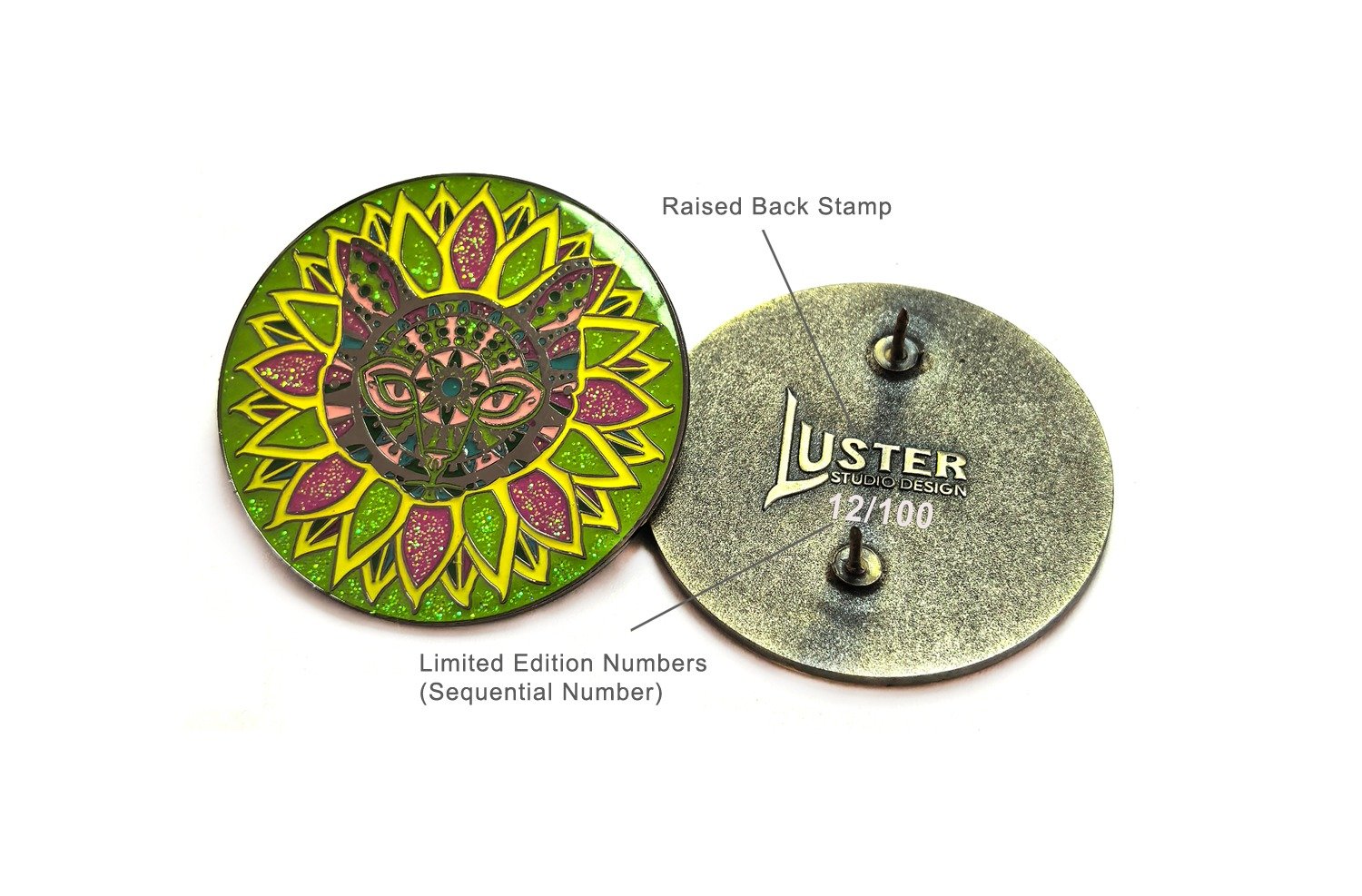
A back stamp is a small custom imprint on the reverse side of your enamel pin — typically your logo, brand name, tagline, website URL, or copyright symbol. It’s carved directly into the production mold during manufacturing, creating a raised or recessed impression that is permanently integrated into the pin’s structure.
Think of it as the artist’s signature on a painting, or the publisher’s imprint on the spine of a book. It’s a mark of authorship, authenticity, and professional seriousness that collectors learn to recognise and trust.
Front of Pin
Back with Custom Stamp
Stamp + Sequential Number
Key Benefits of Adding a Back Stamp
- Establishes brand identity and professionalism — shows buyers and collectors that you’re serious about your pin brand, building immediate trust and repeat purchase intent.
- Protects your design from copycats — a back stamp acts as a mark of authenticity, making imitation immediately visible. Combine with IP and NDA best practices for stronger overall protection.
- Adds collectability for series fans — recognisable back stamps encourage completionist behaviour — fans want to collect every pin carrying your mark.
- Works on nearly any pin size and style — from 0.75″ to 3″ designs, the vast majority of pins can accommodate a back stamp. See size guidelines below for exact constraints.
- Built-in marketing channel — including your website URL or social handle turns each pin into a permanent, miniature advertisement that travels with the wearer.
- Supports resale market value — authenticated pins with clearly branded backs hold value better on secondary markets than anonymous pins.
What Is Sequential Numbering?
Sequential numbering means each individual pin in a limited production run has a unique number engraved or stamped on its back — for example “12/100”, meaning pin number 12 out of a total edition of exactly 100. This method is most popular for limited-edition releases, collector-focused designer series, Kickstarter backer rewards, and special event commemoratives.
Key Benefits of Sequential Numbering
- Creates powerful exclusivity and scarcity — numbered editions feel fundamentally more special than open-ended productions. The edition size becomes a feature of the design.
- Adds long-term collectible value — low numbers — especially #1, #2, and #3 — often command significant price premiums on secondary markets. Early buyers feel rewarded.
- Makes each pin personally unique — every owner has their specific number in the series, creating a personal connection to the pin that identical mass-produced items can never achieve.
- Encourages faster sell-outs via FOMO — visible scarcity drives quicker purchase decisions. Shoppers who see “47/100 remaining” buy faster than those browsing unlimited stock.
- Builds community and conversation — collectors love comparing and sharing their numbers on social media. “What number did you get?” is a genuine community conversation starter.
- Supports higher pricing — numbered limited editions command 20–50% price premiums over identical unnumbered versions in most markets.
How Back Stamps & Sequential Numbers Are Made
Back Stamp Production Process
Back stamps are created during the mold-making phase of production. Your logo or text is carved directly into the metal die (mold), so every pin struck from that mold carries the stamp permanently on its reverse. This makes the back stamp an integral part of the pin’s physical structure — not something applied as an afterthought.
Artwork Preparation
Your back stamp design (logo, URL, text) is prepared as vector artwork alongside the front design. The manufacturer reviews it for minimum line thickness, legibility at scale, and available back surface area. Adjustments are made at this stage before any tooling is cut.
Mold Engraving
The back stamp design is engraved into the metal production die (mold) using CNC machining. The engraved area creates either a raised (embossed) or recessed (debossed) impression on the back of every pin produced from that mold. This is a one-time process — all subsequent pins carry the stamp automatically at no additional per-unit cost.
Production & Verification
The first sample pins are inspected to confirm the back stamp is clear, correctly positioned, and legible under the chosen plating finish before bulk production begins. Any legibility issues are corrected before the production run proceeds.
Sequential Numbering Production Process
Sequential numbers are added after the plating process — meaning after the pin’s metalwork and finish are complete. This allows each pin to receive a unique number without requiring a separate mold per variation.
Laser Engraving
A focused laser beam inscribes precise, clean numbers directly onto the plated metal surface. Ideal for small text, high precision, and runs where legibility is critical. The laser removes a thin layer of plating to reveal the base metal, creating a contrasting mark. Fast, accurate, and suited to most edition sizes.
Mechanical Stamping
A number die is pressed mechanically into the metal surface, creating a deeper, more tactile impression than laser engraving. Suits larger text and bolder number styles. The impression has a classic, physical quality that some collectors particularly appreciate. Slower per unit than laser but creates a more pronounced tactile result.
Quality Check & Sequence Verification
After numbering, pins are checked to confirm each number is correctly applied, legible, and properly sequenced with no duplicates or skipped numbers. For large editions, batch samples are inspected to catch laser drift or stamping inconsistencies early.
Production Tip: If you plan to use both a back stamp and sequential numbering on the same pin, discuss this with your manufacturer early in the design phase — before any mold work begins. They need to allocate appropriate space on the pin back for both elements and adjust the production workflow to include the post-plating numbering step. See our production expectations & tolerances guide for what to expect at each stage.
Choosing the Right Edition Size
Edition size is a strategic decision, not just a production number. The size you choose directly determines the scarcity appeal, the collector urgency, the secondary market value, and the practical legibility of your sequential numbers at pin scale.
Maximum scarcity and secondary market value. Low numbers (#1–5) command highest premiums. Ideal for debut releases, event exclusives, or premium artist series.
Strong scarcity with enough units for broader collector reach. The most common edition size for independent pin artists and designer series. Maximises FOMO while reaching a meaningful audience.
Good collector appeal with commercial viability. Suits brands with established audiences. Large enough for retail distribution while still maintaining meaningful exclusivity claims.
Collector appeal diminishes significantly above 500 units. Editions of 1,000+ also create long number strings (e.g. “847/1000”) that become very small and can be illegible at pin scale.
Avoid Very Large Edition Numbers: Edition sizes above 1,000 create two problems simultaneously — the number string “847/1,000” is very long and can become illegible at the small scale of a pin back, and the scarcity argument becomes unconvincing to collectors. If commercial volume is your goal, consider an unnumbered production run instead of a nominally “limited” large edition.
Design Tips for Optimal Results
Both back stamps and sequential numbers live on the back of a very small metal object. Designing them well requires different thinking than designing your front artwork. These rules prevent the most common design mistakes:
Keep It Simple & Legible
Back stamp logos should be clear, minimal, and easily readable at small sizes — 10–15mm width is typical. Tiny serifs, hairline strokes, and complex graphic details don’t reproduce cleanly in metal at this scale. Choose clean, bold letterforms. For sequential numbers, avoid decorative fonts — a clean sans-serif or monospaced font is safest.
Strategic Placement
Place the back stamp in the centre or lower area of the pin back, away from the post and clasp mechanism. Sequential numbering is typically placed just below or beside the back stamp. Leave enough flat, uninterrupted space around both elements — text squeezed against the post or edge loses legibility and can interfere with the clasp fitting correctly.
Follow Minimum Size Rules
Back stamps work best at 0.5–1 inch wide, depending on pin size. For pins under 1 inch, consider using initials or a monogram rather than a full logo. Sequential numbers are typically very small — around 2–4mm text height. Anything smaller risks being illegible after plating. Avoid long edition sizes (1/10,000) that force the number string to be uncomfortably tiny.
Match Your Brand Consistently
Use the same logo, wordmark, or recognisable initials that appear on your backing cards, packaging, and social channels. The back stamp should feel like a seamless extension of your brand, not an afterthought. For limited runs, consider adding text like “Limited Edition” or “LE 100” alongside the sequential number to explicitly reinforce exclusivity.
Design Front & Back Together
Create a design template that shows both the front and back of your pin together. This helps you visualise how all elements work together and ensures nothing on the back interferes with the pin’s functionality. Share this combined template with your manufacturer for the clearest communication of intent.
Consider Plating Finish Impact
Gold and silver platings offer the best text legibility for both stamps and numbers. Dark platings (black nickel, gunmetal) can make small text harder to read — ask your manufacturer about filled engraving, where engraved text is filled with a contrasting colour (white, gold) for visibility. Heavily textured antique platings present the most challenge for very fine text.
Production Limits & Considerations
Understanding these constraints before finalising your design prevents costly revisions and production delays:
| Factor | Back Stamp | Sequential Numbering |
|---|---|---|
| Complexity | Very fine or small text may not reproduce well in the mold at pin scale — simplify if in doubt | Font complexity is limited by laser or engraving capabilities — clean, bold fonts always perform best |
| Size Constraints | Pins smaller than 0.75″ have very limited back surface — use initials only | Requires a flat, uninterrupted area on the pin back for engraving — recessed areas can’t be numbered |
| Plating Effects | Textured antique platings may make small logos harder to read — request a sample first | Dark platings may require filled engraving for visibility — see our plating colours guide |
| Production Timeline | Added during mold creation — minimal additional time impact once mold is approved | Laser engraving adds a separate post-plating step — factor in extra production time, especially for large editions |
| Cost Impact | Minimal ongoing cost — one-time mold modification fee, then free on every subsequent unit | Adds a per-unit cost for the engraving or stamping step — cost per pin decreases with larger edition sizes |
| Post Compatibility | Must be positioned away from the back post and clasp area — check placement with manufacturer | Number placement must clear the post and clasp — laser engraving cannot be applied over the post mount area |
| Reversibility | Permanent — changing the back stamp requires a new mold (significant cost) | Can vary per run — same mold, different edition numbers for future productions |
Very Small Pins (under 0.75″): These may not have sufficient flat surface area on the back for both a back stamp and sequential numbering simultaneously. In these cases, choose one feature only — or use highly simplified initials for the branding element and reserve sequential numbering for larger pins in the series.
Creative Applications & Advanced Ideas
Beyond basic branding and edition numbering, both back stamps and sequential numbers can be used creatively to build community, drive engagement, and create unique collector experiences:
URL & Social Handle Integration
Add your website URL or Instagram handle to the back stamp. Every time someone discovers or resells your pin, the URL drives new traffic to your store. It’s permanent, passive marketing that travels with the pin forever.
Kickstarter Exclusive Numbering
Use sequential numbering for crowdfunding backer rewards to create tiered collectibility. Early backers get lower numbers — #1–10 become legendary “founder” pins that command premium prices and loyalty.
Chase Variant Stamps
Use a slightly different back stamp (roman numerals, a unique symbol, or an alternate logo) on a small secret subset of your production run. Chase variant collectors will hunt specifically for the alternate stamp, driving complete-set demand.
Event Commemorative Marking
Add a year, event name, or location to the back stamp alongside sequential numbering for convention exclusives or anniversary pins. “SDCC 2026 · 47/100” creates an immediately identifiable provenance that increases long-term value.
Hidden Easter Eggs & Secret Messages
Use the back stamp for a secret message, inside joke, or Easter egg that fans discover on their own. This kind of hidden detail creates genuine surprise and delight — and drives social media sharing as fans compare what they found.
Series Identifier + Numbering
For multi-series pin releases, include a series identifier in the back stamp — “Series 1”, “Wave 2”, “Chapter III” — combined with numbering within each series. This structures your catalogue for serious completionist collectors.
Example Back Stamp Layouts:
Brand + edition: STUDIO NAME · LE 100 · 2026
Brand + copyright: © 2026 STUDIO NAME
Full collector stamp + number: STUDIO NAME · Limited Edition · 23/100
Event commemorative: STUDIO NAME · SDCC 2026 · 47/200
When to Use Back Stamps & Sequential Numbering
✅ Best Applications
- Limited edition runs of under 500 pieces
- Collector-focused designs and artist series
- Branding, authenticity protection, and IP defence
- Higher-priced premium or designer pins
- Series where completion is part of the appeal
- Kickstarter and crowdfunding backer rewards
- Convention, event, and anniversary exclusives
- Any pin intended for secondary market resale
🚫 Avoid For
- Extremely small pins (under 0.75″) with limited back space
- Very large editions (1,000+) where scarcity appeal is minimal
- Pins where production speed is the highest priority
- Extremely budget-sensitive projects with tight margins
- Simple promotional giveaways not intended as collectibles
- Heavily textured plating where small text won’t be legible
The Combined Impact: Back Stamp + Sequential Numbering
Using both features together is the gold standard for collectible pin releases. Here’s why the combination is more powerful than either feature alone:
Authentication & Provenance
Back stamp confirms the maker. Serial number confirms the edition and position. Together they create a complete provenance that supports resale value and collector confidence.
Premium Pricing Justification
The combination of brand authentication and numbered scarcity justifies retail prices 30–60% higher than identical unnumbered pins in most collector markets.
Social Media Sharing Trigger
Collectors love to show their specific number. “Got #7/50!” is a highly shareable moment. This organic sharing extends your reach to new audiences with zero additional marketing spend.
Secondary Market Strength
Authenticated, numbered pins hold resale value far better than anonymous productions. Strong secondary market activity validates your edition size strategy and builds reputation over time.
Ready to Elevate Your Pin Designs?
Our expert team has helped hundreds of artists and brands create stunning collectible enamel pins with professional back stamps and sequential numbering. We’ll guide you through every detail — from design review to production approval.
Get Your Free Consultation →Response within 24 hours • No obligation • Custom quote provided • Free artwork review
Final Thoughts: Small Details, Big Impact
Adding back stamps and sequential numbering is one of the smartest, most cost-effective investments you can make in your enamel pin brand. These features elevate your pins from simple accessories into authenticated, collectible objects with genuine provenance — making them more desirable for fans, more defensible for resale, and more recognisable as your work.
The production considerations — space constraints, plating legibility, edition size strategy — are all manageable when you plan for them early in your design process. Most pin designs can incorporate at least one of these features without issue, and the relatively modest additional investment typically returns significant value in perceived quality, collector appeal, and brand recognition.
If you’re serious about growing your pin brand, building collector loyalty, or creating limited editions that hold their value, these are details worth including in your next release. Plan them from the very beginning — before the mold is made — for the best results.
In a growing collector market, the pins people talk about, trade, and treasure are the ones that feel considered, authentic, and rare. Back stamps and sequential numbering are how you build that feeling from the ground up. 🧷
Frequently Asked Questions
What is a back stamp on an enamel pin?
What is sequential numbering on enamel pins?
How is a back stamp added to an enamel pin?
How is sequential numbering applied to enamel pins?
What is the minimum pin size for a back stamp?
Does sequential numbering add cost to enamel pin production?
What edition size should I choose for a numbered limited edition pin?
What information should I include in a back stamp?
Can I have both a back stamp and sequential numbering on the same pin?
Which plating finishes work best with back stamps and sequential numbering?
Start Your Collectible Pin Series Today
From back stamp artwork review to sequential numbering setup and production approval — our team handles every detail. Get a free consultation and quote for your next limited edition or artist series pin run.
Get Your Free Quote & Consultation →Response within 24 hours • Free artwork review • No obligation • Expert design guidance