Enamel Pin Mold Ownership: Who Owns the Die? Reorder & Transfer Rights
A clear, beginner-friendly guide to enamel pin mold ownership, die transfer rights, reorder costs, and what that mold fee really covers.
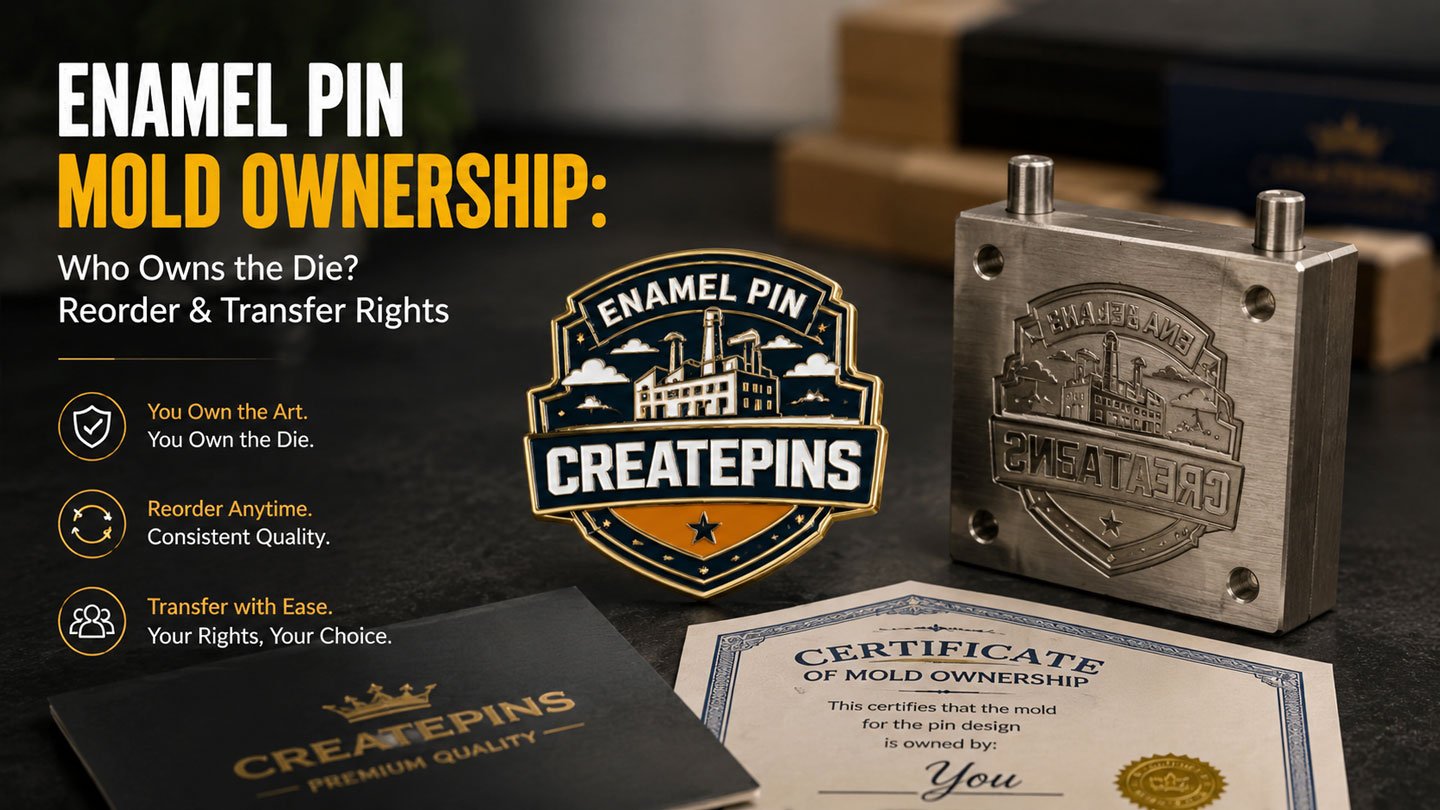
Table of Contents
- 1. What Is an Enamel Pin Mold?
- 2. What Does a Mold Fee Pay For?
- 3. Mold vs. Design Ownership
- 4. Who Usually Owns the Mold?
- 5. Why Does Ownership Matter?
- 6. Reordering Without a New Mold Fee
- 7. How Long Will the Mold Be Stored?
- 8. What If the Mold Is Damaged?
- 9. Can a Mold Be Transferred?
- 10. Why a New Factory May Refuse It
- 11. Mold vs. Production Files
- 12. Why You Should Keep Your Artwork
- 13. Switching Manufacturers
- 14. “No MOQ” ≠ Mold Ownership
- 15. “Free Mold” Marketing Language
- 16. A Large Mold Fee ≠ Ownership
- 17. What About Exclusive Designs?
- 18. If the Manufacturer Closes
- 19. If You Sell Your Brand
- 20. Ownership and Licensing
- 21. What to Put in Your Agreement
- 22. Questions to Ask Your Manufacturer
- 23. A Simple Example
- 24. Common Custom Pin Mold Ownership Mistakes
- 25. How to Reduce Your Risk
- 26. Mold & Tooling Checklist
- 27. How CreatePins Handles Tooling
- 28. The Question Behind the Question
- Frequently Asked Questions
- Final Thoughts
When you order custom enamel pins, you’re usually paying for more than the finished pins. Your project may also involve a mold, die, tooling, production artwork, and other manufacturing files created specifically for your design.
That raises a question many first-time pin buyers never think to ask: who owns the mold used to make your enamel pins? The answer isn’t always as simple as “I paid for it, so I own it.”
Enamel pin mold ownership can depend on the manufacturer’s terms, your quotation, your contract, what the mold fee actually covers, and whether the tooling can realistically be transferred to another factory. If you’re an artist, brand owner, Etsy seller, Kickstarter creator, band, or business ordering custom enamel pins, understanding who owns the mold — and your transfer rights — before production can prevent expensive surprises later.
This guide walks through what a mold is, who may own it, what happens when you reorder, whether a mold can move to another manufacturer, and what to ask before your first order.
1. What Is an Enamel Pin Mold?
An enamel pin mold is a piece of manufacturing tooling used to create the metal shape and features of your pin. Depending on the process, tooling may form the pin’s outer shape, metal borders, recessed enamel areas, raised metal details, holes or attachment features, and other structural elements.
The tooling is created from your approved design. A simple circular pin may need relatively straightforward tooling; a highly detailed custom shape can require considerably more complex tooling. That’s why custom pin quotations often include a separate mold fee, die fee, or tooling fee in addition to the per-unit price.
2. What Does a Mold Fee Actually Pay For?
A mold fee generally covers some or all of the cost of creating manufacturing tooling for your design. However, paying a mold fee and legally owning the physical mold are not necessarily the same thing — and this distinction matters a lot.
A quotation might list “Mold Fee: $50.” It’s tempting to think: I paid $50 for the mold, so the mold belongs to me. But the manufacturer’s terms may define that fee as a tooling creation charge, a setup fee, a production tooling fee, a one-time manufacturing charge, or a fee for tooling that stays at the factory.
The key lesson: never assume custom pin mold ownership just because a mold fee appears on your invoice. Ask what the fee means and who owns the resulting tooling. For more on what a quote typically includes, see Custom Enamel Pin Hidden Costs You Should Know Before Ordering.
3. Enamel Pin Mold Ownership vs. Design Ownership
Another common mix-up is confusing ownership of the artwork with ownership of the manufacturing mold. They’re separate issues. You may own the copyright or other rights in your original pin artwork; the manufacturer creates production artwork from your design; a physical mold is then built from that production artwork.
So it’s entirely possible to have artwork ownership sit with the customer while production tooling sits with the manufacturer — or for both to sit with the customer, depending on the agreement. Licenses, usage rights, storage terms, and exclusive-production rights can all layer on top of this, which is why each issue should be addressed separately.
4. Who Usually Owns an Enamel Pin Mold?
There’s no single universal answer. Common arrangements include:
| Model | How It Works |
|---|---|
| A — Manufacturer owns the mold | You pay a mold/tooling fee, but the factory retains ownership of the physical tooling. You can reorder the same design from that manufacturer. |
| B — Customer owns the mold | You pay for the tooling and the agreement states the physical mold belongs to you. The manufacturer may still store and use it for production. |
| C — Exclusive use, no physical ownership | The manufacturer retains the tooling but agrees not to use it for any other customer — commercial protection without a physical transfer. |
| D — Ownership contractually transferred | You and the manufacturer explicitly agree that ownership transfers to you after payment or under specified conditions. |
The important point: your quotation and written agreement matter more than assumptions.
Want a quote that spells out tooling ownership and reorder terms up front?
Get a Custom Pin Quote5. Why Does Enamel Pin Mold Ownership Matter?
For many customers, custom pin mold ownership never becomes an issue — if you keep ordering the same design from the same manufacturer, the existing tooling is simply stored and reused. It matters much more when something changes: you want to switch manufacturers, your supplier closes, you want to move production, sell your pin brand, use another factory, move production to another country, or reproduce a discontinued design years later.
In those situations, the real question becomes: can the existing tooling move with me? The answer depends entirely on your agreement.
6. Can You Reorder Without Paying the Mold Fee Again?
Often, yes — if the original manufacturer retains the tooling and it’s still usable. When you reorder the same pin from the same factory, the enamel pin mold can typically be reused, meaning you may not pay a new mold fee every time.
But tooling has limits. It can wear out, need modification for a design tweak, get damaged, run into a manufacturer’s retention policy, or be archived/discarded after a certain period. Before assuming a reorder will always be mold-free, ask about the manufacturer’s tooling storage and reuse policy. Our Step-by-Step Ordering Guide walks through what to expect for both first orders and reorders.
7. Ask How Long the Enamel Pin Mold Will Be Stored
This matters especially for businesses that reorder periodically. Imagine a popular pin launched in 2026 that sells out, with no need for another run until 2029 — will the original mold still be around? Policies vary: some manufacturers retain tooling for years, others set storage limits, charge storage fees, or reserve the right to discard inactive tooling.
Ask before you need the answer:
- How long do you retain customer molds?
- Is there a storage period?
- Are there any storage fees?
- What happens if I don’t reorder for several years?
- Can you confirm my pin mold will be available for future reorders?
8. What Happens If the Enamel Pin Mold Is Damaged?
Manufacturing tooling is a physical object — it can wear out, corrode, get mishandled, or run into manufacturing problems over repeated production. If a mold becomes unusable, the manufacturer may need to create replacement tooling, and who pays for it depends on your agreement: the customer, the manufacturer, a shared cost, or a cause-dependent split. Don’t wait until there’s a problem to find out what your agreement actually says.
9. Can an Enamel Pin Mold Be Transferred to Another Factory?
Sometimes, physically — but physical transfer doesn’t automatically mean the new manufacturer can use it. There are two separate questions here: can the tooling be removed, packed, shipped, and delivered (physical transfer), and does the customer have the right to possess and use it elsewhere (contractual transfer)?
If your original manufacturer owns the mold, you may not have the right to take it elsewhere even if you paid a mold fee. And if you do own it, you still need to confirm the new factory can actually use that specific tooling.
10. Why a New Factory May Not Be Able to Use the Old Mold
Even with a physical mold in hand, another factory may not be able to use it as-is — manufacturing systems differ in machines, tooling standards, production processes, mold specifications, metal thickness requirements, and tolerances. A mold built for one production system may need modification or full replacement before another factory can run it.
Enamel Pin Mold ownership does not guarantee manufacturing portability — a critical point if you’re ever planning to switch suppliers.
11. Custom Pin Mold Ownership Is Not the Same as a Production File
There’s an important difference between the physical mold and the digital production artwork. Your manufacturer’s files may contain vector outlines, metal line specifications, color separations, dimensions, plating information, backing details, and production instructions. A physical mold is only one piece of the manufacturing puzzle — if you switch factories, having the original production artwork makes it much easier for a new manufacturer to recreate the tooling.
12. Why You Should Keep Your Approved Artwork
Even if your manufacturer keeps everything on file, don’t rely entirely on the factory’s records. Keep your own copies of:
- Original artwork & vector files
- Final approved artwork and proofs
- Dimensions, color, plating & backing specifications
- Packaging artwork and production notes
- Previous invoices and purchase orders
Think of your artwork files as the blueprint for your product — the pin mold is the physical tool built from that blueprint. If something happens to the mold, the blueprint helps recreate it. Our guide on Best File Formats for Custom Enamel Pins covers what to save and in which format.
Not sure what your approval process should include? See how sample approval typically works.
Read the Sample Approval Process13. What If You Want to Switch Manufacturers?
Imagine you’ve ordered the same pin for years, your business grows, and you start comparing suppliers. You ask your current manufacturer to send you the mold — and discover you never clarified ownership. Before switching, check:
- Who owns the tooling? Check the contract, quotation, and written agreement.
- Can the tooling be released? Some agreements restrict transfer.
- Can it be shipped? The manufacturer may need to package and transport it.
- Can the new factory use it? Ask them to inspect the tooling specifications first.
- Do you have the production artwork? If not, you may need to recreate the tooling from scratch.
14. Don’t Assume “No MOQ” Means “Free Enamel Pin Mold Ownership”
Flexible ordering terms like low minimums or no minimum order quantity are a separate issue from custom pin mold ownership. No MOQ means you can order a small quantity — it doesn’t mean you own the tooling. See our guide on No Minimum Order Custom Pins for what that term does and doesn’t include.
15. Watch for “Free Mold” Marketing Language
An ad promising “free mold!” sounds attractive, but ask what it actually means. It could mean no separate mold charge, mold cost folded into the unit price, a tooling fee waived above a certain quantity, the factory absorbing the initial tooling cost — or simply that the mold stays with the manufacturer either way. None of these guarantee you receive physical ownership. Compare the whole agreement, not one line of the quote.
16. What If You Pay a Large Mold Fee?
A bigger number doesn’t establish ownership either. “Mold Fee: $150” tells you what you’re being charged, not what rights you receive. If ownership matters, ask directly: “Who owns the physical production tooling after I pay the tooling fee?” and “Can I request transfer of the tooling to another manufacturer?” — far more useful questions than simply asking whether the mold is free.
17. What About Exclusive Designs?
If you’ve created a unique mascot and don’t want another customer receiving the same pin, remember: tooling ownership and design exclusivity are not identical. Clarify whether the artwork is exclusive to you, whether the enamel pin mold can only be used for your orders, whether the manufacturer can reproduce or modify the design for someone else, and whether they can display the finished pin in their portfolio.
18. What If the Manufacturer Closes?
This is one of the biggest long-term risks. If you have a best-selling pin and your manufacturer closes unexpectedly, owning and possessing the physical tooling gives you more options. If the manufacturer owned it, you may need to recreate it elsewhere — and if their records are gone, your own production artwork becomes essential. For a successful product, think beyond today’s run: what happens if you need to manufacture it again five years from now?
19. What If You Sell Your Brand?
If you eventually sell your pin business, a buyer will likely want artwork, brand assets, product and packaging designs, manufacturing information, supplier relationships, existing inventory, and production tooling. If the mold is part of that manufacturing infrastructure, its ownership and transferability can become commercially significant — documenting these rights early makes a future sale much smoother.
20. Enamel Pin Mold Ownership and Licensing
Sometimes what a customer really needs isn’t physical ownership but exclusive manufacturing control. An agreement can let the manufacturer keep the tooling while promising it’s only ever used for your products — useful when you don’t need to move the tooling, the manufacturer offers long-term storage, you want exclusivity, or physical transfer would be impractical anyway. The key is distinguishing ownership from right to use from exclusive use — three different contractual concepts.
21. What Should Be Written Into Your Agreement?
If enamel pin mold ownership matters to you, put these points in writing:
Ownership & Payment
Who owns the physical mold, and does paying the tooling fee transfer that ownership?
Storage & Duration
Who stores the mold, and for how long will it be retained?
Reorders & Exclusivity
Can the mold be reused for future orders, and can it be used for anyone besides you?
Transfer & Shipping
Can you request the mold be transferred, and who pays for transportation?
Compatibility
Can the tooling realistically be used by another manufacturer?
Damage & End of Relationship
Who’s responsible if the mold is damaged, who pays for replacement, and what happens when you stop ordering?
You don’t need a complicated contract for every small order, but important commercial arrangements should be clear in writing.
22. Questions to Ask Your Enamel Pin Manufacturer
Before ordering a large quantity, ask:
- Who owns the pin mold after production?
- Does the mold fee include ownership or only tooling creation?
- Can I reorder without paying the mold fee again?
- How long will you store the mold?
- Do you charge mold storage fees?
- Can the mold be transferred to another manufacturer?
- If transferred, who pays shipping?
- Can another factory use the existing mold?
- Can I receive the final production artwork?
- Can my enamel pin mold be used for another customer?
- What happens if the mold is damaged?
- What happens if your factory closes or stops producing this product?
For a major commercial order, get the answers in writing.
Have questions about tooling before you commit to a quantity?
Get a Custom Pin Quote23. A Simple Example
Say you order 500 custom enamel pins. Your quotation shows a $60 mold fee, $0.95 per pin, and $475 in total production cost. You pay everything. Three years later, you want to move production to another supplier and ask, “Can I have my mold?” A few outcomes are possible, depending entirely on your written agreement:
Scenario A — Customer-owned tooling
Your agreement says the tooling belongs to you. You likely have the contractual right to request its release, subject to applicable terms.
Scenario B — Manufacturer-owned tooling
The agreement says the manufacturer owns the tooling. You may not have the right to take it.
Scenario C — Exclusive-use tooling
The manufacturer owns the mold but agrees not to use it for anyone else. You can keep ordering, but can’t necessarily transfer production.
Scenario D — Transfer permitted
The manufacturer owns the mold but agrees to release it if you cover reasonable transfer and shipping costs.
24. Common Enamel Pin Mold Ownership Mistakes
Assuming payment equals ownership
Paying a mold fee is not the same as owning the mold.
Never asking about reorders
Assuming every reorder skips the mold fee automatically.
Ignoring storage policies
Not knowing how long your tooling will actually be kept.
Assuming any factory can use it
Different production systems often can’t share the same tooling.
Losing your production artwork
No backup blueprint if the mold is lost or damaged.
Only discussing terms verbally
Nothing in writing to fall back on later.
Waiting until you switch factories
Discovering ownership terms only when it’s too late to negotiate.
Confusing custom pin mold ownership with copyright
Owning your artwork’s copyright doesn’t mean you own the tooling.
25. How to Reduce Your Risk
Manufacturing doesn’t need to be complicated — a few simple habits go a long way:
- Keep your artwork: store the original and final approved files
- Keep your proofs: save the approved production proof
- Keep your specifications: size, plating, enamel type, backing, and other production details
- Ask about tooling: clarify ownership before production starts
- Get important terms in writing: especially for large or long-term orders
- Ask about storage: know what happens if you don’t reorder for years
- Plan for supplier changes: think through what a switch would require
- Keep documentation organized: one folder per product — artwork, proofs, mold info, specs, purchase orders, invoices, packaging, and any agreements
This simple system can save significant time later.
26. A Recommended Mold & Tooling Checklist
Before approving your first custom enamel pin order, check:
- Who owns the physical mold?
- What exactly does the mold fee cover?
- Can the mold be reused for reorders?
- Is there a storage period?
- Are there storage fees?
- What happens if the mold is damaged?
- Who pays for replacement tooling?
- Can the tooling be transferred?
- Can another factory use it?
- Who pays transfer and shipping costs?
- Is the design exclusive?
- Can the mold be used for another customer?
- Do I have the final production artwork?
- Do I have the approved proof?
- Have important terms been documented?
Answering these before production gives you a much clearer picture of your manufacturing rights.
27. How CreatePins Handles Custom Pin Tooling
At CreatePins, we understand customers may be ordering a pin as a one-time project — or building a product they plan to manufacture repeatedly. That’s why it’s important to distinguish between the artwork, tooling, and finished products involved in a custom pin order.
When you work with us, our team can help you understand the manufacturing process and the tooling behind your design. For repeat customers, existing production tooling may allow the same design to be reproduced without restarting the entire tooling process, subject to the applicable production terms and condition of the tooling.
If you’re planning a long-term product line, it’s worth discussing your needs before the first order — tell us if you expect to reorder regularly, manufacture for several years, build a collectible series, work with multiple suppliers, launch a Kickstarter campaign, keep the design confidential, or eventually transfer production. The more we understand about your project, the easier it is to set up the right arrangement from day one.
28. The Most Important Question Isn’t “Who Owns the Mold?”
Ownership matters, but for many pin creators the more practical question is: what rights do I have if I need to manufacture this design somewhere else? A mold could technically belong to you while still being difficult to use elsewhere. Conversely, a manufacturer could retain the mold while giving you strong contractual rights for exclusive production.
Look beyond the single word “ownership” and consider the whole manufacturing relationship: who owns it, who stores it, who can use it, can it be transferred, can another factory use it, what happens if the supplier closes, and what happens if you stop ordering. These questions give a far clearer picture of your actual business risk.
📌 Further reading from our blog
29. Final Thoughts: Clarify Mold Ownership Before You Need It
For a small personal pin order, mold ownership may never come up. But if your pin becomes a successful product, the situation changes fast. Selling thousands of units of a design that becomes a bestseller makes the ability to reorder quickly, change manufacturers, protect exclusivity, reproduce the design years later, transfer production, and maintain business continuity extremely valuable.
That’s why custom pin mold ownership and tooling rights are worth discussing before production begins. The most important rule is simple: never assume that paying a mold fee automatically means you own the physical mold. Ask what the fee covers, who owns the tooling, how long it will be stored, whether you can reorder without new tooling, whether the mold can be transferred, and whether another manufacturer can use it — and keep your own copies of the artwork and production documentation.
A few questions before production can prevent a major headache later. Your pin design is an intellectual asset. Your mold is a manufacturing asset. Understanding how the two connect protects your ability to keep producing your product.
Frequently Asked Questions
Who owns the enamel pin mold after production?
Ownership depends on your agreement with the manufacturer. Paying a mold fee does not automatically transfer ownership. Some manufacturers retain ownership while granting exclusive use, while others transfer ownership if explicitly stated in the contract.
What does the enamel pin mold fee actually pay for?
A mold fee typically covers the cost of creating the manufacturing tooling for your design. However, it may be a setup charge, a one-time manufacturing fee, or a tooling creation fee — and it does not always include physical ownership of the die.
Can I reorder enamel pins without paying the mold fee again?
Often yes, if the original manufacturer retains the tooling and it remains usable. However, tooling can wear out, become damaged, or be discarded after a storage period, so it’s best to confirm the manufacturer’s storage and reuse policy.
Can an enamel pin mold be transferred to another factory?
Physical transfer is possible, but it doesn’t guarantee the new factory can use it. Manufacturing systems differ, and the new factory may need to modify or replace the tooling. Contractual rights also matter — if the manufacturer owns the mold, you may not have the right to move it.
How long will my enamel pin mold be stored?
Storage policies vary by manufacturer. Some retain molds for years, others have time limits or charge storage fees. Always ask about retention periods and what happens if you don’t reorder for several years.
What happens if my enamel pin mold is damaged?
If a mold becomes unusable through wear, accidents, or manufacturing issues, replacement tooling may be needed. Who pays depends on your agreement — the customer, the manufacturer, or shared costs may be specified in the contract.
Ready to Start Your Custom Pin Project?
Get a transparent quote with a clear breakdown of tooling fees, ownership, and reorder terms. We’re here to help first-time creators and brands alike.