How to Scale Custom Enamel Pin Production from 100 to 10,000 Pins (Complete Guide)
A practical, stage-by-stage roadmap for brands, artists, and event organizers moving from a small test batch to full bulk production — without wasting money, missing deadlines, or sacrificing quality.
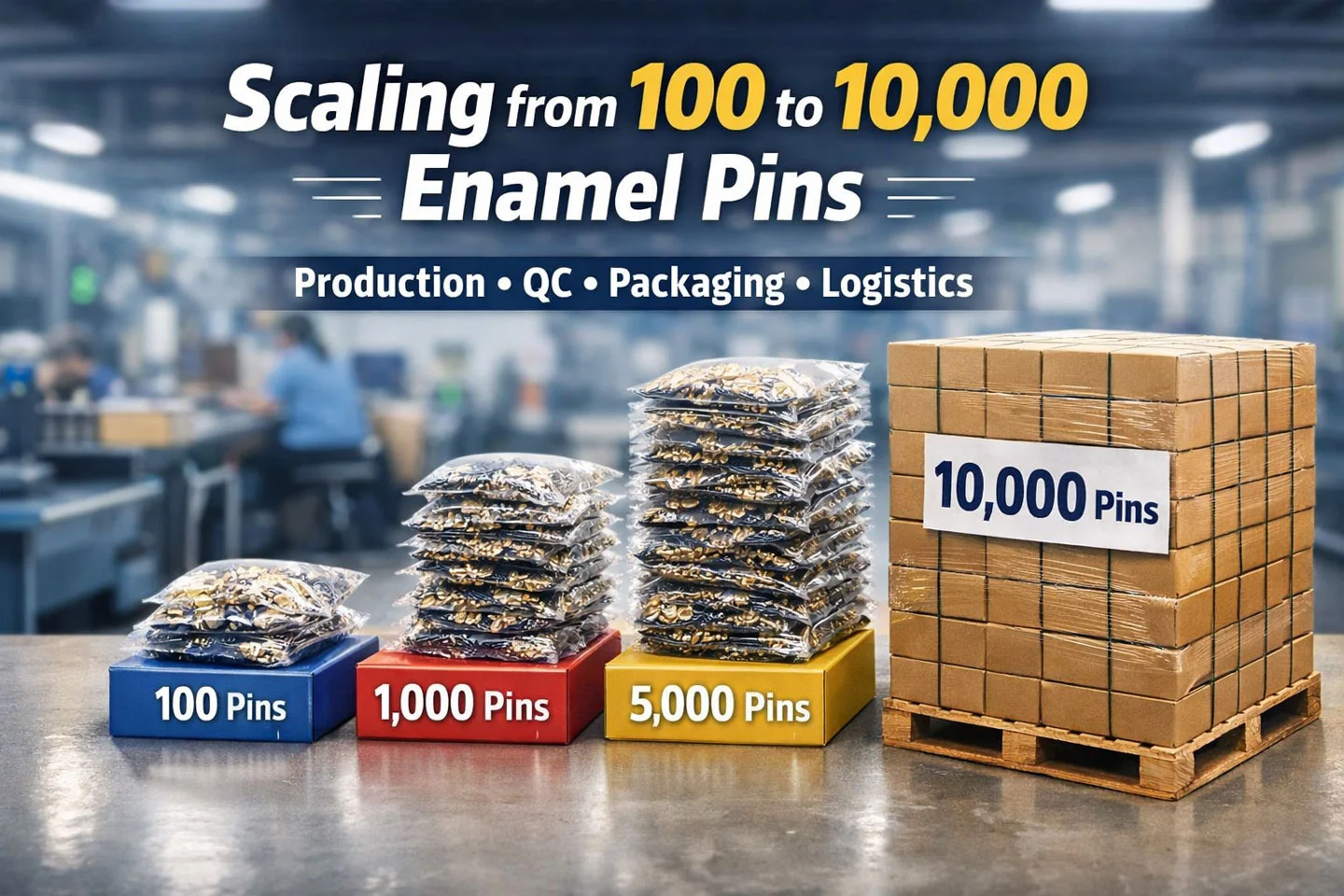
Going from “let’s order 100 pins to test the idea” to “we need 10,000 units for a nationwide launch” is one of the most common — and most misunderstood — journeys in custom enamel pin production. The mistakes are rarely about design. They’re about timing, tooling, cash flow, quality control, and communication with your enamel pin manufacturing partner.
This guide breaks the scaling journey into four realistic stages, with the pricing logic, lead times, quality checks, and pitfalls specific to each. Whether you’re an indie artist selling at conventions, a brand launching a merch line, or an event organizer planning giveaways, this is the roadmap that keeps quality consistent as volume grows.
Why Scaling Enamel Pins Is Different From Scaling Other Products
Unlike printed merchandise, enamel pins are made from a physical metal mold (the “die”) that is hand-filled and hand-plated in most factories. That means:
- The mold is a one-time investment. Once it exists, unit cost drops sharply at higher volumes — but the mold itself doesn’t change, so your design needs to already be production-ready before your first order, per this enamel pin design guide. This is the foundation of efficient custom enamel pin production at scale.
- Plating and enamel filling are semi-manual processes. More pins means more labor hours, not just “more machine time,” so lead times stretch as volume grows — especially for large enamel pin orders.
- Small color or size errors compound at scale. A tolerance that’s invisible at 100 units becomes obvious across 10,000 — which is why understanding production expectations and tolerances matters more as you grow.
The good news: once you understand these mechanics, scaling becomes predictable. Let’s walk through it stage by stage.
Stage 1: Testing the Waters (100–300 Pins)
Goal: Validate the design and the market
This is your proof-of-concept run. You’re not trying to hit the lowest per-unit price — you’re trying to confirm that people actually want the pin, that the colors translate well from screen to metal, and that your supplier communicates clearly and delivers on time.
What to expect at this stage:
- Mold/tooling fee is usually a flat, one-time charge regardless of quantity (this is the biggest reason 100 pins can feel “expensive per unit”).
- At this tier, the enamel pin MOQ (minimum order quantity) is usually low—often 100–300 units—which makes it accessible, though per-unit costs are highest here since the mold fee isn’t yet spread across a large batch.
- Standard production time: roughly 10–15 business days after art and quantity are confirmed, plus shipping. If you’re on a deadline, read about whether 7-day turnaround is actually realistic before promising a date to customers.
- You’ll typically receive a digital proof, and sometimes a physical sample, before full production begins — learn how the sample approval process works so you know what to check for.
- Follow a clear step-by-step ordering process the first time — it prevents 90% of “why doesn’t this match my mockup” surprises later.
Pro tip: Order slightly more than you think you need (e.g., 150 instead of 100). Small factory over-runs and breakage during shipping are normal, and reordering a tiny batch later usually costs more per pin than adding a buffer up front.
Stage 2: Building Momentum (300–1,000 Pins)
Goal: Lower unit cost while locking in consistency
By this point you’ve validated demand. Now the focus shifts to unit economics and making sure every batch looks identical to the last one. This is the volume where bulk pin orders begin to make financial sense.
Pricing Shifts
The one-time mold fee is now spread across more units, so per-pin price drops noticeably. This is the range where most small brands find their sweet spot for a first “real” launch. See a full pricing and cost breakdown to model your margins.
Watch for Hidden Costs
Packaging upgrades, backing cards, rush fees, and shipping duties can all add up quietly. Review this list of hidden costs before ordering so your quote and your invoice match.
What to lock in now: your final pin size and thickness, plating finish, and packaging style. Changing any of these later means re-tooling or re-approving samples, which slows down future reorders. If you haven’t finalized these, check the size and thickness guide and the backings guide first.
Stage 3: Mid-Volume Production (1,000–5,000 Pins)
Goal: Systemize quality control and logistics
At this volume, you’re no longer hand-checking every pin yourself — you need a system. Reputable manufacturers apply formal grading standards during this stage; it’s worth understanding the quality standards and inspection criteria they should be using, and what the seven factors that determine enamel pin quality actually are.
This tier is the sweet spot for bulk pin orders, offering substantial savings without the extended lead times typical of large enamel pin orders. However, this is also the stage where defects — if they’re going to happen — become statistically noticeable (a 1–2% defect rate is normal in enamel pin manufacturing). Ask your supplier how they identify and prevent common enamel pin defects, and request their standard defect-replacement policy in writing.
Operational checklist for this stage:
- Request a pre-production sample from the same mold and plating batch you’ll be using for full production, not a generic “similar pin” sample.
- Ask for real-time order tracking so you’re not blindly waiting — many suppliers now offer real-time order tracking from production to delivery.
- Decide on backing cards, poly bags, or branded boxes now — packaging decisions get expensive to change once thousands of units are already made. See this packaging guide covering types and costs.
- If pins are shipping internationally, get ahead of paperwork with this customs clearance guide.
Stage 4: Full-Scale Bulk Production (5,000–10,000+ Pins)
Goal: Maximize efficiency without losing control
At 5,000+ units, you’re usually working with large enamel pin orders split across multiple plating and filling batches, sometimes over several weeks. Communication and documentation become just as important as the design itself.
Key things to nail down before placing a bulk order:
- Confirm the full timeline in writing. Bulk runs take longer than small batches — understand the full production timeline from art approval to delivery, including buffer time for customs if shipping overseas.
- Ask about volume discounts. Many suppliers offer meaningful savings at bulk tiers — it’s worth asking directly how to save up to 30% on a large custom pin order.
- Push back on quality shortcuts. Learn what some manufacturers don’t tell you upfront — from plating thickness to enamel fill consistency — so a lower quote doesn’t come with a hidden downgrade. This is especially true if you’re trying to get the cheapest possible price without losing quality.
- Decide on batch delivery vs. one shipment. For events or retail rollouts, staggered delivery can reduce storage costs and risk.
At this volume, a 2% defect rate is 200 pins. Build inspection and buffer stock into your plan from day one — don’t discover the gap the week before your event.
Cost Breakdown by Quantity
Exact pricing varies by pin size, plating, and add-ons, but the relationship between volume and per-unit cost follows a consistent curve across the industry. For bulk pin orders and large enamel pin orders, the per-unit cost drops significantly as the fixed mold cost amortizes over a much larger quantity. Use this as a planning framework, then request a written quote for your exact spec.
| Quantity | Relative Per-Unit Cost | Typical Use Case | What Matters Most |
|---|---|---|---|
| 100–300 | Highest (mold fee dominates) | Concept testing, small pop-up shops | Design accuracy, sample approval |
| 300–1,000 | Moderate | First product launch, Kickstarter rewards | Locking specs, avoiding hidden fees |
| 1,000–5,000 | Lower, noticeable savings | Retail restock, brand merch line | QC systems, defect rate, packaging |
| 5,000–10,000+ | Lowest per unit | National launches, large giveaways, conferences | Timeline, batch logistics, discounts |
For a full breakdown including base metal, plating type, and add-on pricing (glitter, glow, epoxy dome), see this detailed enamel pin cost guide for 2026.
Quality Control at Scale
Quality control isn’t a single checkpoint — it’s a process that should run through every stage of scaling:
- Digital proof review: Confirm Pantone colors, size, and plating finish against your original artwork.
- Physical sample approval: Especially important above 1,000 units — this is your last chance to catch color drift before mass production, as covered in the sample approval process guide.
- In-line inspection: Ask whether your supplier inspects pins during filling and plating, not just at the very end.
- Final random sampling: Before shipment, a percentage of each batch should be pulled and checked against the approved sample.
- Post-delivery spot check: When your shipment arrives, check a random sample from different boxes, not just the top layer.
Remember that plating colors can look slightly different in person than on a backlit screen — this is normal and expected, and it’s worth reading why enamel pin colors can look different from your screen mockup so you can set realistic expectations with your own customers or stakeholders.
Common Scaling Mistakes to Avoid
1. Changing the design between batches
Even small tweaks can require a new or modified mold. Finalize your design before Stage 2 whenever possible.
2. Ignoring lead time until it’s urgent
Bulk pin orders need more calendar time, not just more money. Plan backwards from your event or launch date.
3. Skipping the physical sample at higher volumes
A digital proof cannot show you texture, weight, or true plating tone — always request a physical sample above 1,000 units, especially for large enamel pin orders.
4. Underestimating packaging and shipping costs
Backing cards, poly bags, custom boxes, and freight can meaningfully change your landed cost per unit — budget for it early.
5. Not asking about defect/replacement policy
Know in advance how your supplier handles the (expected, small) defect rate in every production run.
6. Choosing the cheapest quote without checking specs
A lower price can mean thinner plating, softer enamel fill, or lower-grade backings. Compare like-for-like specs, not just the total.
For a broader list of pitfalls beyond scaling specifically, see the biggest enamel pin design mistakes that ruin everything.
Realistic Timeline Expectations
| Stage | Typical Additional Lead Time | Notes |
|---|---|---|
| Art approval & digital proof | 1–3 business days | Faster with print-ready files (see file format guide below) |
| Physical sample production | 5–10 business days | Recommended above 1,000 units |
| Full production (100–1,000 pins) | 10–15 business days | Standard, non-rush |
| Full production (1,000–5,000 pins) | 15–20 business days | May run in parallel plating batches |
| Full production (5,000–10,000+ pins) | 20–30+ business days | Often split into staged shipments |
| International shipping & customs | 5–20 business days | Varies heavily by destination country |
Always request a written production and shipping schedule from your supplier for your exact order — and build in a buffer of at least 1–2 weeks before any hard deadline like an event or retail launch.
Packaging, Shipping & Import at Scale
Packaging decisions that seem minor at 100 pins become major cost and logistics factors at 10,000. Consider:
- Backing cards: Custom-printed backing cards elevate perceived value for retail — see the backing card design, size, and finish guide.
- Bulk packaging vs. individual packaging: Bulk poly bags reduce cost for giveaways; individual backing cards make more sense for retail or e-commerce.
- Freight method: Air freight is faster but pricier; sea freight is economical for very large orders but needs 4–8 extra weeks of lead time.
- Customs and duties: If importing pins internationally, review the complete customs clearance guide so duties don’t catch you off guard at the border.
Choosing and Working With a Manufacturing Partner
Your manufacturer is effectively a production partner, not just a vendor — especially once you’re placing repeat bulk pin orders. When scaling to large enamel pin orders, your manufacturer becomes a critical partner; make sure they have the capacity for high-volume custom enamel pin production. Look for:
- Clear, proactive communication about timelines and delays.
- Transparent quotes that break down mold fees, unit price, add-ons, and shipping separately (revisit the hidden costs guide before signing off).
- A documented sample approval and grading process.
- Willingness to provide references or examples of previous bulk orders similar to yours.
- Support for your specific file format — most factories prefer vector files; check this file format guide (AI vs. PSD vs. PNG) before sending final art.
If you’re specifically producing for a conference, trade show, or large branded event, this dedicated guide to pins for conferences and events covers planning timelines and pricing tiers in more detail. And if you’re evaluating whether custom pins are even worth the investment at your current size, this piece on whether custom enamel pins are worth it for small businesses is a useful gut-check before you commit to a large volume.
Ready to Scale Your Pin Order the Right Way?
Whether you’re ordering your first 100 test pins or planning a 10,000-unit launch, get a transparent, no-surprises quote built around your exact design, quantity, and timeline.
Frequently Asked Questions
What is the typical enamel pin MOQ for bulk orders?
While many suppliers offer low or no MOQ for small test runs, enamel pin MOQ for discounted bulk pricing usually starts around 500–1,000 units. For true large enamel pin orders (5,000+), the MOQ is effectively a floor that unlocks the best per-unit rates and ensures the factory prioritizes your production slot.
Does the per-pin price really drop that much at higher quantities?
Yes. Because the mold/tooling fee is a one-time cost, it gets spread across more units as your order grows, which is the main driver of lower per-pin pricing at scale. Labor efficiencies in plating and filling also improve slightly at higher volumes, making bulk pin orders significantly more cost-effective per unit than small batches.
How long does it take to go from 100 pins to a 10,000-pin order?
There’s no fixed timeline — it depends on your testing results and cash flow — but most brands take one of two paths: a phased approach across several months (100 → 1,000 → 5,000 → 10,000), or committing to a large order directly once demand is already proven, such as through pre-orders or a signed contract.
Can I change my design between small and large batches?
You can, but it typically requires a new mold and a new sample approval cycle, which adds cost and lead time. It’s best to finalize your design during the 100–300 pin testing stage whenever possible to avoid disrupting custom enamel pin production down the line.
What defect rate should I expect in a bulk enamel pin order?
A defect rate of roughly 1–2% is considered normal in enamel pin manufacturing. Reputable suppliers account for this with slight overage in production and have a clear replacement policy for defective units.
Should I request a physical sample before a large bulk order?
Yes, strongly recommended above 1,000 units. A physical sample confirms plating tone, texture, and weight in a way a digital proof cannot, and it’s your last checkpoint before committing to full production — especially critical for large enamel pin orders where the cost of a mistake is high.
Related Reading
Get a Free, No-Obligation Quote Today
Tell us your design, quantity, and timeline — we’ll help you find the right stage to start at and the most cost-effective path to scale.