Buying & Design Guide
Custom Metal Signs: Types, Materials, Sizes, Manufacturing Processes, and Design Guide
A plain-English walkthrough of custom metal signage — how to pick the right metal, choose a process that fits your artwork and budget, size the sign correctly, and get a quote that doesn’t come back with five questions.
Short answer
Most first-time buyers end up happiest with aluminum metal signs in 1.5–2 mm anodized sheet for outdoor work, 0.8–1.5 mm brushed stainless steel for lobbies and directories, and 0.8 mm brass for indoor nameplates. If you need fine permanent text, go engraved. If you need full-colour artwork or a photo, go UV printed. Everything else in this guide is about the exceptions.
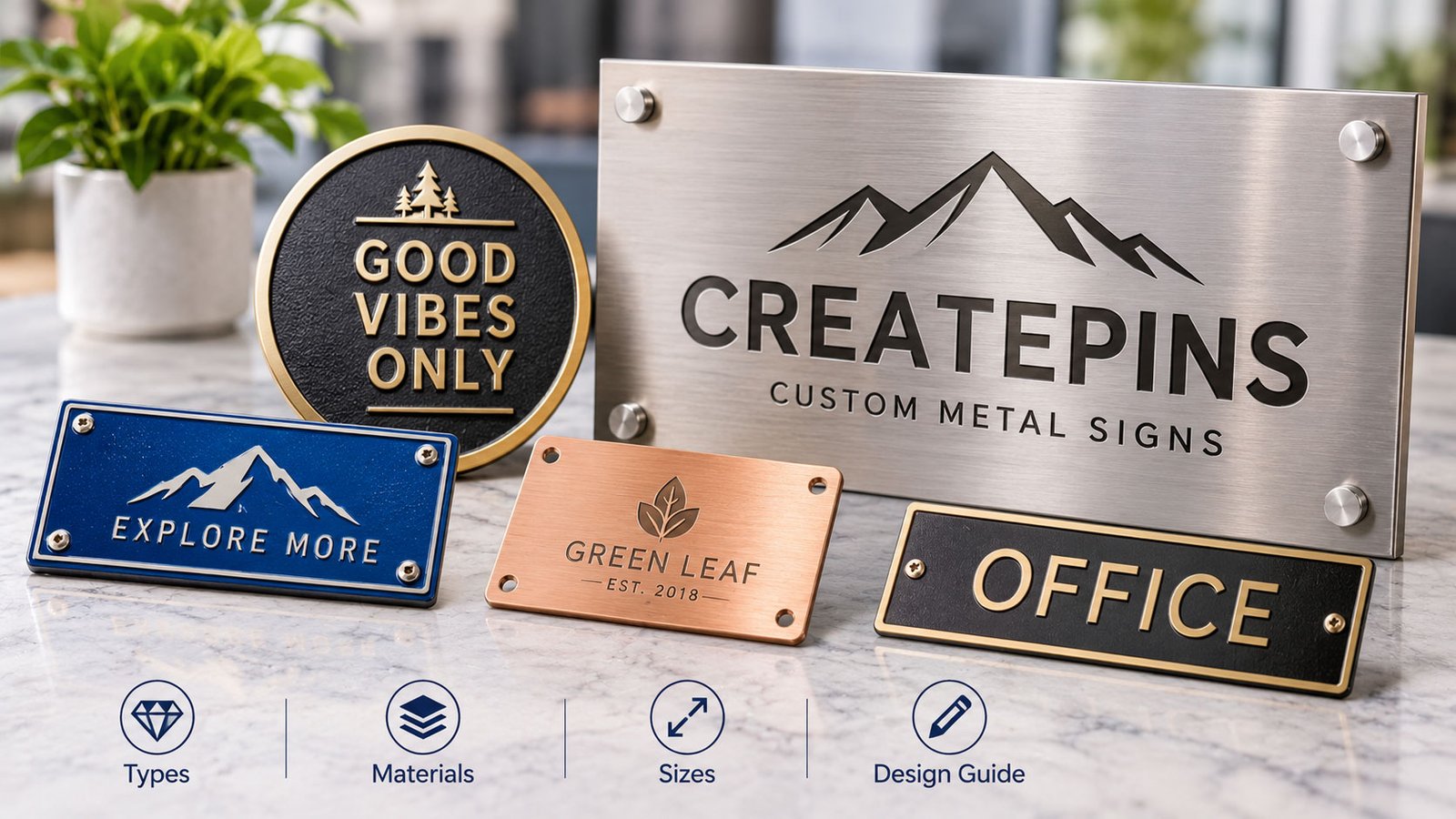
Custom metal signs show up everywhere: shopfronts, office doors, factory floors, hospital corridors, parks, car badges, and the front of a building that wants you to know it has been there since 1924. Compared with paper, acrylic or foam board, metal brings structural strength, a surface that reads as “permanent”, and a huge range of finish options.
But here’s the part that trips people up. Ordering a metal sign isn’t a two-step job of “pick a shape, print a logo”. The metal grade, the thickness, the way the artwork is applied, the edge treatment, how it hangs on the wall, and how much weather it will see all change the result — and the price — far more than the design does.
This guide covers the whole picture: the main types of custom metal signs, the metals themselves, realistic size ranges, manufacturing methods, where each one is actually used, the limits your artwork has to respect, and a checklist you can hand straight to a metal sign manufacturer when you ask for a quote. If you are new to this, read sections 1–4 and 9 first. Those three will get you 80% of the way to a sensible order.
1. What Are Custom Metal Signs?
Custom metal signs are identification, branding, informational or decorative signs made from metal sheet, plate or fabricated metal parts. The “custom” part covers essentially every variable a buyer cares about — and it helps to see them laid out, because each one is a decision you will be asked to make.
| Variable | Typical options | What it changes |
|---|---|---|
| Shape | Rectangle, square, circle, oval, irregular, logo cut-out | Cutting method, waste, price |
| Size | 25 mm labels up to 1.2 m+ building signs | Material cost, weight, mounting |
| Material | Aluminum, stainless steel, brass, copper, carbon steel | Corrosion resistance, weight, look |
| Thickness | 0.3 mm foil up to 5 mm plate | Rigidity, edge quality, price |
| Finish | Brushed, polished, matte, mirror, anodized, powder-coated | Durability, colour range, maintenance |
| Artwork | Printed, engraved, embossed, etched, cut-out, raised metal | Process choice, minimum detail |
| Mounting | Adhesive, screw holes, standoffs, brackets, studs, frames | Install time, wall type, safety |
The right combination depends on where the sign goes, how long it needs to last, what it has to look like, how many you need, and what you can spend. There’s rarely one correct answer — but there are plenty of combinations that quietly fail after eighteen months outdoors.
2. Common Types of Custom Metal Signs
Sign types split mainly by how the artwork gets onto the metal. Here’s the fast comparison, then a short section on each.
| Type | Best for | Watch out for |
|---|---|---|
| Printed | Full-colour logos, photos, gradients | Ink fading without a UV top coat |
| Engraved | Permanent text, serial numbers, nameplates | Tiny text fills in and becomes unreadable |
| Etched | Fine detail on stainless, brass, copper | Chemical handling limits material list |
| Embossed / debossed | Logos with tactile relief | Needs dies — costly at low quantities |
| Laser-cut | Lettering, outlines, openwork patterns | Thin bridges can snap; thickness cap |
| Cast | Sculpted 3D plaques, heritage look | Mould cost; long lead time |
| Stamped | High-volume repeat plates and tags | Tooling investment; distortion on deep forms |
2.1 Printed Metal Signs
Printed signs put graphics onto a prepared metal surface, and a printed metal sign is only as durable as the ink system plus whatever protective coat sits over it. The four methods you’ll be quoted for are UV printing, screen printing, digital printing, and dye sublimation on coated aluminum.
UV printing handles full-colour work well — gradients, photographs, small text, fine detail — and it’s what most short-run custom metal signage uses today. Screen printing wins when you have a handful of solid spot colours and a large repeat order, because the setup cost is amortised across the run. Sublimation only works on specially coated aluminum, but it bonds into the coating rather than sitting on top of it, which makes it surprisingly tough.
Typical uses: promotional displays, retail branding, office signage, decorative plaques, information boards. It’s also the fastest route to a full-colour metal sign, which is why most short-run retail work starts here.
2.2 Engraved Metal Signs
Engraved metal signs have lettering, numbers, logos or patterns cut into the surface — material removed, not added on top. The common techniques are CNC engraving, laser engraving, mechanical engraving and chemical etching, and each leaves a slightly different edge.
Engraved metal signs are the default for industrial equipment labels, office nameplates, door signs, asset tags, and anything that must stay legible for a decade. On brass and aluminum, the recessed areas can be filled with paint for contrast — which is how you get black text on a gold plate.
Where it struggles: very small text. Once strokes drop below roughly 0.3 mm, the cutter can’t separate them cleanly and letters start to merge. Deep engraving also adds machine time, which you pay for.
Related reading: how to keep small lettering readable — the same rules apply to engraved plates.
2.3 Etched Metal Signs
Etching removes metal chemically or electrochemically instead of mechanically. Because there’s no cutter touching the surface, it can hold finer detail than engraving and leaves the plate flat overall, with only shallow recesses.
It’s the classic choice for stainless steel, brass and copper — corporate plaques, architectural signage, memorial plaques, decorative panels, industrial ID plates. Etched areas fill with paint beautifully, so you get crisp two-tone contrast without any raised edge to catch on. Etched metal signs cost more than a plain printed metal sign, and they’re worth it when the detail has to survive twenty years of cleaning.
2.4 Embossed and Debossed Metal Signs
Embossed means raised; debossed means recessed. Both come from stamping, pressing or forming the sheet between tooled surfaces, so the relief is part of the metal itself rather than applied on top.
- Embossed suits brand logos, product ID plates, decorative signs, vintage-style advertising, premium packaging labels.
- Debossed suits equipment labels, industrial identification, decorative plaques and branding plates.
Either way you get a tactile surface that printed graphics can’t imitate — light moves across it. The trade-off is tooling: a die is specific to one design, so embossing only makes financial sense on repeat production.
2.5 Laser-Cut Metal Signs
Laser cutting slices the design straight out of the sheet, which makes it the natural fit for lettering, intricate outlines, decorative patterns and openwork. Nothing is printed; the shape is the design.
Common uses: building names and street numbers, exterior business signs, garden and landscape signs, wall art, metal logo displays, directional signage. Edges come off the machine clean and slightly darker, and many buyers leave them raw on purpose.
The catch is thickness. Maximum cut depth depends on material, laser power and the edge quality you’ll accept — very thick plate usually moves to waterjet or plasma cutting instead.
2.6 Cast Metal Signs
Casting pours molten metal into a mould and lets it solidify. Aluminum, brass and bronze are the usual suspects. It’s how you get genuine three-dimensional plaques: raised lettering, decorative borders, sculpted logos, deep relief.
You’ll see cast signs on historic buildings, hotels and resorts, memorials, government and institutional plaques, and premium architectural branding. They read as substantial and traditional in a way that flat plate never quite does.
The honest downside: a mould is a real cost, and it only pays off across a run. For a single sign, casting is usually the most expensive option on the list.
2.7 Stamped Metal Signs
Stamping presses sheet metal between dies to form raised or recessed detail. Aluminum, steel, brass and stainless steel all work. It’s fast, repeatable, and the tooling pays for itself quickly at volume.
Typical output: equipment ID plates, serial tags, automotive labels, industrial signs, repetitive branded plates. Deep or complicated forming can distort thin material, so designs are usually kept fairly shallow.
3. Common Materials Used for Custom Metal Signs
Material choice is the single decision that most affects how a sign looks in year five. Here’s the comparison first.
| Metal | Weight | Outdoor life | Typical thickness | Best for |
|---|---|---|---|---|
| Aluminum | Light | Very good | 0.5–3 mm | Outdoor signs, big panels |
| Stainless 304 | Heavy | Excellent | 0.5–3 mm | Lobbies, directories, industrial |
| Stainless 316 | Heavy | Excellent (coastal) | 0.5–3 mm | Sea air, chemical plants |
| Brass | Medium | Good, patinas | 0.3–2 mm | Nameplates, hotels, plaques |
| Copper | Medium | Good, patinas fast | 0.3–2 mm | Heritage, decorative |
| Carbon steel | Heavy | Poor unless coated | 0.8–5 mm | Structure, big painted signs |
3.1 Aluminum
Aluminum metal signs are the workhorse of the whole category. Aluminum is roughly a third the weight of steel, forms its own protective oxide layer, cuts and drills easily, and takes almost any finish you can think of: brushed, polished, anodized, powder-coated, painted or printed.
That combination makes aluminum metal signs the sensible default for building signs, retail displays, office directories, parking signs and equipment labels — especially anything large, because weight drives both shipping and mounting cost. If you’re mounting to drywall or a composite façade, aluminum is usually the only practical choice.
3.2 Stainless Steel
Stainless metal signs are the premium structural option: strong, corrosion-resistant, and visually clean. It’s used heavily in architectural and commercial signage where the sign has to look good for twenty years and take a knock or two.
The grade matters more than most buyers realise. 304 is standard for general indoor and outdoor use. 316 adds molybdenum and is the right call within about a kilometre of salt water, or anywhere chlorides are present — pool halls, food plants, coastal hotels. Using 304 on a beachfront sign is a common and expensive mistake: tea-staining appears within months.
Finishes run from mirror-polished (statement piece, shows every fingerprint) through brushed, satin and matte (forgiving, hides handling marks), to black-coated and etched.
3.3 Brass
Brass is a copper-zinc alloy with a warm golden tone, and it’s the traditional choice for anything that should feel established. Polished, brushed, antique, satin, oxidized and clear-coated versions are all available.
Brass metal signs are also one of the few sign types that look better as they age, which is either the whole point or a problem, depending on the brief. Uncoated brass develops a patina over time — if the original shine has to stay, specify a clear protective coat up front.
3.4 Copper
Copper has a distinctive reddish-brown colour and ages through a well-known sequence of browns to green. Designers choose it when the changing surface is part of the concept: building plaques, historic signage, restaurant fronts, decorative walls, architectural nameplates.
It can be polished, brushed, engraved, etched or chemically treated to speed up or freeze a particular tone. The one thing it won’t do is stay consistent — so it’s a poor choice when colour matching across multiple signs is critical.
3.5 Carbon Steel
Carbon steel is strong, versatile and cheaper than stainless. It welds, bends and machines easily, which makes it popular for large outdoor signs, industrial signage, architectural structures and heavy-duty mounting.
Its weakness is rust. Unprotected carbon steel will corrode, and fast in humid or coastal air. Powder coating, painting, galvanizing, electroplating or a clear coat are all viable — but the coating becomes part of the specification, not an optional extra. Any scratch that reaches bare metal is where corrosion starts.
3.6 Other Materials and Combinations
- Aluminum composite panel (ACP): two thin aluminum skins on a plastic core — flat, light, cheap at large sizes, but easy to dent and not repairable.
- Galvanized steel: zinc-coated carbon steel, a budget route to outdoor durability.
- Zinc: cast or machined decorative pieces with a soft grey finish.
- Bronze: premium architectural and memorial work; expensive and heavy.
- Titanium: niche, high-performance, distinctive colour response.
Metals are also frequently layered with acrylic, wood, glass or plastic to build depth — a brushed aluminum backplate with raised acrylic letters, for example. Layered construction looks expensive and often costs less than a thick cast plaque.
Beginner tip: don’t choose the thickest metal you can afford. Choose the thinnest that stays flat at your sign’s size, then spend the difference on a better finish. A 1.5 mm anodized aluminum panel looks better in three years than a 3 mm untreated one.
4. Common Metal Sign Sizes (and How to Choose Yours)
There’s no universal standard size for a metal sign. Size follows the installation location, the viewing distance, the information on the sign, and how much material you’re willing to pay for. That said, these are the dimensions that come up most often in quotes.
| Application | Common dimensions | Typical thickness |
|---|---|---|
| Small equipment labels | 25 × 50 mm, 50 × 75 mm | 0.5–0.8 mm |
| Product ID plates | 50 × 100 mm, 75 × 150 mm | 0.5–1 mm |
| Office nameplates | 200 × 50 mm, 250 × 75 mm | 0.8–1.5 mm |
| Door identification | 150 × 50 mm, 200 × 100 mm | 0.8–1.5 mm |
| Desk signs | 200 × 50 mm, 250 × 75 mm | 1–1.5 mm |
| Small decorative plaques | 150 × 150 mm, 200 × 200 mm | 1–2 mm |
| Building identification | 300 × 200 mm, 600 × 300 mm | 1.5–2 mm |
| Retail wall signs | 600 × 300 mm, 900 × 450 mm | 1.5–3 mm |
| Large outdoor signs | 1200 × 600 mm and up | 2–3 mm or framed |
Treat these as starting points for a quotation conversation, not fixed standards. Custom dimensions are normal — the constraint is sheet width and how flat the panel stays once it’s cut.
Four factors that actually decide the size
- Viewing distance A rough rule that works: allow about 25 mm of capital letter height for every 3 m of viewing distance. A sign read from 15 m needs letters around 125 mm tall, and a sign with 125 mm letters is rarely smaller than 600 mm wide. Reading that backwards is the fastest way to size a metal sign correctly.
- Installation space Measure the actual wall, door, panel or pillar before you finalise anything. Then subtract for door swing, light fittings and anything that will grow in front of it.
- Information density A logo plus a company name fits comfortably on 300 × 200 mm. Add opening hours, a phone number and a suite number and you need roughly triple the area — or a second sign.
- Mounting and structure Screw holes, standoffs and brackets need clear space at the edges. On a large panel, the frame or sub-structure often dictates the final size more than the design does.
Cost note: some sizes are noticeably cheaper because they nest efficiently on a standard 1220 × 2440 mm sheet. If your quote feels high, ask whether adjusting the size by 20–30 mm reduces waste. It often does.
5. Metal Sign Manufacturing Processes
Most metal signs involve several processes, not one. A typical engraved nameplate is cut, deburred, engraved, paint-filled, cleaned, and clear-coated — five steps. Knowing them helps you understand where cost and lead time come from.
- Laser cutting
- Focused beam cuts the outline. Best accuracy for complex shapes and small lettering. Detail limit depends on thickness and machine power.
- CNC machining
- Rotating tools remove material — grooves, recesses, relief lettering. The usual route when a metal sign needs dimensional depth rather than surface marking.
- Die stamping
- Press and tooling form or cut the sheet. Fast and consistent at volume, but the die is design-specific.
- Chemical etching
- Selective removal by etchant. Holds the finest detail and leaves a flat surface; common on stainless, brass and copper.
- Casting
- Molten metal into a mould. The only practical way to get deep sculpted relief.
- Printing
- UV, screen or sublimation onto a prepared surface. Colour capability depends entirely on the ink and top coat.
Whichever route you take, a metal sign is rarely a single-step product. The handoffs between steps are where most delays and most quality problems happen, so it’s worth asking which steps are done in house.
Surface finishing
After cutting, forming, engraving or printing, most signs go through finishing. This stage is where a cheap sign and a good sign usually diverge.
- Deburring and edge polishing
- Brushing or graining
- Sandblasting
- Anodizing
- Powder coating
- Painting and paint-filling
- Electroplating
- Clear protective coating
- Protective film application
- Edge sealing for outdoor use
Finishing affects appearance, corrosion resistance and long-term performance — which is why two quotes for the “same” sign can differ by 40%. Ask what finishing steps are included. If the answer is vague, the cheap quote is probably skipping two of them.
The general principles here are the same across metal manufacturing — CNC and digital production explained covers the technology side in more depth.
6. Where Custom Metal Signs Are Used
Six categories cover most custom metal signage orders. If your project doesn’t obviously fit one, it’s usually a hybrid — a printed aluminum sign in a stainless frame, for instance.
6.1 Business and corporate signage
Logos, reception signs, office identification, corporate plaques, conference room signs, building entrances. Brushed stainless, anodized aluminum and polished brass dominate here because they photograph well and age gracefully.
6.2 Retail and commercial
Storefronts, logo plaques, department signage, price and product plates, promotional displays, cafés and restaurants. Printed aluminum and laser-cut metal are the usual picks — printed for colour, laser-cut for silhouette and shadow.
6.3 Industrial and equipment labels
Machine ID plates, serial numbers, electrical labels, warning signs, asset tags, control panels. Stainless and anodized aluminum are preferred because they survive coolant, cleaning chemicals and vibration. If the label must outlive the machine, engraved metal signs are the safe answer.
6.4 Architectural and building
Building names, street numbers, room numbers, elevator signs, wayfinding, memorial plaques, property markers. This is the category where material and finish get specified by an architect — and where 316 stainless, bronze and cast aluminum appear most often.
6.5 Outdoor and public signage
Parking, traffic-related information, property markers, gardens, parks, public facilities. Material selection has to account for UV, rain, humidity, temperature swings, salt and vandalism. For regulated traffic and safety signs, local standards, reflectivity requirements and approved substrates apply on top of everything in this guide — check those before you design.
6.6 Promotional and decorative
Vintage-style advertising, metal wall art, branded plaques, event signage, commemorative pieces, limited editions. Printed, embossed, engraved and laser-cut metal all work; the choice is stylistic. If you’re producing merchandise alongside pins or keychains, the same artwork rules apply — see our guide to custom metal emblems for the manufacturing side.
7. Production Limitations to Know Before You Design
Metal signs are flexible, but they’re not infinitely flexible. Every one of these limits has caused a reprint or a redesign for somebody. Checking them before artwork approval is the cheapest quality control available.
7.1 Material thickness
| Material | Common sheet thickness | Notes |
|---|---|---|
| Aluminum | 0.5–3 mm | Below 1 mm needs a frame at large sizes |
| Stainless steel | 0.5–3 mm | Heavy fast — check mounting early |
| Brass | 0.3–2 mm | Soft; dents on thin sheet |
| Copper | 0.3–2 mm | Soft, scratches easily in production |
| Carbon steel | 0.8–5 mm | Must be fully coated |
These are starting ranges, not production ceilings. A 50 mm equipment tag needs almost nothing structurally; a 1.2 m freestanding sign needs a frame, and no amount of extra sheet thickness replaces one.
7.2 Minimum line width and detail
Thin lines, tiny type and tightly packed detail are where artwork fails. What’s achievable depends on thickness, process, tool diameter, print resolution, finish and the tolerance you’ll accept. As a working rule:
- Engraved text: keep strokes at 0.3 mm or wider.
- Laser-cut details: keep bridges at least the sheet thickness, ideally 1.5×.
- Printed small text: 6 pt minimum for reliable readability.
- Etched detail: fine strokes are possible, but ask for the house minimum.
If your logo has a hairline flourish, expect a conversation. Engraved metal signs live or die on line weight, and so does anything laser-cut. It’s cheaper to simplify the artwork than to fix it later — the same problem shows up constantly in designs that can’t be manufactured.
7.3 Holes, cut-outs and internal corners
Mounting holes and decorative openings in a metal sign must suit the process. Tiny holes in thick plate are slow and often ragged; hole diameter also has to allow for the screw, washer and installation tolerance. Internal corners always carry a radius — a true 90° inside corner isn’t achievable with a round cutter.
7.4 Bending and forming
Folded edges, return flanges and three-dimensional shapes depend on thickness, bend radius and grain direction. Tight bends crack or distort, especially on harder tempers. If the sign folds, the manufacturer needs to review the design before production — not after.
7.5 Colour and finish behaviour
- Printing on brushed aluminum shows the grain through the ink, so colours look metallic.
- White ink under a colour improves opacity on dark or reflective metal.
- Screen printing suits solid spot colours, not photographic gradients.
- Anodizing limits you to a fixed dye palette.
- Mirror-polished surfaces reflect their surroundings, which can swallow a logo.
For brand-critical work, ask for a physical sample or a signed colour proof. Screen-to-metal colour never matches exactly; the question is whether the difference is acceptable. We wrote about this separately in why production colours drift from your mockup.
7.6 Outdoor durability
Metal is not automatically weatherproof. Evaluate corrosion resistance, UV exposure, moisture, temperature cycling, salt, coating quality and — often forgotten — the mounting hardware. Stainless fixings against aluminum can cause galvanic corrosion; a perfectly good sign fails at the screw holes instead.
7.7 Size and weight
Large stainless signs get heavy fast. Weight affects shipping, installation labour, wall reinforcement, hardware and safety. Above roughly 20 kg, plan for two installers and a structural check. Where possible, aluminum metal signs, ACP or a fabricated frame will solve the problem more cheaply than a thicker solid plate.
7.8 Tooling and minimum quantities
Stamping needs dies, casting needs moulds, embossing needs tooling, custom forming needs fixtures. Laser cutting, CNC engraving and digital printing generally don’t — which is why they’re the practical route for prototypes and short runs. There’s no universal MOQ: some shops take single pieces, others set minimums based on setup cost. Ask early, because it can quietly decide your process for you.
Tooling ownership is worth clarifying in writing: who owns the die after the order decides whether you can reorder elsewhere.
8. Custom Metal Sign Design Guide
A good sign balances how it looks, how it reads, whether it can be made, and whether it can be hung. These are the habits that separate a smooth order from three rounds of revisions.
8.1 Decide the process before you finish the artwork
Almost every metal sign design constraint follows from the process. Choose it first, then design to it — UV printing for full-colour graphics, laser engraving for permanent text and logos, chemical etching for fine recessed detail, laser cutting for outlines and openwork, stamping for repeat runs, casting for sculpted depth.
8.2 Keep text readable
- Use clear, legible typefaces; avoid ultra-thin weights.
- Increase letter spacing rather than reducing font size.
- Push contrast — light text on dark metal, or paint-filled recesses.
- Keep text at least 10% of the sign’s width away from the edges.
- For outdoor signs, judge letter height against viewing distance, not against the mockup.
8.3 Send vector artwork
Vector scales without losing resolution, which matters when a 90 mm mockup becomes a 900 mm metal sign. Preferred formats:
- AI (Illustrator, fonts outlined)
- EPS
- SVG
- PDF with live vector paths
- DXF / DWG for cutting files
- High-res PNG or TIFF for print-only
Convert fonts to outlines, or supply the font files if the supplier asks. Confused about which format is best? This breakdown of AI vs PSD vs PNG explains the trade-offs clearly.
8.4 Watch line weight and spacing
Thin strokes vanish during engraving, cutting and etching. For laser-cut work, check that every narrow bridge has enough material to survive handling. For engraved work, leave breathing room between strokes so a paint fill doesn’t bleed across. Ask the manufacturer for their minimum line width before you draw anything — it takes one email and saves a redraw.
8.5 Bleed, safe area and cut lines
If the print runs to the edge, you need bleed. A typical starting point for printed metal is 2–3 mm, but use the supplier’s own template — theirs is based on their finishing equipment. Keep critical text and logos inside the safe area, account for corner radii and hole positions, and keep separate layers for cutting paths versus printed artwork so nobody has to guess which line is which.
8.6 Design the mounting holes now
Holes added after artwork approval cost money and usually land in the wrong place. Specify the number of holes, diameter, positions, edge distance, countersunk or plain, and what fastener they’ll take. For standoff mounting, the hole spacing must match the standoff pattern exactly — a 2 mm error means redrilling on site.
8.7 Match the finish to the environment
| Location | Sensible finish |
|---|---|
| Modern office interior | Brushed stainless, matte anodized aluminum |
| Hotel or law office | Polished or satin brass, clear-coated |
| Coastal exterior | 316 stainless, or anodized aluminum with UV top coat |
| Industrial floor | Anodized aluminum, powder-coated steel |
| Garden or park | Powder-coated aluminum, weathered steel |
| Retail interior | Printed aluminum, powder coat in brand colour |
8.8 Think about installation before production
A sign can look perfect on screen and be impossible to hang. Before approving, confirm the wall or surface material, indoor or outdoor exposure, mounting method, weight limits, available space, and whether the fixings are supplied. On listed buildings or glass façades, that conversation needs to happen before the artwork is finalised, not after.
The five-minute pre-flight check: zoom your artwork to 100% at final size on screen. If the text is hard to read at real scale, it will be hard to read on the wall. This one habit catches more problems than any checklist.
9. What to Include When Requesting a Metal Sign Quote
The more complete the brief, the more accurate the price — and the fewer emails you’ll exchange. A good metal sign manufacturer will ask for all of this anyway, so sending it up front usually saves a week.
A useful custom metal sign quote should read like a spec sheet, not a single number. If you only get one figure with no material grade, thickness or finish listed, you can’t compare it to anything — including the next quote.
| Specification | What to tell them |
|---|---|
| Product type | Printed, engraved, etched, embossed, laser-cut, cast, stamped |
| Dimensions | Width × height, plus thickness; shape and corner radius |
| Material | Aluminum, 304/316 stainless, brass, copper, carbon steel — or “recommend one” |
| Surface finish | Brushed, polished, mirror, matte, anodized, powder-coated, plated, antique |
| Artwork | AI, EPS, SVG, vector PDF, DXF/DWG; fonts outlined |
| Colours | Number of colours, PMS references, background print needed? |
| Mounting | Adhesive, screw holes, countersunk, studs, standoffs, brackets |
| Application | Indoor, outdoor, industrial, coastal, decorative |
| Quantity | Total units, plus whether reorders are likely |
| Packaging | Individual protective, bulk, retail-ready, foam or film |
| Delivery | Destination, required date, shipping method |
| Budget | Target price, if you have one — it shapes the recommendation honestly |
If you don’t know the material or process, say so and describe the application instead. “Outdoor, near the sea, seen from 10 m, needs to last 10 years” is more useful than a guess at the grade. A good supplier will recommend from that.
If you want to see how detailed a well-built quote should be, our breakdown of what belongs in a custom quote maps the same line items.
10. What Drives the Cost of Custom Metal Signs
The cost of a custom metal sign is mostly material, machine time and finishing — in that order. Whether you’re ordering one plaque or two hundred tags, custom metal signage pricing follows the same few levers.
- Material and grade Brass, copper and 316 stainless cost more than aluminum and carbon steel. Thickness compounds it.
- Size and thickness More area means more material, more handling, more shipping weight.
- Process Printed signs are relatively economical; casting, deep engraving, custom stamping and complex forming are not.
- Design complexity Intricate cut-outs, small text, layers and 3D detail all add machine time.
- Finishing Polishing, plating, anodizing, powder coating and protective treatments are separate steps with separate costs.
- Quantity Setup and tooling spread across more units, so per-piece cost drops — sometimes sharply.
- Packaging and freight Heavy metal plus individual protection equals real money, especially on small orders.
Practical ways to reduce cost
- Use the thinnest metal that stays flat
- Simplify decorative detail
- Adjust size to standard sheet nesting
- Match process to quantity
- Batch multiple signs together
- Approve artwork before production starts
- Swap to a cheaper material with a similar look
- Choose a stocked finish over a custom colour
The hidden costs tend to be artwork revisions, rush freight and rejected samples — all avoidable with a slower, more careful start. More on that in custom manufacturing costs people forget to budget for.
11. How to Choose a Metal Sign Manufacturer
The supplier matters as much as the material. A shop that can cut but not finish will subcontract your order and add a week. A shop that can’t read artwork will manufacture exactly what you sent, mistakes included. Choosing a metal sign manufacturer is really a test of how clearly they explain constraints before money changes hands.
Ask these before you commit:
- Capability. Can they cut, engrave, print, form and finish in house? Which processes are subcontracted?
- Material range. Do they stock the grades and thicknesses you need, including 316 stainless if it’s a coastal job?
- Artwork review. Will someone flag a 0.2 mm line before it goes to production? This is the single best signal of a professional shop.
- Quality control. What’s inspected — dimensions, surface, colour, packaging — and against what tolerance?
- Samples. Can you get a prototype before committing to a full run? Always worth it on large or high-value projects.
- Lead time. Get a schedule that includes artwork approval, sampling, production, finishing and shipping, not just a single number.
- Communication. Do they explain limitations and alternatives, or just take the file?
A reliable manufacturer improves your design rather than accepting it. Ours does — and if you want a second opinion on the shortlist, how to compare manufacturers and 25 questions worth asking both apply directly to metal signage.
12. Looking After a Metal Sign After Installation
Nobody budgets for maintenance, and almost nobody needs to. A properly specified metal sign needs about ten minutes a year. But the wrong cleaning product can strip an anodized layer or dull a brushed grain in one go, so it’s worth knowing four basics.
Clean it the boring way
Warm water, a little mild soap, a soft cloth, then dry with a microfibre towel. That’s it. On brushed metal, wipe along the grain rather than across it, or you’ll leave visible cross-marks in raking light.
Things to keep away from a metal sign
- Abrasive pads and scouring cream
- Bleach and chlorine-based sprays
- Acidic descalers or vinegar soaks
- Solvent thinners on printed surfaces
- Pressure washers at close range
- Steel wool — it leaves iron particles that rust
A five-minute annual check
Wash the sign, then look at the fixings rather than the face. Loose screws, corroded washers and blocked drainage cause more metal sign failures than the metal itself. Check edges for coating chips, touch in any bare spot with matching paint, and confirm the sign still sits flat — a panel that’s started to bow is telling you the mounting is undersized.
When to go back to the manufacturer
If a coated finish is blistering, if printed colour has shifted unevenly, or if corrosion has appeared on 316 stainless, that’s a specification or process issue rather than wear. Raise it with your metal sign manufacturer early, with photos and the installation date. Most problems are far easier to diagnose in the first year than the fifth.
13. Quick Glossary
Sixteen terms you’ll hear on a metal sign quote, in plain language.
- Anodizing
- An electrochemical finish that grows an oxide layer into the aluminum. Hard-wearing, dyeable, won’t chip like paint.
- Bleed
- Extra artwork beyond the cut line so printing can run to the edge without a white sliver.
- Deburring
- Removing the sharp burr left by cutting so edges are safe to handle.
- Debossed
- Design pressed into the surface, recessed below the face.
- Embossed
- Design raised above the surface.
- Etching
- Chemical removal of metal to create shallow, fine recesses.
- Engraving
- Mechanical or laser removal of material for deeper, sharper recesses.
- Grain
- The directional texture left by brushing; affects how light and ink sit on the metal.
- Patina
- The colour change brass, copper and bronze develop as they oxidise.
- PMS
- A standard ink colour reference used to specify and match brand colours.
- Powder coating
- Dry powder sprayed and baked into a hard, opaque film. Excellent for colour and protection.
- Return flange
- A folded edge that stiffens a panel or hides the mounting gap.
- Safe area
- The zone inside the trim where text and logos are guaranteed not to be cut off.
- Standoff
- A metal spacer that holds the sign off the wall for a floating look.
- Sublimation
- Heat transfers dye into a coated surface rather than laying ink on top of it.
- Tea-staining
- Brown surface discolouration on stainless from chloride exposure — the classic 304-versus-316 problem.
14. Frequently Asked Questions
What is the best metal for outdoor signs?
Aluminum metal signs and stainless steel signs are the two reliable answers, because both resist corrosion without needing a coating to survive. Aluminum is lighter and cheaper at large sizes; stainless is stronger and holds a premium look for longer. Within about a kilometre of the coast, specify 316 stainless rather than 304, and give aluminum an anodized or powder-coated finish if the colour has to hold.
Can custom metal signs be made in any shape?
Mostly, yes — circles, ovals, rectangles, irregular outlines and logo silhouettes are all routine. Laser cutting and waterjet handle custom outlines; the real limits are material thickness, machine capability and whether narrow sections stay strong enough to survive handling. If a shape has a very thin connecting bridge, expect to thicken it slightly.
Can metal signs have full-colour printing?
Yes. UV printing is the usual method for full colour, screen printing for large runs of solid spot colours, and sublimation on coated aluminum where the graphic needs to be part of the surface. Which one suits you depends on the artwork, quantity, substrate and how much UV exposure the sign will see. A UV-resistant top coat is worth specifying for anything outdoors.
What is the difference between engraved and etched metal signs?
Engraving removes metal mechanically or with a laser, producing a deeper, sharper recess. Etching removes it chemically, producing a shallower but finer recess across a flat surface. Both look permanent and both can be paint-filled. Practically: choose etching for very fine detail on stainless, brass or copper, and engraving when you need depth, speed or a wider material choice.
Are metal signs waterproof?
Metal itself doesn’t degrade in water the way paper or untreated wood does, but that’s not the whole story. Corrosion depends on the alloy and environment, printed graphics depend on the ink and top coat, and the fixings can fail before the sign does. A well-specified aluminum or stainless sign with quality finishing handles rain and humidity easily. Bare carbon steel does not.
Can metal signs be made with adhesive backing?
Yes, and it’s common on small and medium plates. Match the adhesive to the sign’s weight, the surface (glass, painted drywall, metal, brick), the temperature range and whether it’s indoors or out. Above roughly 500 g, or on any textured or damp surface, mechanical fixing is the safer choice — adhesive failures usually happen months later, in public.
What file format should I provide for custom metal signs?
Vector files: AI, EPS, SVG, or a PDF with live vector paths. For cutting and CNC work, DXF or DWG. For print-only graphics, a high-resolution PNG or TIFF at final size works. Outline your fonts or send the font files, and keep cutting paths on a separate layer from printed artwork.
What is the minimum order quantity for custom metal signs?
It depends on the process, not the product. Digital printing, laser cutting and CNC engraving usually accept single pieces. Die stamping, casting and embossing need tooling, so they only make economic sense at higher quantities — often 50 to several hundred. Always ask before you design around a process you can’t afford at your volume.
How long does custom metal sign production take?
A straightforward printed or laser-cut sign is typically a matter of days once artwork is approved. Cast or custom-stamped work with new tooling can run several weeks. Always ask for a schedule that separates artwork approval, sampling, production, finishing and shipping — a single quoted number hides where the time actually goes.
Can I order a sample before mass production?
Many manufacturers will produce a prototype or production sample first, and it’s worth doing whenever the project involves custom colour, an unusual finish, a large format or specialised mounting. Approve the physical sample, not the screen mockup — that’s the only reliable check on colour, edge quality and weight. Our sample approval walkthrough covers what to inspect.
Do engraved metal signs work for very small text?
Up to a point. Below roughly 0.3 mm stroke width, cutters and lasers can’t separate the strokes cleanly and letters start to fill in — especially after a paint fill. For small engraved metal signs, use a simpler typeface, increase spacing, and keep the amount of text down. If the text is genuinely tiny, etching usually holds detail better than engraving.
How do I clean and maintain a metal sign?
Warm water with a little mild soap, a soft cloth, then dry. Avoid abrasive pads, bleach and acidic cleaners — they dull brushed grain and can attack anodized or clear-coated surfaces. For brushed stainless, wipe along the grain, never across it. Outdoors, an annual wash removes the airborne deposits that start corrosion, and it’s the cheapest maintenance you’ll ever do.
Final Thoughts
Custom metal signs earn their keep because they last. That’s also why getting them wrong is expensive: you live with the result for a decade. The good news is that almost every failure is predictable in advance — wrong grade for the environment, detail too fine for the process, mounting decided after the artwork, colour approved from a screen.
Before you start, write down five things: where the sign goes, how far away people read it, how long it must last, what it should look like, and roughly how many you need. Those five answers narrow the material, the process, the finish and the budget almost automatically.
Then work with a manufacturer who reads your artwork properly and tells you what won’t work. That conversation is worth more than any specification sheet — and it’s the difference between custom metal signage that looks considered and signage that looks ordered.